Letter Requesting Motion To Vacate Order Of Default Without Notice In Virginia
Description

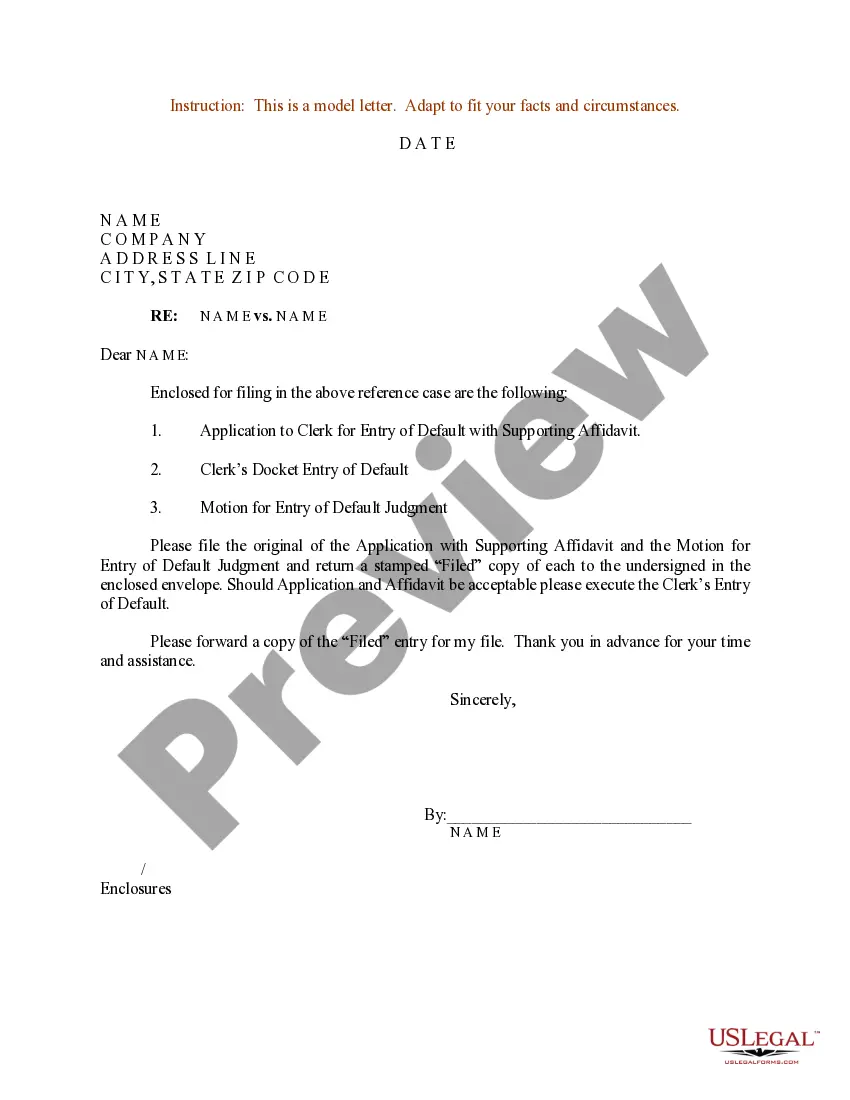
Get your form ready online
Our built-in tools help you complete, sign, share, and store your documents in one place.
Make edits, fill in missing information, and update formatting in US Legal Forms—just like you would in MS Word.
Download a copy, print it, send it by email, or mail it via USPS—whatever works best for your next step.
Sign and collect signatures with our SignNow integration. Send to multiple recipients, set reminders, and more. Go Premium to unlock E-Sign.
If this form requires notarization, complete it online through a secure video call—no need to meet a notary in person or wait for an appointment.
We protect your documents and personal data by following strict security and privacy standards.

Make edits, fill in missing information, and update formatting in US Legal Forms—just like you would in MS Word.

Download a copy, print it, send it by email, or mail it via USPS—whatever works best for your next step.

Sign and collect signatures with our SignNow integration. Send to multiple recipients, set reminders, and more. Go Premium to unlock E-Sign.

If this form requires notarization, complete it online through a secure video call—no need to meet a notary in person or wait for an appointment.

We protect your documents and personal data by following strict security and privacy standards.
Looking for another form?









Form popularity
FAQ
Once the judgment is set aside, the case starts up again. If you do not file an answer with the court to defend against plaintiff's complaint, you could again be defaulted and another default judgment could be entered against you.
If a Default Judgment Is Entered, Act Fast If a default judgment has been entered against you, you must act quickly to open the judgment, generally within ten (10) days of its entry, or establish a defect on the face of the record to warrant a Court striking the judgment.
Upon motion of the plaintiff or judgment debtor and after reasonable notice to the opposite party, his attorney of record or other agent, the court may set aside a judgment by default or a decree pro confesso upon the following grounds: (i) fraud on the court, (ii) a void judgment, (iii) on proof of an and ...
Orders of default judgment (aka judgment in default) are obtained in two different ways: by using an administrative process – a Request - judgment is entered by a court officer; or. by filing an application for Judgment in Default, with a Form N244 Application Notice.
In one responsive pleading, the respondent may move to dismiss on any appropriate ground, including the failure to state facts upon which relief should be granted, and, in the alternative, may set forth grounds of defense as in an action at law.
If you do not think the default judgment was appropriately entered against you, you must file a motion with the court asking the judge to “set aside” (void or nullify) the judgment. If the judge grants your motion, the case starts back up again.
When a court renders a decision of another court to be invalid, that verdict or decision is set aside; see also annul or vacate. The phrase is often used in the context of appeals, when an appellate court invalidates the judgment of a lower court. For example, in Eckenrode v.
Depending on whether your pleading was verified, or not, this can be as quick as a few days in cases where the clerk can enter default, or as long as a few weeks in the event a hearing is necessary in order to secure a default judgment.
Can a default judgment affect my credit score or ability to obtain future financing? Yes, a default judgment may negatively affect your credit score, and will be a lien on all of your real estate. Buying and selling real estate will be negatively affected by the entry of a default judgment.
