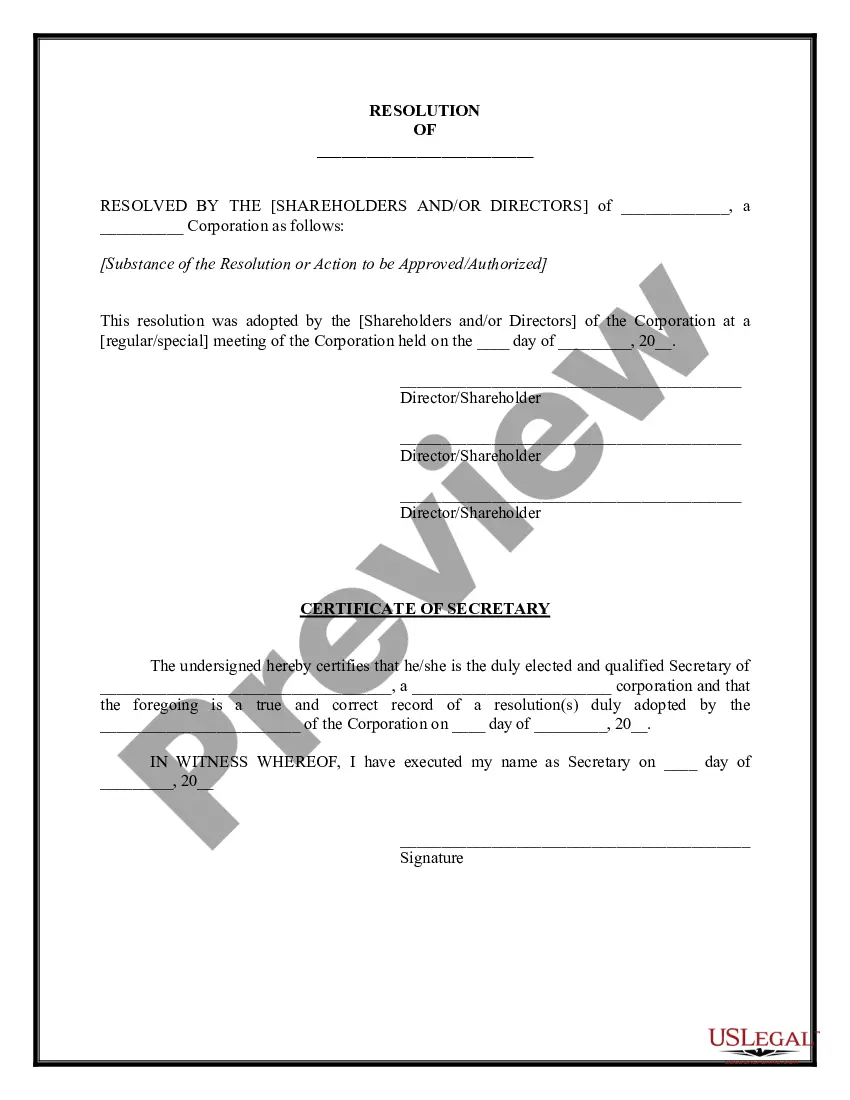
Board Meeting Resolution Example In Sacramento
Description




Get your form ready online
Our built-in tools help you complete, sign, share, and store your documents in one place.
Make edits, fill in missing information, and update formatting in US Legal Forms—just like you would in MS Word.
Download a copy, print it, send it by email, or mail it via USPS—whatever works best for your next step.
Sign and collect signatures with our SignNow integration. Send to multiple recipients, set reminders, and more. Go Premium to unlock E-Sign.
If this form requires notarization, complete it online through a secure video call—no need to meet a notary in person or wait for an appointment.
We protect your documents and personal data by following strict security and privacy standards.

Make edits, fill in missing information, and update formatting in US Legal Forms—just like you would in MS Word.

Download a copy, print it, send it by email, or mail it via USPS—whatever works best for your next step.

Sign and collect signatures with our SignNow integration. Send to multiple recipients, set reminders, and more. Go Premium to unlock E-Sign.

If this form requires notarization, complete it online through a secure video call—no need to meet a notary in person or wait for an appointment.

We protect your documents and personal data by following strict security and privacy standards.
Looking for another form?









Form popularity
FAQ
7 steps for writing a resolution Put the date and resolution number at the top. Give the resolution a title that relates to the decision. Use formal language. Continue writing out each critical statement. Wrap up the heart of the resolution in the last statement.
Use formal language to record the resolutions. You will write your board resolutions using “whereas” and “resolved” clauses. “Whereas” statements show the reason for the resolution while “resolved” clauses state the action that will be taken. Your “whereas” statement should lead the reader to the “resolved” clause.
The title of the resolution must appropriately reflect the intent. Resolutions begin with "Whereas" statements, which provides the basic facts and reasons for the resolution, and conclude with "Resolved" statements which, identifies the specific proposal for the requestor's course of action.
To write a board resolution, include: Title: Use the title to state that the document is a resolution clearly. Date: This should be the date the resolution is being proposed. Resolution Number: Give the resolution a unique identifier ing to your record-keeping system.
How to write a board resolution Put the date and resolution number at the top. Give the resolution a title that relates to the decision. Use formal language. Continue writing out each critical statement. Wrap up the heart of the resolution in the last statement.
A Board Resolution is only valid when: The meeting has been properly convened with prior intimation as per Company bylaws. The board properly holds the resolution and quorum is maintained. Duly certified and signed by the appointed chairperson.
How to fill out a resolution of the board of directors? Date, time, and location of the meeting. Title that describes the board's decision to be made. Statement of majority or unanimous decision. Resolution of the decision, including any necessary actions. Officers responsible for carrying out the resolution.
Resolutions must be proposed in the notice that is circulated prior to a board meeting or general meeting. Proposed members' resolutions must be also be issued to the auditors, if a company has any. If the proposed resolution is for the removal of a director, the director in question must receive a copy.
Under this act, Section 179 provides provisions and powers for the board of directors to pass board resolutions. In Section 179(3)(c), the Board of Directors can issue securities, which means they can issue new shares and debentures in the company by passing a board resolution.
A form of written resolutions of the directors of a company, for use where those directors wish to pass resolutions without holding a board meeting.