Board Directors Resolutions With Board Members In Kings
Description




Get your form ready online
Our built-in tools help you complete, sign, share, and store your documents in one place.
Make edits, fill in missing information, and update formatting in US Legal Forms—just like you would in MS Word.
Download a copy, print it, send it by email, or mail it via USPS—whatever works best for your next step.
Sign and collect signatures with our SignNow integration. Send to multiple recipients, set reminders, and more. Go Premium to unlock E-Sign.
If this form requires notarization, complete it online through a secure video call—no need to meet a notary in person or wait for an appointment.
We protect your documents and personal data by following strict security and privacy standards.

Make edits, fill in missing information, and update formatting in US Legal Forms—just like you would in MS Word.

Download a copy, print it, send it by email, or mail it via USPS—whatever works best for your next step.

Sign and collect signatures with our SignNow integration. Send to multiple recipients, set reminders, and more. Go Premium to unlock E-Sign.

If this form requires notarization, complete it online through a secure video call—no need to meet a notary in person or wait for an appointment.

We protect your documents and personal data by following strict security and privacy standards.
Looking for another form?







Form popularity
FAQ
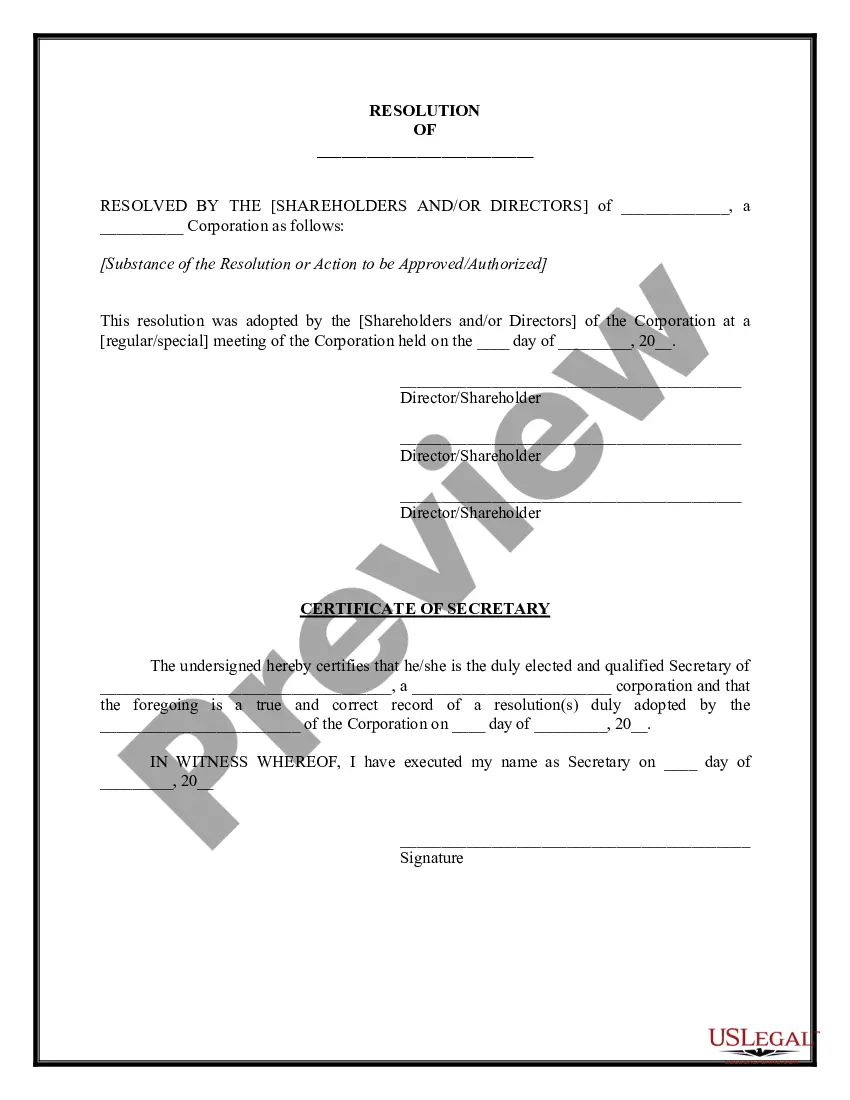
The board resolution is a formal document used to track details of an organization's specific decision including who voted, and their role. The board resolution is a legally binding record and is sometimes included in the board meeting minutes.
Written resolutions serve as a vital tool for directors when consensus is required without convening a formal meeting. The practice note delves into the statutory framework governing written resolutions, particularly under the Companies Act 2006.
There are three types of board resolutions, including: Ordinary Resolution: It requires just over 50% of directors to pass a decision. Special Resolution: It requires 75% of the directors' votes to be in favor of the resolution. Unanimous Resolution: All board members must agree to the resolution.
A board resolution is a formal, legally binding document that records the decisions made by a corporation's Board of Directors during a board meeting. This could be the decision to change the company's ownership structure, appoint new board members, sell company shares, or issue dividends.
Examples of board resolutions include appointing or removing a board member, amending the company's articles of association, or formal changes to board roles, contracts, and policies.
A Board resolution merely certifies and documents a particular decision taken by the Board of Directors of a company. All the relevant decisions made by the Board are documented by the passing of the resolution for the same.
Ordinary resolutions are passed for routine matters and require a simple majority vote for approval. Special resolutions are passed for more complex matters, and require three-fourth majority for approval. Ordinary resolutions are proposed by one of the board members, and discussions are held to decide upon it.
Directors' Resolution in Writing (DRIW) is a written document consisting of resolutions passed by the directors when a physical meeting is not held. It needs to be posted in the minute book of the company and maintained by the company secretary. It can either be a physical copy or an electronic version.
How to write a board resolution Put the date and resolution number at the top. Give the resolution a title that relates to the decision. Use formal language. Continue writing out each critical statement. Wrap up the heart of the resolution in the last statement.
Resolutions begin with "Whereas" statements, which provides the basic facts and reasons for the resolution, and conclude with "Resolved" statements which, identifies the specific proposal for the requestor's course of action.