Board Directors Resolution With Specimen Signature In Hennepin
Description




Get your form ready online
Our built-in tools help you complete, sign, share, and store your documents in one place.
Make edits, fill in missing information, and update formatting in US Legal Forms—just like you would in MS Word.
Download a copy, print it, send it by email, or mail it via USPS—whatever works best for your next step.
Sign and collect signatures with our SignNow integration. Send to multiple recipients, set reminders, and more. Go Premium to unlock E-Sign.
If this form requires notarization, complete it online through a secure video call—no need to meet a notary in person or wait for an appointment.
We protect your documents and personal data by following strict security and privacy standards.

Make edits, fill in missing information, and update formatting in US Legal Forms—just like you would in MS Word.

Download a copy, print it, send it by email, or mail it via USPS—whatever works best for your next step.

Sign and collect signatures with our SignNow integration. Send to multiple recipients, set reminders, and more. Go Premium to unlock E-Sign.

If this form requires notarization, complete it online through a secure video call—no need to meet a notary in person or wait for an appointment.

We protect your documents and personal data by following strict security and privacy standards.
Looking for another form?





Form popularity
FAQ
How to write a board resolution Put the date and resolution number at the top. Give the resolution a title that relates to the decision. Use formal language. Continue writing out each critical statement. Wrap up the heart of the resolution in the last statement.
A resolution is generally only signed by one director if a formal meeting does not take place – but that's rare. ing to , the resolution of the board of directors must be signed by all directors if the board meets formally to discuss the topics contained within minutes of the meeting.
Directors' written resolutions Again, the company's articles control this, but usually they can only be passed by unanimous agreement of all eligible directors. A director is 'eligible' if there is no conflict of interest for them in voting.
Once you have finalized your corporate resolution, the person who brought the decision to the board or whoever will be charged with enacting it must sign. This is generally a board member or a corporate secretary.
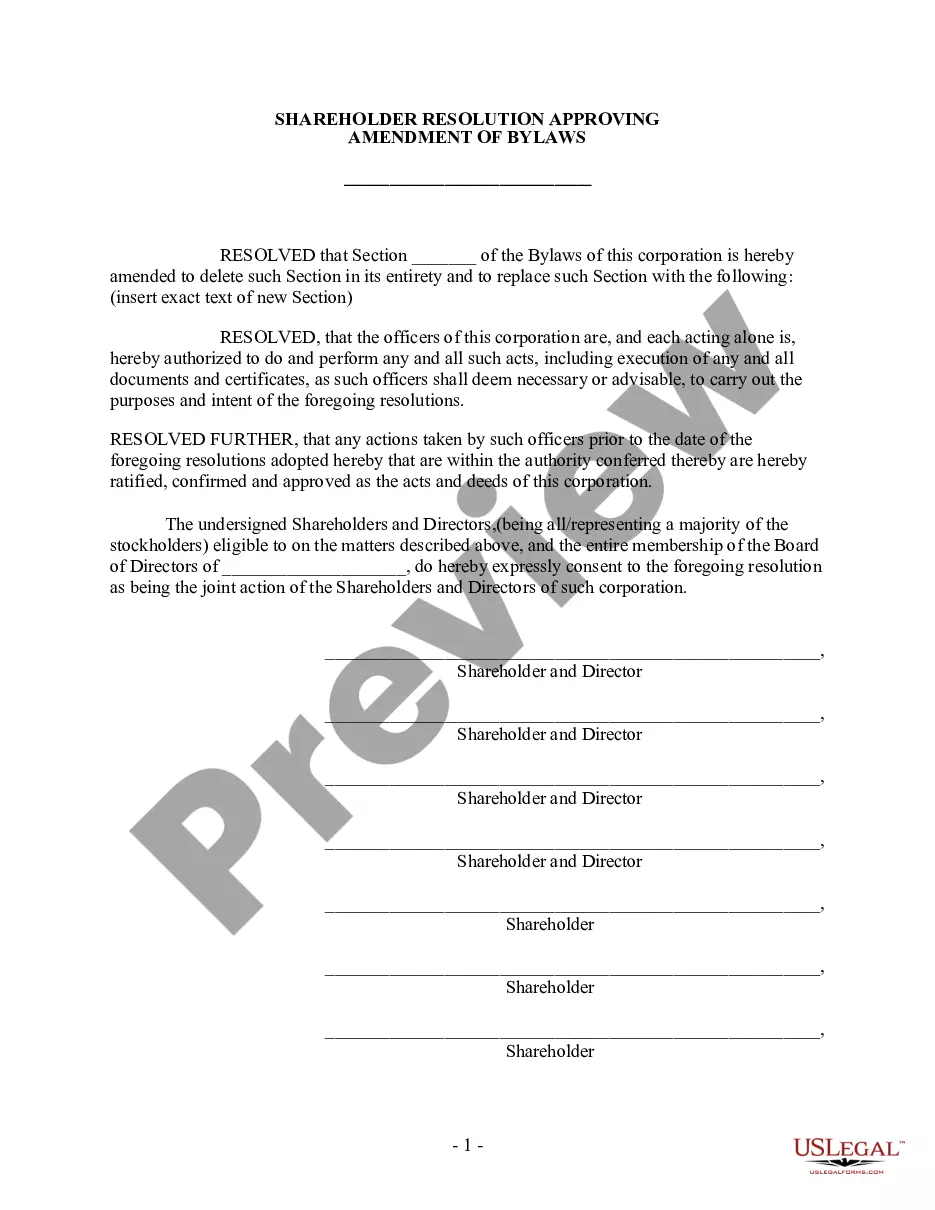
Board Resolution Granting Signing Authority BE IT RESOLVED, that the board of directors hereunder authorizes Authorized Individual's Name, Position, to sign, execute, and endorse on behalf of Company Name for all financial transactions, legal documents, and other official agreements.
When a board resolution is passed by a simple majority, it is called an ordinary resolution. Votes cast in favor are more than the ones against. A resolution with a majority of just over 50% of the quorum is considered passed. For example, 6 'yes' votes out of 10 are considered a majority.
The resolution is approved when the majority of the board members vote “yes.” Provide a section for the board president's signature. The resolution is not complete without the board president's signature and the date they signed it. Some boards provide room for all the board's officers to sign resolutions.
A resolution in writing signed by each director member will be effective as long as the constitutional documents do not preclude this approach, however we advise that the articles are drafted to expressly permit this type of decision-making.
Resolutions must be certified to be legal, meaning that the board secretary, assistant secretary or other designated person verifies the resolution and certifies it by having the board president sign the resolution.
A board resolution is subject to voting 'yes' or 'no'. This can be done by a show of hands, chits, or by electronic means.

