Sample Letter Payoff Mortgage Draft With First Pick In Houston
Description
Get your form ready online
Our built-in tools help you complete, sign, share, and store your documents in one place.
Make edits, fill in missing information, and update formatting in US Legal Forms—just like you would in MS Word.
Download a copy, print it, send it by email, or mail it via USPS—whatever works best for your next step.
Sign and collect signatures with our SignNow integration. Send to multiple recipients, set reminders, and more. Go Premium to unlock E-Sign.
If this form requires notarization, complete it online through a secure video call—no need to meet a notary in person or wait for an appointment.
We protect your documents and personal data by following strict security and privacy standards.

Make edits, fill in missing information, and update formatting in US Legal Forms—just like you would in MS Word.

Download a copy, print it, send it by email, or mail it via USPS—whatever works best for your next step.

Sign and collect signatures with our SignNow integration. Send to multiple recipients, set reminders, and more. Go Premium to unlock E-Sign.

If this form requires notarization, complete it online through a secure video call—no need to meet a notary in person or wait for an appointment.

We protect your documents and personal data by following strict security and privacy standards.
Looking for another form?










Form popularity
FAQ
Summary: A Letter of Intent (LOI) is a preliminary document indicating willingness to enter business deals and is often used in banking for loans.
A document that expresses an offer to lend with rates and terms. The letter of intent explains a simple process and contains basic conditions that a borrower can review to determine if the lending offer fits with the borrower's project parameters.
A letter of intent (also known as an LOI) is often written to initiate a business transaction and help define expectations with customers, partners, and vendors before creating a binding agreement. They also help with negotiating terms.
An LOI is a Formal Legal Document This offers significant protections to both parties. It forces each side to take the deal seriously, prevents wasted time and effort, and provides legal recourse if one party harms the other during the process of negotiations and closing.
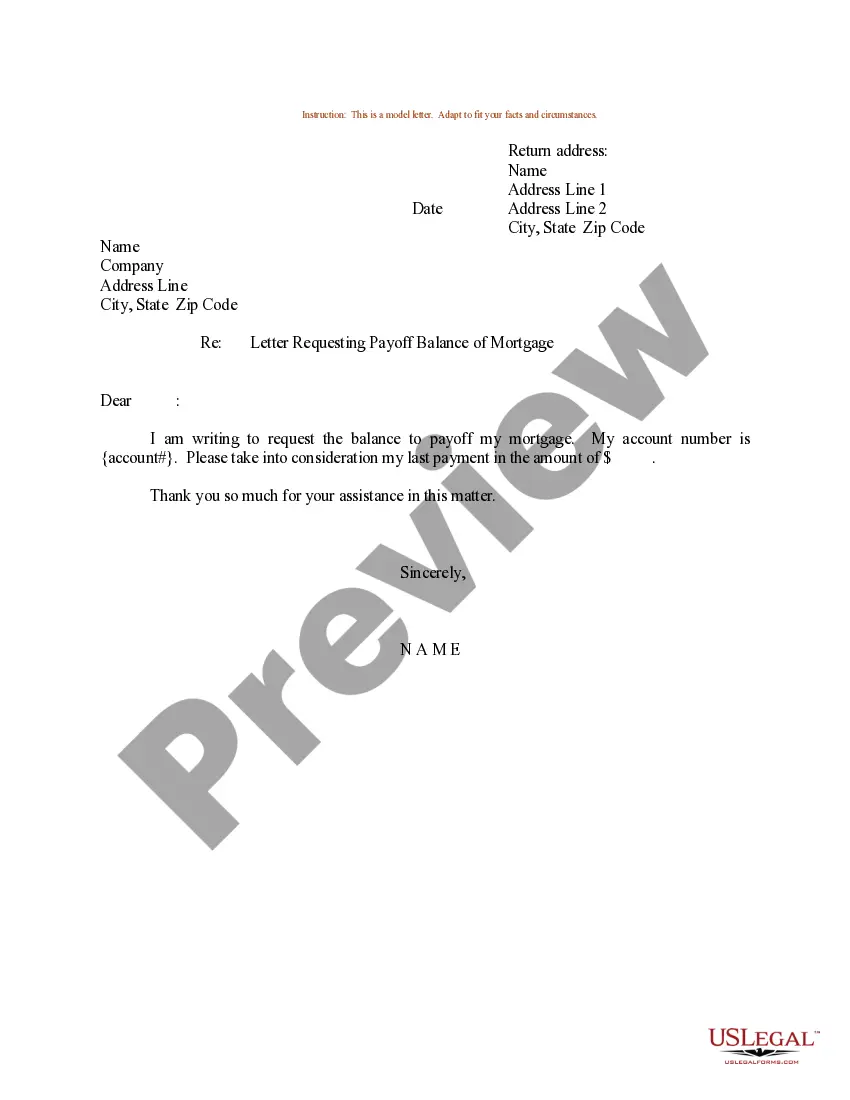
There's a process to getting the mortgage payoff statement. First, you'll need to contact your lender and let them know you want the information. Depending on your lender, you may have to sign in to an online account, call a helpline, or send a formal letter to start the request process.
There's a process to getting the mortgage payoff statement. First, you'll need to contact your lender and let them know you want the information. Depending on your lender, you may have to sign in to an online account, call a helpline, or send a formal letter to start the request process.
Under federal law, the servicer must generally send you a payoff statement within seven business days of your request, subject to a few exceptions. (12 C.F.R. § 1026.36.)

