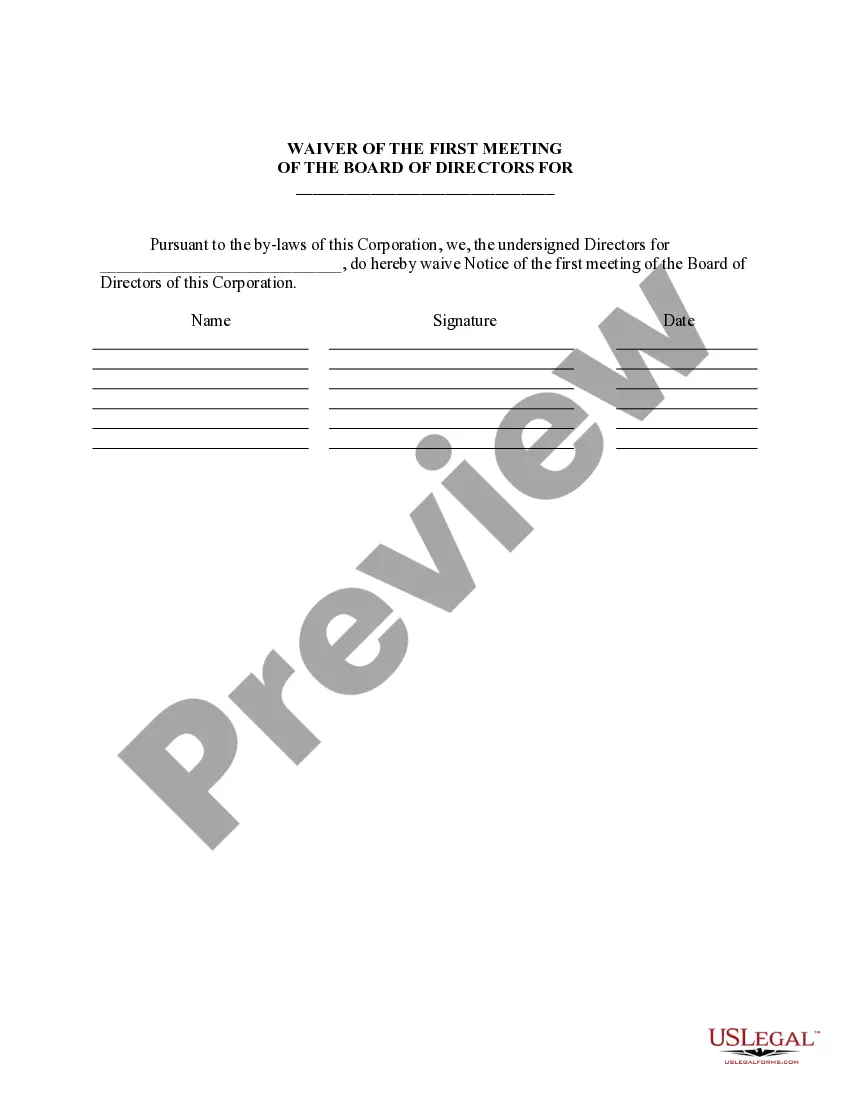
Board Directors Corporate Without Ceo In Virginia
Description


Get your form ready online
Our built-in tools help you complete, sign, share, and store your documents in one place.
Make edits, fill in missing information, and update formatting in US Legal Forms—just like you would in MS Word.
Download a copy, print it, send it by email, or mail it via USPS—whatever works best for your next step.
Sign and collect signatures with our SignNow integration. Send to multiple recipients, set reminders, and more. Go Premium to unlock E-Sign.
If this form requires notarization, complete it online through a secure video call—no need to meet a notary in person or wait for an appointment.
We protect your documents and personal data by following strict security and privacy standards.

Make edits, fill in missing information, and update formatting in US Legal Forms—just like you would in MS Word.

Download a copy, print it, send it by email, or mail it via USPS—whatever works best for your next step.

Sign and collect signatures with our SignNow integration. Send to multiple recipients, set reminders, and more. Go Premium to unlock E-Sign.

If this form requires notarization, complete it online through a secure video call—no need to meet a notary in person or wait for an appointment.

We protect your documents and personal data by following strict security and privacy standards.
Looking for another form?







Form popularity
FAQ
All corporations, regardless of the state, must have a shareholder-elected Board of Directors. An LLC is not required to have a Board of Directors, but can adopt this form of management if the members (the owners of the LLC) choose to do so.
In most large corporate entities, the CEO will report into a board of directors, however many entrepreneurs do call themselves a CEO without a BOD, so are they right to be a “chief” of other officers? This is an important point to highlight as many use the title of Founder/Owner and CEO interchangeably.
If your business is a corporation, then you are required by law to have a board of directors. Depending on your particular corporate structure and your state, one or two directors may be all that's legally required.
You will need at least one, but can have more than one. Directors make up the governing body of your nonprofit corporation and are stakeholders in your organization's purpose and success. You'll want to identify three, unrelated individuals to meet IRS requirements.
You might think that a board of directors is something that only big companies have, but all S corporations and C corporations—even small businesses—are legally required to have boards of directors.
Removal of directors. A. The members may remove one or more directors with or without cause, unless the articles of incorporation provide that directors may be removed only with cause.
§ 13.1-871. For purposes of subdivision A 1, a conflict of interests transaction is authorized, approved, or ratified if it receives the affirmative vote of a majority of the disinterested directors on the board of directors, or on the committee.
An S Corp, like a C Corp, must have a board of directors. Directors represent the company and make decisions on behalf of the shareholders. If your S Corp has more than three shareholders, you'll need to appoint at least three directors. S Corps with fewer than three shareholders must have a director per shareholder.
Federal and state-level laws, as well as a company's incorporation documents, require public and private corporations in the U.S. to have boards of directors (BoDs). Although private LLCs do not have the same requirements, some choose to elect a board of directors after incorporating.