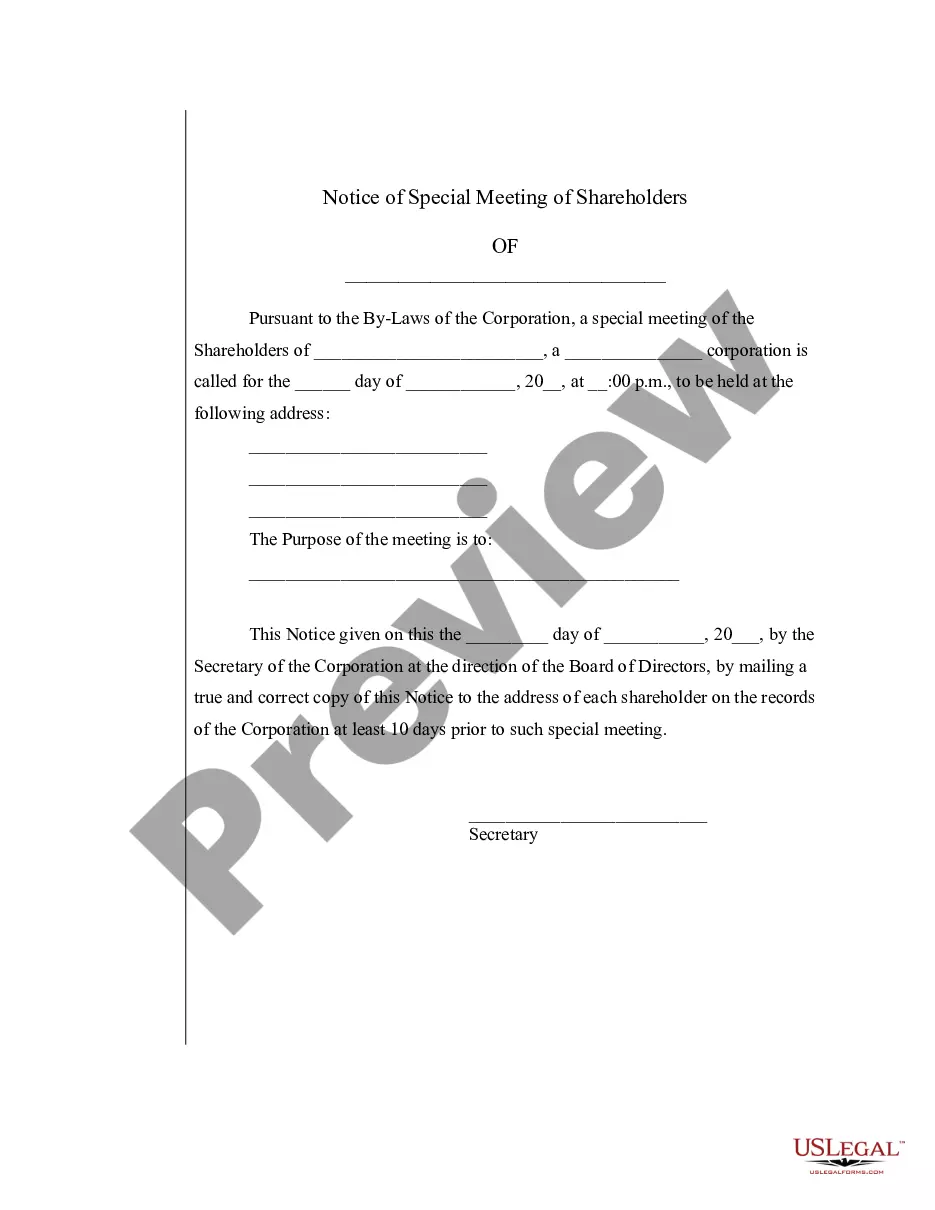
Special Meeting Sample With Board Members In Middlesex
Description



Get your form ready online
Our built-in tools help you complete, sign, share, and store your documents in one place.
Make edits, fill in missing information, and update formatting in US Legal Forms—just like you would in MS Word.
Download a copy, print it, send it by email, or mail it via USPS—whatever works best for your next step.
Sign and collect signatures with our SignNow integration. Send to multiple recipients, set reminders, and more. Go Premium to unlock E-Sign.
If this form requires notarization, complete it online through a secure video call—no need to meet a notary in person or wait for an appointment.
We protect your documents and personal data by following strict security and privacy standards.

Make edits, fill in missing information, and update formatting in US Legal Forms—just like you would in MS Word.

Download a copy, print it, send it by email, or mail it via USPS—whatever works best for your next step.

Sign and collect signatures with our SignNow integration. Send to multiple recipients, set reminders, and more. Go Premium to unlock E-Sign.

If this form requires notarization, complete it online through a secure video call—no need to meet a notary in person or wait for an appointment.

We protect your documents and personal data by following strict security and privacy standards.
Looking for another form?








Form popularity
FAQ
Occasionally, special meetings need to be called because of an urgent or special matter. ing to Robert's Rules of Order, special meetings always require previous notice. Here are a few valid reasons for calling a special meeting: An urgent matter needs to be dealt with before the next regular meeting.
The quorum is the minimum number of directors required to be present for the meeting to proceed and for its decisions to be valid. This requirement safeguards against decisions being made by an unrepresentative minority, thereby protecting the interests of the company and its stakeholders.
No. The General Assembly Hall and other Chambers are not open to the public and can only be viewed as part of a guided tour (meetings permitting).
Special board meetings may be called by the chair of the board, the president, any vice president, the secretary, or any two directors.
Unless the nonprofit is a governmental entity, there is no obligation to open board meetings to the public. (“Governmental entities” would include school boards, state educational organizations, such as a state university, and quasi-governmental groups such as public libraries.)
All Council and Council Committee meetings are open to the public, with the exception of "closed session" meeting items. Members of the public may comment on agenda items either at Council Committee meetings or Council meetings.
Yes, non-board members can often sit in on board meetings, depending on the organization's policies and state regulations. Many nonprofits encourage community members, donors, and volunteers to attend these meetings to foster transparency and collaboration.
There are a few ways to make board meetings more fun. One way is to introduce interactive activities that engage the team and encourage collaboration. For example, you could have members of the board participate in an icebreaker game or brainstorming session to get everyone's creative juices flowing.
Special Committee Meetings – Urgent meetings of the committee are called Special Committee Meetings and are usually called to deal with a dispute or grievance or other matters of urgency. Minutes from the committee meeting are not available to the members. General Meetings - General meetings are for all members.
Ing to Robert's Rules of Order, special meetings always require previous notice. Here are a few valid reasons for calling a special meeting: An urgent matter needs to be dealt with before the next regular meeting. There is a proposal to amend bylaws.
