Special Meeting Sample With No Experience In Maryland
Description



Get your form ready online
Our built-in tools help you complete, sign, share, and store your documents in one place.
Make edits, fill in missing information, and update formatting in US Legal Forms—just like you would in MS Word.
Download a copy, print it, send it by email, or mail it via USPS—whatever works best for your next step.
Sign and collect signatures with our SignNow integration. Send to multiple recipients, set reminders, and more. Go Premium to unlock E-Sign.
If this form requires notarization, complete it online through a secure video call—no need to meet a notary in person or wait for an appointment.
We protect your documents and personal data by following strict security and privacy standards.

Make edits, fill in missing information, and update formatting in US Legal Forms—just like you would in MS Word.

Download a copy, print it, send it by email, or mail it via USPS—whatever works best for your next step.

Sign and collect signatures with our SignNow integration. Send to multiple recipients, set reminders, and more. Go Premium to unlock E-Sign.

If this form requires notarization, complete it online through a secure video call—no need to meet a notary in person or wait for an appointment.

We protect your documents and personal data by following strict security and privacy standards.
Looking for another form?







Form popularity
FAQ
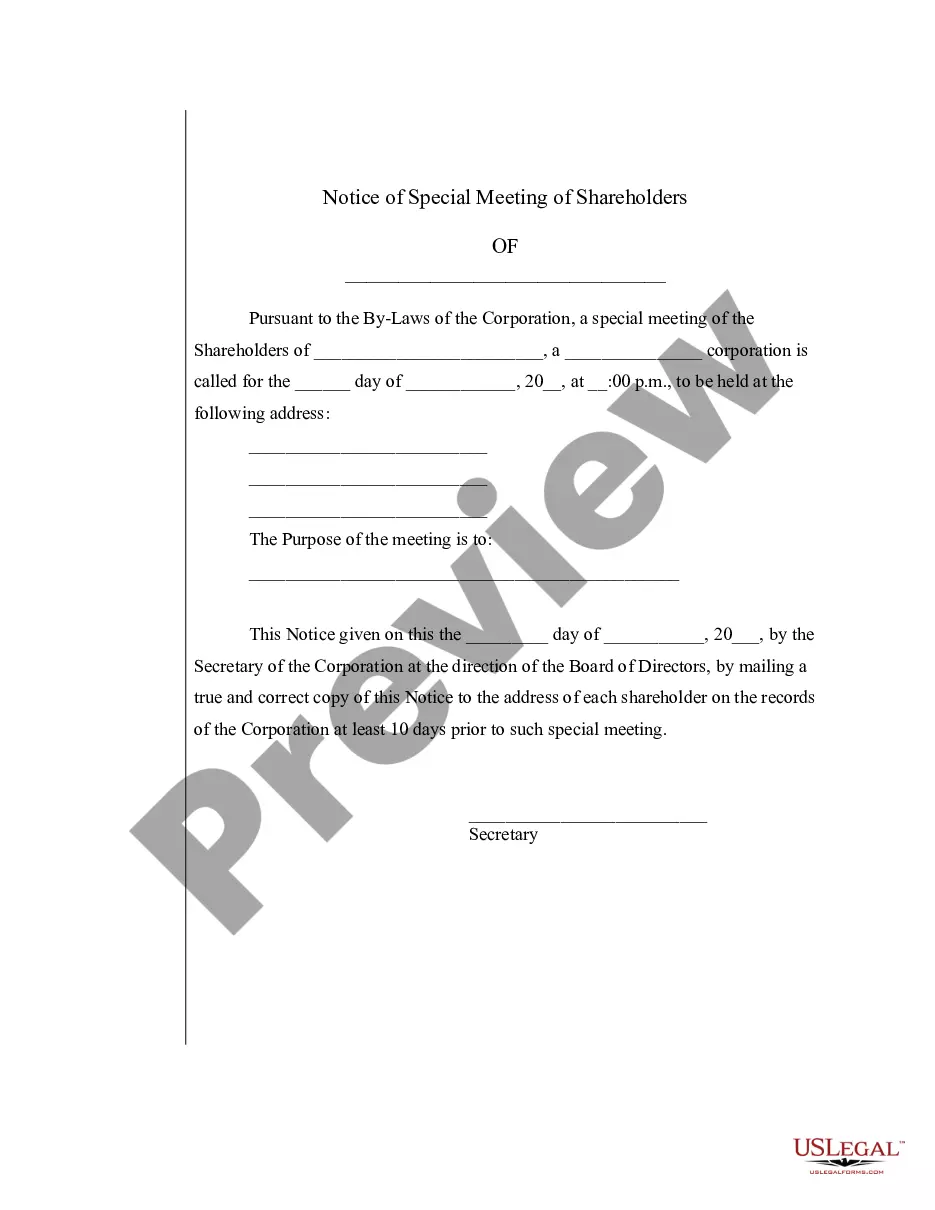
The notice for an annual meeting must state the time of the meeting, the place of the meeting, if any, and the means of remote communication, if any, by which stockholders and proxy holders may be deemed to be present and entitled to vote at the meeting. Quorum and Presence at the Meeting.
For example, a company may call a special meeting to discuss a major decision, such as a merger or acquisition. A school board may call a special meeting to address a specific issue, such as a budget shortfall.
Content of Notice A proper meeting notice should include: Date, Time, and Venue: Clear details on when and where the meeting will take place. Purpose of the Meeting: A brief description of the meeting's objectives. Agenda: An outline of topics to be discussed; this helps attendees prepare for the meeting.
Minutes should start with the attendance and continue through the motion to close the meeting (opening and closing of the meeting should have times attached.) Each topic that is discussed should have a brief paragraph summarizing what was discussed.
When the Open Meetings Act applies, what does it require the public body to do? The Act requires the public body to give “reasonable advance notice” of its meetings, to make an agenda available in advance except in cases of emergency, to hold its meetings openly, to adopt minutes, and to retain them for 5 years.
Conducting an HOA Meeting Start the meeting on time. Begin with a roll call to ensure all Board members are present. Discuss the items on the agenda in the order they are listed. Encourage all members to participate in the discussion. Stay on topic and avoid discussing items that are not on the agenda.
Annual shareholder meetings require a notice period of at least 21 days. The notice period can be shortened with the expressed consent of all shareholders. The notice should include all the basic meeting details and other important pieces of documentation, such as the meeting agenda.
An AGM (also known as an annual shareholder meeting) is a yearly meeting between shareholders and board members where they gather to: Discuss business matters. Review financial statements. Address resolutions.
At their core, meeting minutes should include several key elements: Details of the Meeting: Start with the basics - the date, time, and location of the meeting, as well as the type of meeting (regular, special, annual, etc.). This sets the stage for what follows. Attendees: List everyone present and note any absences.

