First Stockholders Sample For A Business
Description
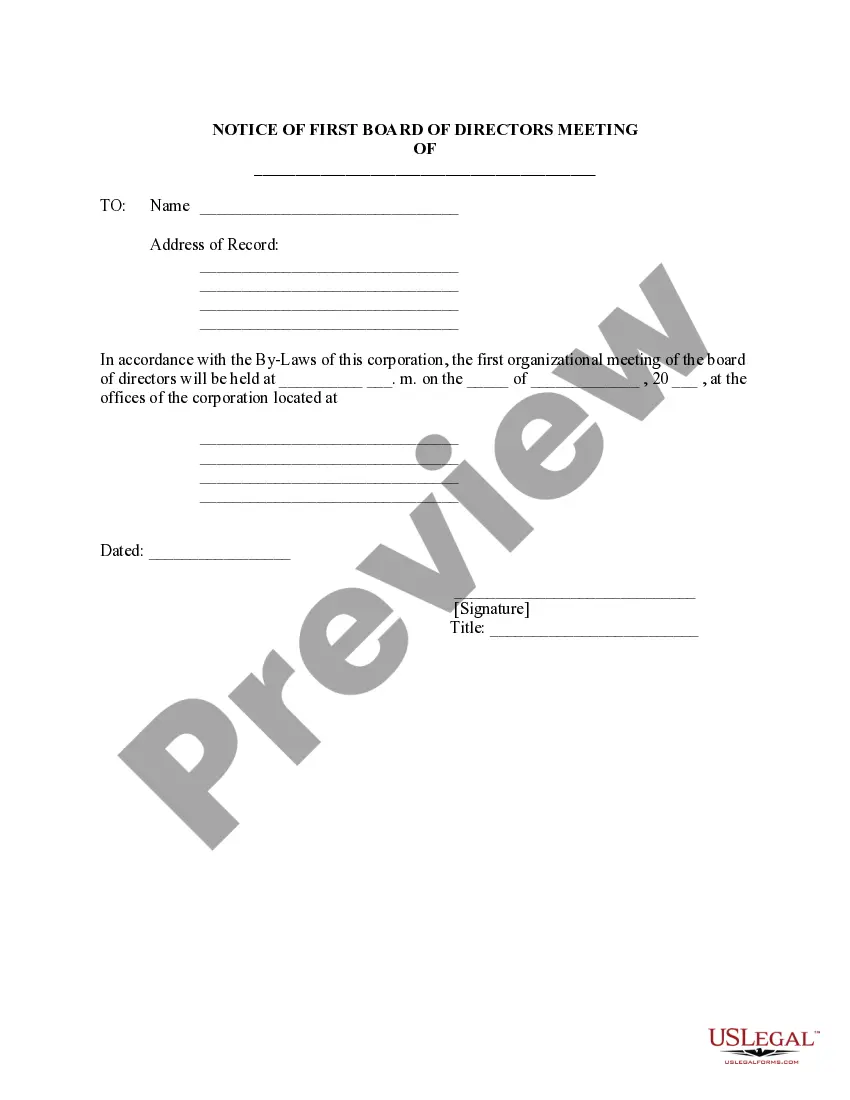



How to fill out Notice Of First Stockholders Meeting - Corporate Resolutions?
- Log in to your US Legal Forms account if you're a returning user. Ensure your subscription is active to access the forms. If it's expired, renew it according to your chosen payment plan.
- For first-time users, start by browsing the legal forms available. Use the Preview mode to check the details and ensure it meets your specific requirements.
- If the initial form doesn't match your needs, utilize the Search tab to find a more suitable template.
- Once you've found the correct form, click on the 'Buy Now' button. Select your preferred subscription plan and create an account to access the library.
- Complete your purchase by entering your credit card or PayPal information for the subscription.
- After your purchase, download the form and save it to your device. You can access it anytime via the 'My Forms' section in your profile.
By leveraging US Legal Forms, individuals and attorneys can swiftly complete necessary legal documents with confidence. The service not only offers a vast array of forms, but also provides expert assistance to guarantee that your documents are accurate and compliant.
Don’t wait any longer—start your legal documentation process today with US Legal Forms to ensure smooth business operations!
Form popularity
FAQ
Filling out owner's equity involves calculating the difference between total assets and total liabilities, followed by detailing any capital contributions and withdrawals by owners. This section gives a snapshot of the financial stake held by the owners in the business. Utilizing a first stockholders sample for a business can help ensure that you capture all necessary details accurately.
Initial shareholders are typically the founders of the company or early investors who contribute capital at the start. They play a critical role in establishing the business's foundation and often hold a significant percentage of shares. If you want to learn more, examining a first stockholders sample for a business can provide detailed insights into shareholder structure.
A stockholder is typically an individual or institution that owns shares in a company. For instance, if you own shares of a tech startup, you are considered a stockholder. Understanding the role of a stockholder is crucial, and reviewing a first stockholders sample for a business may enhance your comprehension.
To fill out stockholders' equity, gather your business's financial data, including assets and liabilities. Begin by calculating total equity through the formula: total assets minus total liabilities. Utilizing a first stockholders sample for a business can simplify this process and ensure accuracy in data presentation.
To calculate stockholders' equity, start by taking the total assets of the company and subtracting its total liabilities. This figure represents the net worth of the business and is essential for investors. For a clearer understanding, consider using a first stockholders sample for a business to provide a structured overview of equity calculation.
Examples of stockholders in business can range from individual investors to large institutions like pension funds. For instance, a company might have thousands of small stockholders as well as major shareholders like investment firms. To effectively utilize a first stockholders sample for a business, ensuring diverse representation of different types of stockholders is beneficial.
Shareholders are effectively the same as stockholders, as they own shares in a company. For example, if a woman named Sarah buys 100 shares of a biotechnology firm, she becomes a shareholder. When developing a first stockholders sample for a business, including various examples of shareholders reinforces the definition and implications of ownership.
An example of stockholders includes anyone who purchases shares of a company's stock, such as individual investors or venture capital firms. For instance, if a tech startup sells shares to raise funds, those who buy the shares become stockholders. In your first stockholders sample for a business, highlight examples like these to clarify the concept.
Stockholders are individuals or organizations that hold shares in a corporation, granting them ownership rights. This group can include private individuals, institutional investors, and mutual funds. When looking at the first stockholders sample for a business, consider documenting all stockholders to clearly define share ownership.
An initial shareholder is one of the first individuals or entities that owns shares in a company when it is formed. They are crucial to the company's foundation and can significantly impact its governance and direction. When drafting a first stockholders sample for a business, including initial shareholders ensures you acknowledge these foundational contributors.
