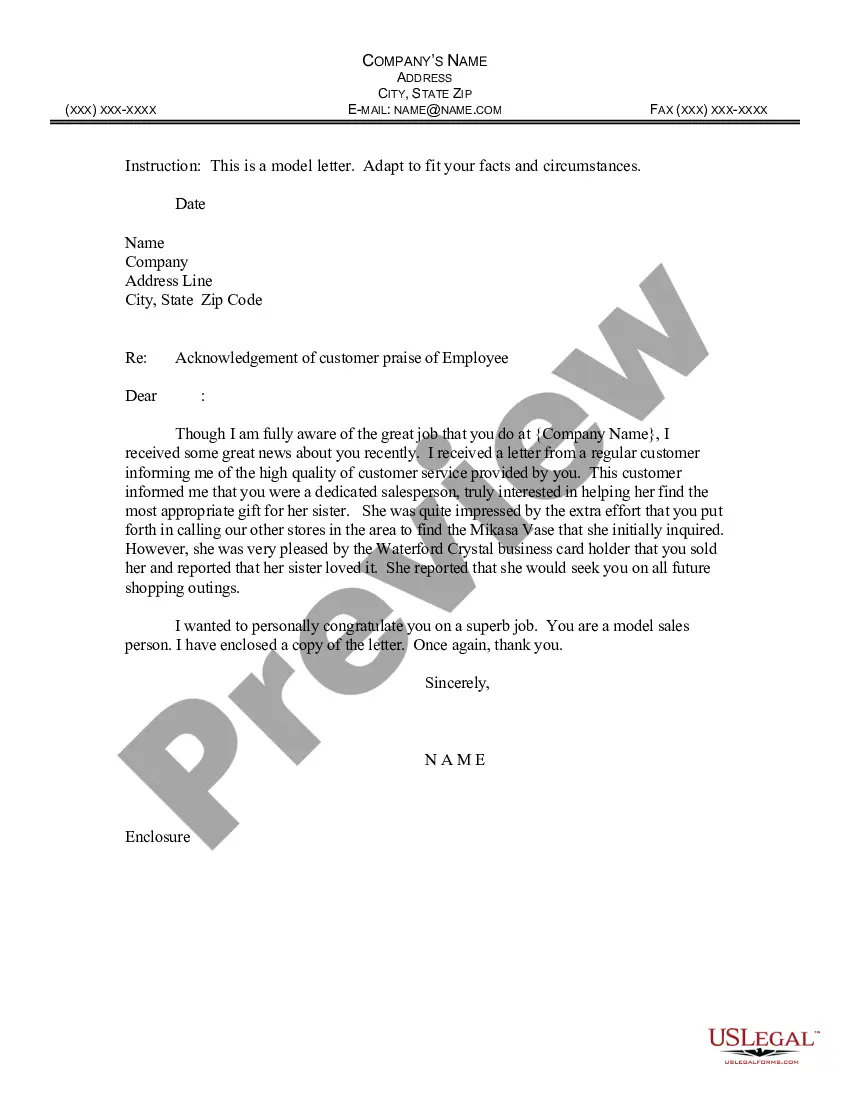
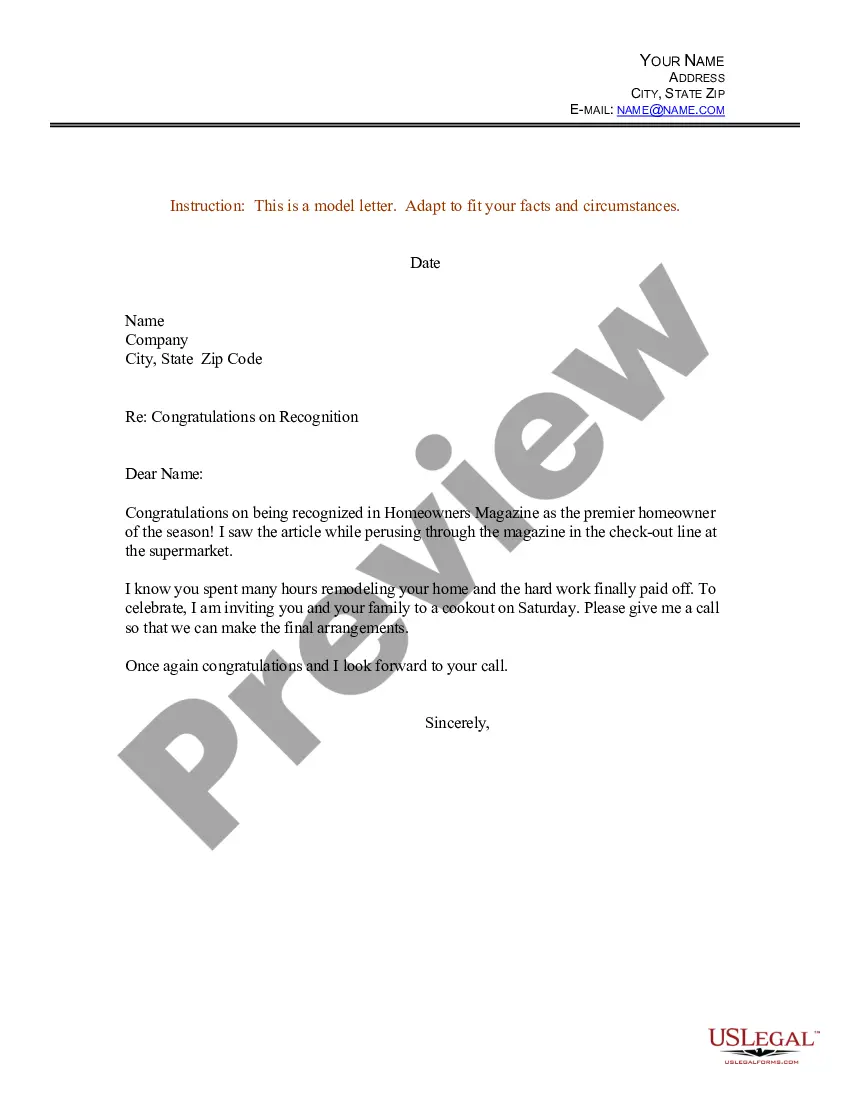
Employee Praise Letter Without Name In Ohio
Description

Get your form ready online
Our built-in tools help you complete, sign, share, and store your documents in one place.
Make edits, fill in missing information, and update formatting in US Legal Forms—just like you would in MS Word.
Download a copy, print it, send it by email, or mail it via USPS—whatever works best for your next step.
Sign and collect signatures with our SignNow integration. Send to multiple recipients, set reminders, and more. Go Premium to unlock E-Sign.
If this form requires notarization, complete it online through a secure video call—no need to meet a notary in person or wait for an appointment.
We protect your documents and personal data by following strict security and privacy standards.

Make edits, fill in missing information, and update formatting in US Legal Forms—just like you would in MS Word.

Download a copy, print it, send it by email, or mail it via USPS—whatever works best for your next step.

Sign and collect signatures with our SignNow integration. Send to multiple recipients, set reminders, and more. Go Premium to unlock E-Sign.

If this form requires notarization, complete it online through a secure video call—no need to meet a notary in person or wait for an appointment.

We protect your documents and personal data by following strict security and privacy standards.
Looking for another form?


Form popularity
FAQ
If you can't find the name of the hiring manager, you can use a polite and appropriate generic salutation, such as Dear Hiring Manager or Dear Recruiter. It is best to avoid salutations that are too vague, like To Whom It May Concern, or too informal, such as Hi or Hey.
If you cannot find the hiring manager's name after thorough research, address your cover letter to a specific department or team. Examples include “Dear Hiring Manager,” “Dear Department Team,” or “Dear Job Title Hiring Team.”
If you cannot find the name and title of the recipient, you can use a generic salutation instead. A generic salutation is a general way of addressing a person or a group of people, such as "Dear Sir or Madam", "To Whom It May Concern", or "Dear Hiring Manager".
If you don't know the name of the person who will receive your cover letter, you can use one of the following options: ``Hiring Manager'' -- This is a general title that is widely accepted. ``Recruiting Team'' -- This can be used if you want to address the entire recruitment team.
Here are nine key tips for writing an employee recognition letter: Choose the appropriate format. Personalize the message. Determine why you're writing the letter. Recognize specific achievements. Use active voice and positive vocabulary. Express your sincere appreciation. Share others' recognition.
If you can't find the name of the hiring manager after doing some research, you can use a generic salutation instead. Avoid using "To whom it may concern" or "Dear Sir/Madam" as they are outdated and too formal. Instead, use "Dear Hiring Manager", "Dear Recruiter", or "Dear Job Title Team".
If you can't find the name of the person to address your cover letter to, here are a few options you can consider: Use a Generic Greeting: ``Dear Hiring Manager,'' or ``Dear (Company Name) Team,'' are widely accepted and professional.
I want you to know that I value the amount of effort you have put into your work and see great potential in you. Once again, thank you for working so diligently and helping lead your team to success! I look forward to seeing your future achievements at our company.
Selected by the community from 1 contribution. 1 Identify the purpose. Before you start writing, you need to identify the purpose of your compliment letter. 2 Be specific and detailed. 3 Use positive and respectful language. 4 Add a personal touch. 5 Keep it concise and clear. 6 Here's what else to consider.
Dear Employee's Name, I want to express my gratitude for your unwavering support during project. Your willingness to go above and beyond to help the team and ensure its success has been truly remarkable. Your support is invaluable, and we couldn't have done it without you.