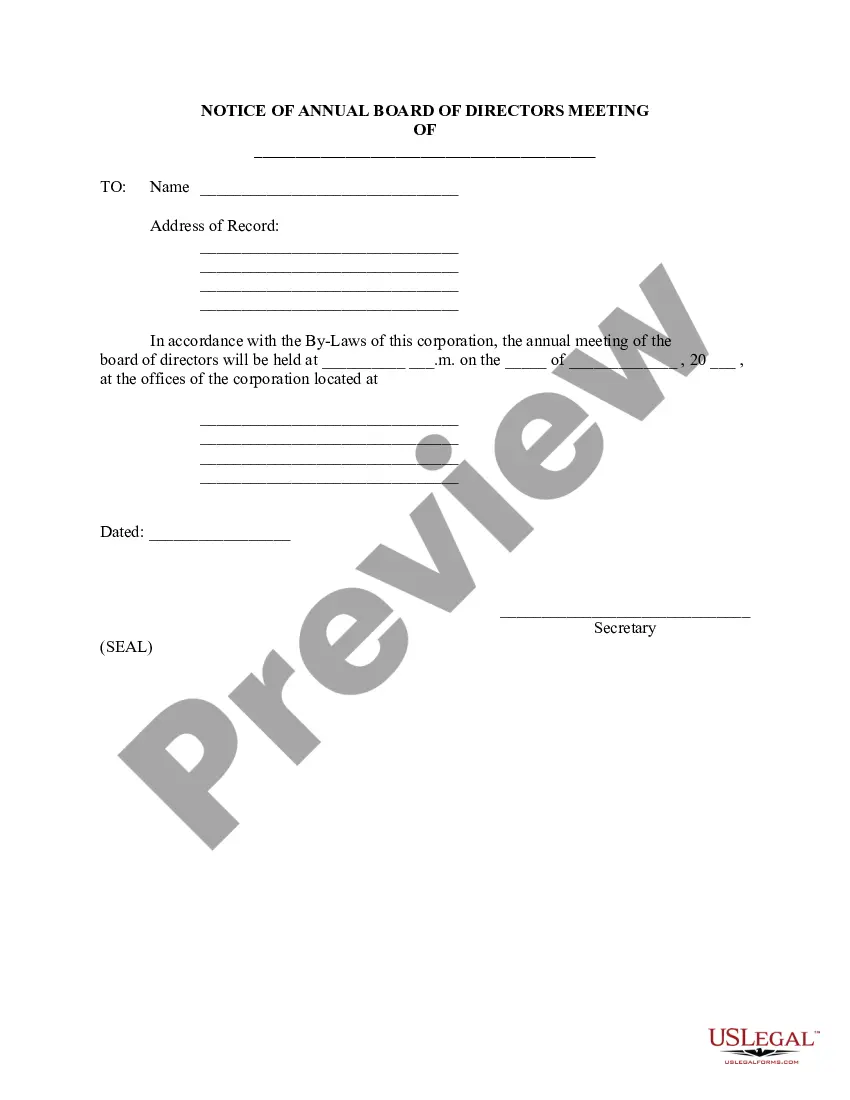
Notice For Meeting Sample In Pennsylvania
Description


Get your form ready online
Our built-in tools help you complete, sign, share, and store your documents in one place.
Make edits, fill in missing information, and update formatting in US Legal Forms—just like you would in MS Word.
Download a copy, print it, send it by email, or mail it via USPS—whatever works best for your next step.
Sign and collect signatures with our SignNow integration. Send to multiple recipients, set reminders, and more. Go Premium to unlock E-Sign.
If this form requires notarization, complete it online through a secure video call—no need to meet a notary in person or wait for an appointment.
We protect your documents and personal data by following strict security and privacy standards.

Make edits, fill in missing information, and update formatting in US Legal Forms—just like you would in MS Word.

Download a copy, print it, send it by email, or mail it via USPS—whatever works best for your next step.

Sign and collect signatures with our SignNow integration. Send to multiple recipients, set reminders, and more. Go Premium to unlock E-Sign.

If this form requires notarization, complete it online through a secure video call—no need to meet a notary in person or wait for an appointment.

We protect your documents and personal data by following strict security and privacy standards.
Looking for another form?

Form popularity
FAQ
Section 703, 65 Pa. C.S.A. Section 707 identifies the three (3) exceptions to the requirement of open meetings, which are: executive session, conference and certain working sessions. Executive sessions tend to be the most common exception to open meetings.
The PA Sunshine Act The Pennsylvania Sunshine Act, 65 Pa. C.S. §§ 701-716, requires agencies to deliberate and take official action on agency business in an open and public meeting.
The Sunshine Law generally requires all meetings of public bodies to be open. However, a public body may exclude the public from portions of a meeting, commonly referred to as “executive” or “closed” sessions.
The Sunshine Act allows meetings to be recorded with an audio recorder or a video recorder. It also allows agencies to issue reasonable rules concerning the use of recording devices in order to avoid any disruptions. However, such rules cannot be an attempt to prevent a member of the public from recording a meeting.
The Commonwealth Court shall have original jurisdiction of actions involving State agencies and the courts of common pleas shall have original jurisdiction of actions involving other agencies to render declaratory judgments or to enforce this chapter by injunction or other remedy deemed appropriate by the court.
What to do if an Agency Violates the PA Sunshine Act. You can object during the meeting if you think there is a violation. You can also file a complaint with the Commonwealth Court for state agencies.
--An agency may hold an executive session for one or more of the following reasons: (1) To discuss any matter involving the employment, appointment, termination of employment, terms and conditions of employment, evaluation of performance, promotion or disciplining of any specific prospective public officer or employee ...
Robert's allows both discussion and voting during an executive session. In fact, decisions made during a closed meeting don't even have to be revealed to non-board members until the board chooses.
Yes. The purpose of executive session is to prevent members from sharing the information at the meeting with non-members (except non-members who were permitted to attend).

