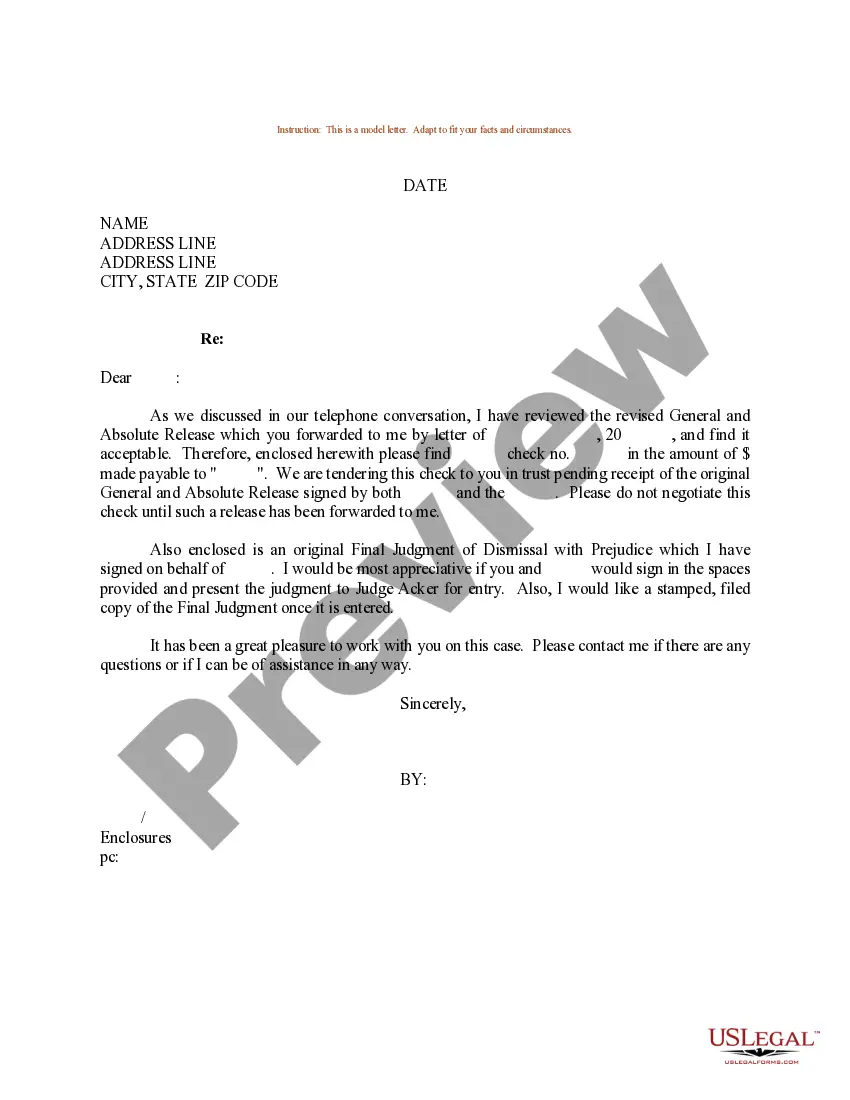
Release With Prejudice Without Prejudice In Travis
Description

Get your form ready online
Our built-in tools help you complete, sign, share, and store your documents in one place.
Make edits, fill in missing information, and update formatting in US Legal Forms—just like you would in MS Word.
Download a copy, print it, send it by email, or mail it via USPS—whatever works best for your next step.
Sign and collect signatures with our SignNow integration. Send to multiple recipients, set reminders, and more. Go Premium to unlock E-Sign.
If this form requires notarization, complete it online through a secure video call—no need to meet a notary in person or wait for an appointment.
We protect your documents and personal data by following strict security and privacy standards.

Make edits, fill in missing information, and update formatting in US Legal Forms—just like you would in MS Word.

Download a copy, print it, send it by email, or mail it via USPS—whatever works best for your next step.

Sign and collect signatures with our SignNow integration. Send to multiple recipients, set reminders, and more. Go Premium to unlock E-Sign.

If this form requires notarization, complete it online through a secure video call—no need to meet a notary in person or wait for an appointment.

We protect your documents and personal data by following strict security and privacy standards.
Looking for another form?


Form popularity
FAQ
A motion to dismiss must state that it is made pursuant to this rule, must identify each cause of action to which it is addressed, and must state specifically the reasons the cause of action has no basis in law, no basis in fact, or both. 91a.
At or immediately prior to the time an interlocutory or final default judgment is rendered, the party taking the same or his attorney shall certify to the clerk in writing the last known mailing address of the party against whom the judgment is taken, which certificate shall be filed among the papers in the cause.
Unlike dismissals with prejudice, which permanently close a case, a non-suit leaves the door open for future litigation. The process is governed by Rule 162 of the Texas Rules of Civil Procedure, which ensures plaintiffs retain some degree of control over their lawsuits.
Lost Evidence If the prosecution lost an important piece of physical evidence, then the case may not be able to go to trial. If this happens, the prosecution may not have enough other evidence to prove guilt beyond a reasonable doubt so the case may be dismissed.
Dismissal Without Prejudice: Allows the plaintiff to refile the case in the future, assuming no statute of limitations has elapsed. Dismissal With Prejudice: This is a final judgment that prevents the plaintiff from bringing the same claim or cause of action against the same defendant in the future.
That bright line or “two-dismissal” rule is: “If a plaintiff has once dismissed an action, a dismissal by notice of a second action based on or including the same claim, amounts to an adjudication on the merits.
Without Prejudice Meaning In other words, if the party says something that might be considered an admission against their interests, they cannot be prejudiced by it if the parties later engage in litigation, arbitration, tribunal proceedings or another form of alternative dispute resolution.
What is 'without prejudice'? It's a legal tool that limits who can have access to the contents of a written communication. For example, a letter/email, or recording/transcript of a verbal conversation such as you might have in a meeting or over the phone.
A motion to dismiss must be: (a) filed within 60 days after the first pleading containing the challenged cause of action is served on the movant; (b) filed at least 21 days before the motion is heard; and (c) granted or denied within 45 days after the motion is filed.
In sum, a dismissal with prejudice means that a judge's order is the final judgment in the case, and the prosecutor cannot refile charges. In a dismissal without prejudice, the prosecutor can, in the future, either refile the charges or file new charges based on the same alleged criminal incident.
