Arbitration Case Law Examples In Pennsylvania
Description



Get your form ready online
Our built-in tools help you complete, sign, share, and store your documents in one place.
Make edits, fill in missing information, and update formatting in US Legal Forms—just like you would in MS Word.
Download a copy, print it, send it by email, or mail it via USPS—whatever works best for your next step.
Sign and collect signatures with our SignNow integration. Send to multiple recipients, set reminders, and more. Go Premium to unlock E-Sign.
If this form requires notarization, complete it online through a secure video call—no need to meet a notary in person or wait for an appointment.
We protect your documents and personal data by following strict security and privacy standards.

Make edits, fill in missing information, and update formatting in US Legal Forms—just like you would in MS Word.

Download a copy, print it, send it by email, or mail it via USPS—whatever works best for your next step.

Sign and collect signatures with our SignNow integration. Send to multiple recipients, set reminders, and more. Go Premium to unlock E-Sign.

If this form requires notarization, complete it online through a secure video call—no need to meet a notary in person or wait for an appointment.

We protect your documents and personal data by following strict security and privacy standards.
Looking for another form?








Form popularity
FAQ
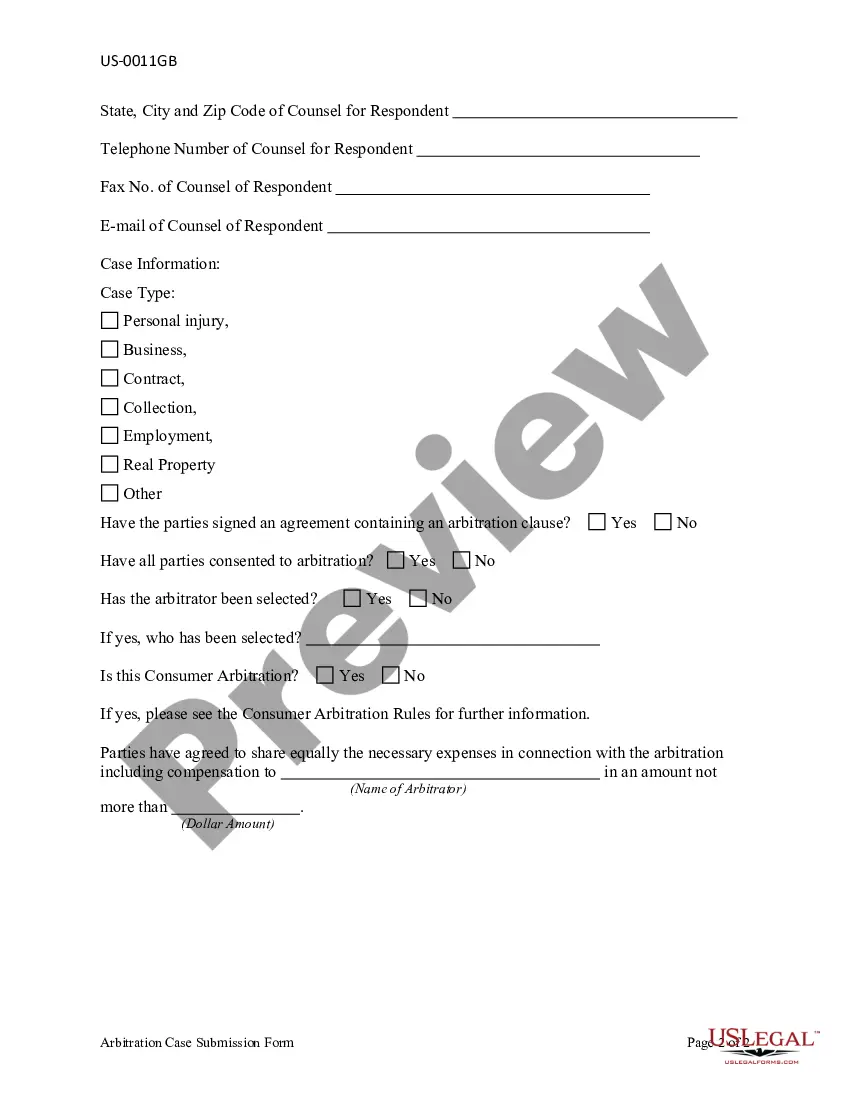
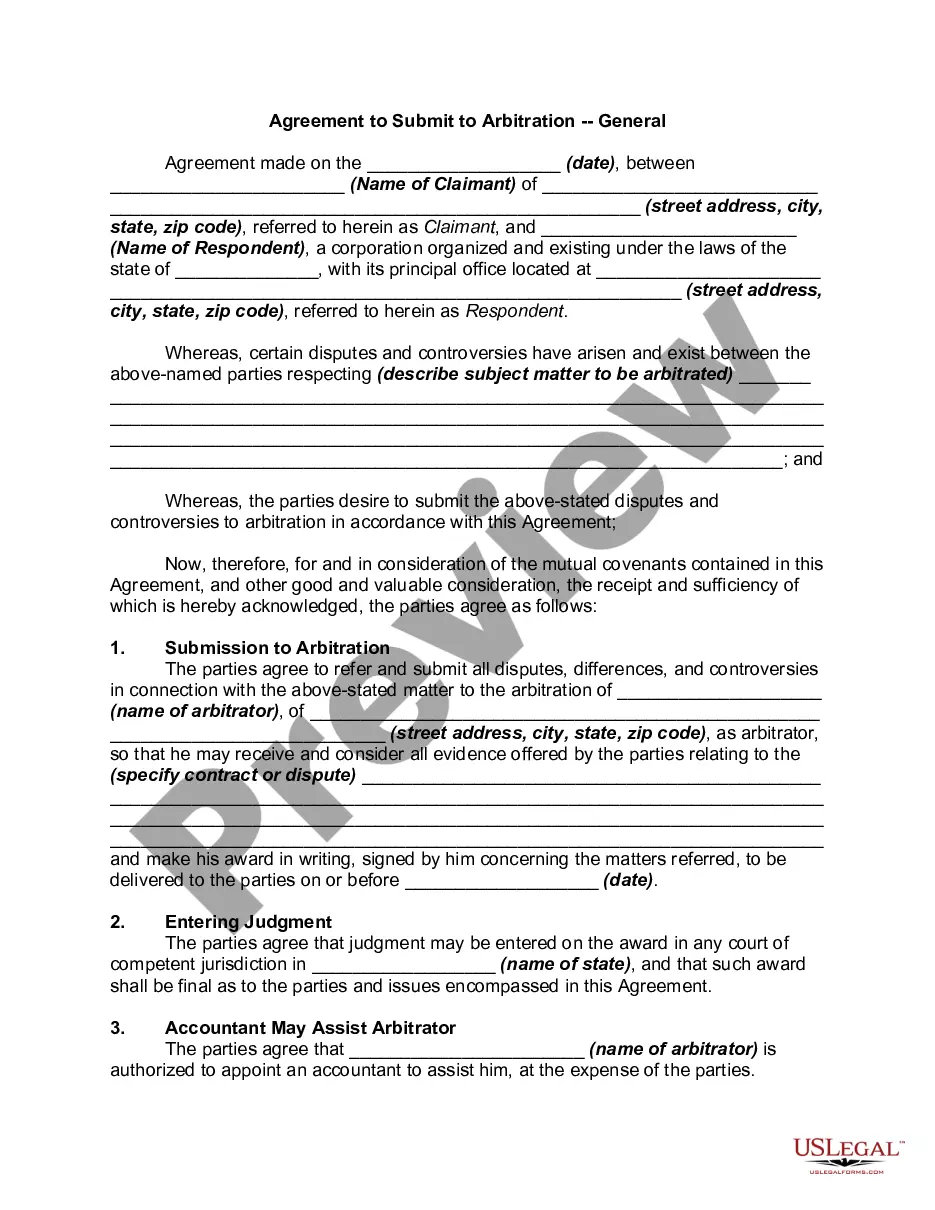
INTRODUCTION. Arbitration is a dispute-resolution process in which the parties select a neutral third party to resolve their claims. Parties typically agree to arbitrate in order to avoid the time, expense, and complexity of litigation.
Usually, when the court intervenes, it could cause the case to drag on for a long time without a meaningful resolution. Arbitration as a dispute resolution is used mostly in commercial disputes, consumer disputes, credit obligation disputes, and state or investor disputes.
Arbitration is a fairer, faster, and less expensive way to resolve disputes than time-consuming and expensive litigation.
An arbitration agreement is valid, enforceable, and irrevocable if it is in writing and provides that the parties agree to arbitrate either: ∎ An existing controversy. ∎ Prospective controversies that may arise between the parties. (42 Pa.
Generally, disputes in rem which are regarding a thing or property can't be resolved through arbitration, while disputes in personam regarding a selected person are often.
Parties typically agree to arbitrate in order to avoid the time, expense, and complexity of litigation. Arbitration clauses that require parties to submit all disputes to arbitration are widely used in domestic consumer and employment contracts.
If your case involves factors like privacy concerns, the need for a quicker resolution, or the desire to avoid a public jury trial, arbitration might be an ideal solution. However, if you're worried about the finality of the arbitrator's decision or the potential for bias, you might prefer the traditional court route.
Parties will need to provide material evidence during the arbitration process. Some arbitrators may require that some types of evidence (such as invoices, pictures, and party correspondence) be presented in a specific format, such as in a binder and labeled in a certain order.