Submission Agreement Sample With Collateral In Illinois
Description



Get your form ready online
Our built-in tools help you complete, sign, share, and store your documents in one place.
Make edits, fill in missing information, and update formatting in US Legal Forms—just like you would in MS Word.
Download a copy, print it, send it by email, or mail it via USPS—whatever works best for your next step.
Sign and collect signatures with our SignNow integration. Send to multiple recipients, set reminders, and more. Go Premium to unlock E-Sign.
If this form requires notarization, complete it online through a secure video call—no need to meet a notary in person or wait for an appointment.
We protect your documents and personal data by following strict security and privacy standards.

Make edits, fill in missing information, and update formatting in US Legal Forms—just like you would in MS Word.

Download a copy, print it, send it by email, or mail it via USPS—whatever works best for your next step.

Sign and collect signatures with our SignNow integration. Send to multiple recipients, set reminders, and more. Go Premium to unlock E-Sign.

If this form requires notarization, complete it online through a secure video call—no need to meet a notary in person or wait for an appointment.

We protect your documents and personal data by following strict security and privacy standards.
Looking for another form?





Form popularity
FAQ
Examples of collateral documents are a security agreement, guarantee and collateral agreement, pledge agreement, deposit account control agreement, securities account control agreement, mortgage, and UCC-1s.
Suppose you agree to rent an apartment. The lease agreement you sign with the landlord is the main contract. However, your landlord promises to fix the toilet drainage. Therefore, this is the collateral contract.
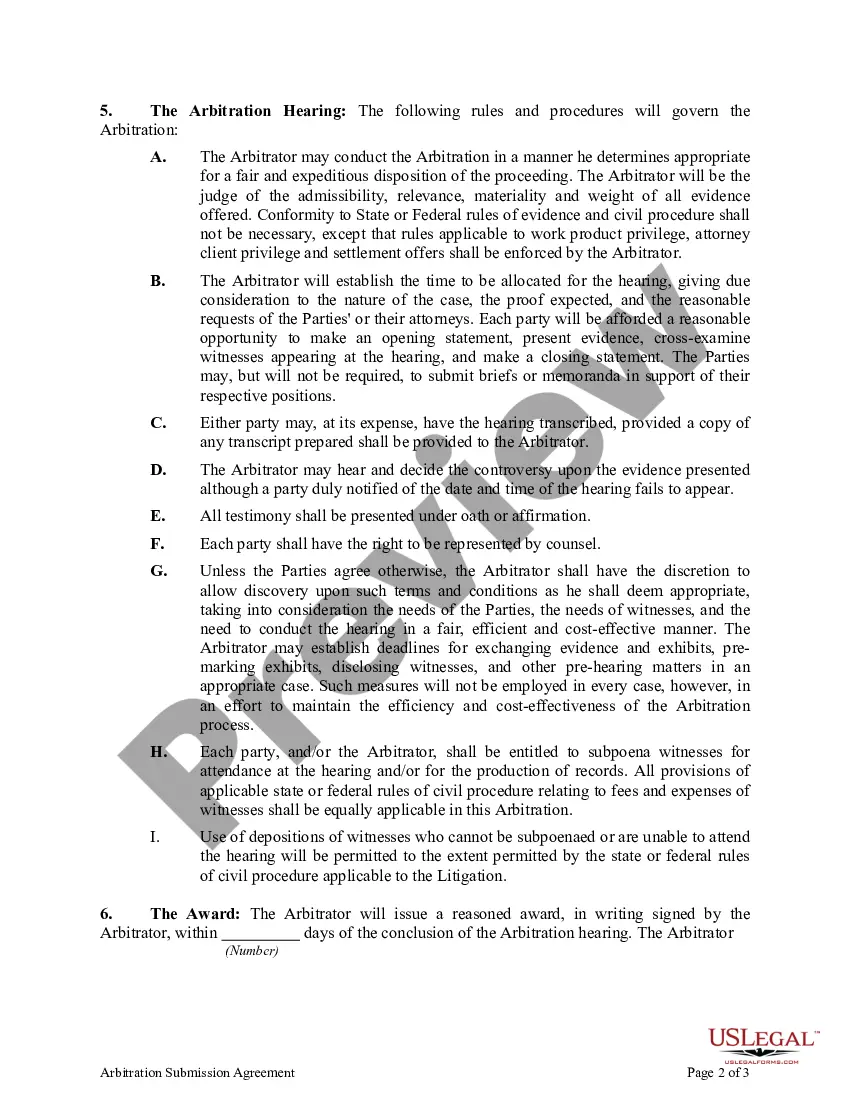
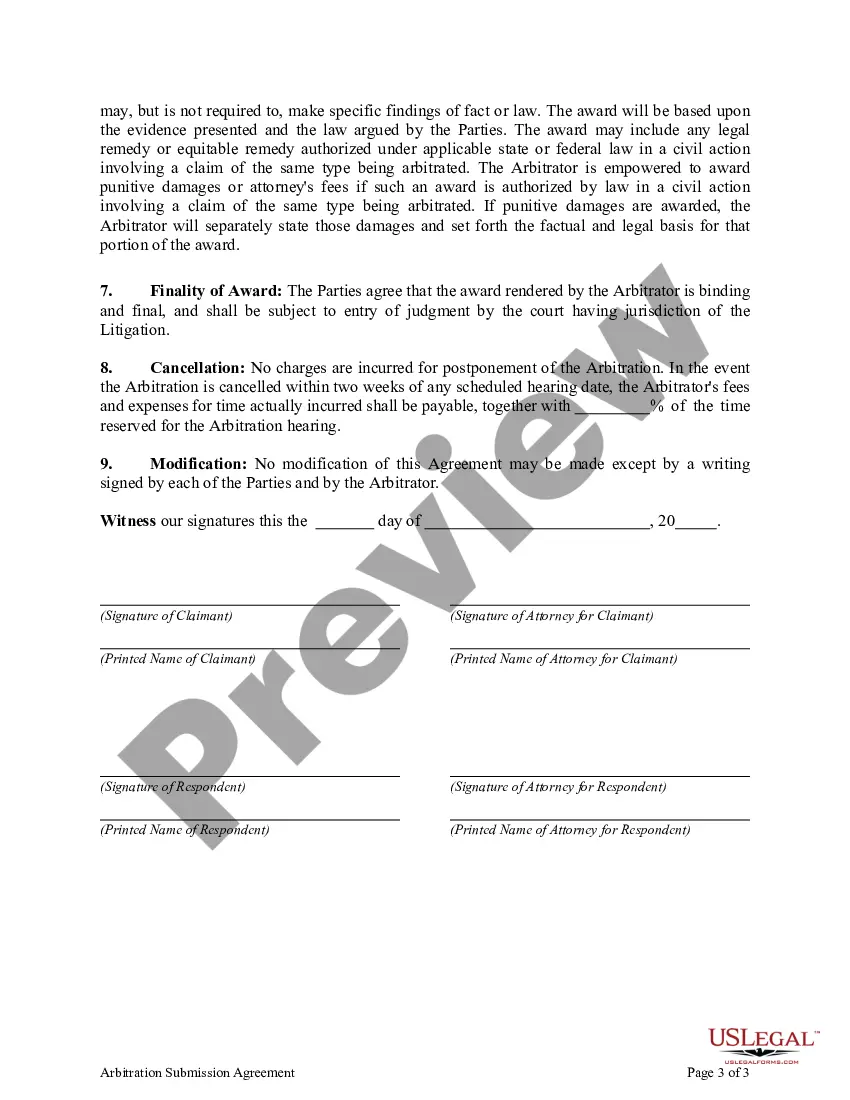
A “submission agreement” (also called an “agreement to arbitrate”) is a written agreement between two parties that establishes the use of arbitration to settle a dispute (or any and all disputes) that may arise between them.
A collateral contract is a contract to enter into an future contract. Part of the consideration for the collateral contract is the promise to enter into the second contract. This is similar to a conditional contract whereby the consideration for one party is conditioned on the other party doing something.
Collateral descriptions often include an after-acquired property clause to include within the scope of the collateral certain property that was not in the debtor's possession when the security agreement was executed but which may come into the debtor's possession afterward.
A collateral contract is one where the parties to one contract enter into or promise to enter into another contract. Thus, the two contracts are connected and it may be enforced even though it forms no constructive part of the original contract.
The lender should describe the collateral in the security agreement by type, category or a specific listing. A generic “all assets” description is not sufficient for purposes of the security agreement.
(c) Supergeneric description not sufficient. A description of collateral as "all the debtor's assets" or "all the debtor's personal property" or using words of similar import does not reasonably identify the collateral.
Collateral, in the form of securities/assets, is delivered by the borrower to a third party under a collateral arrangement with the lender. Borrower and lender agree a daily collateralisation Required Value (RQV) which is then passed to a triparty agent.
