Submission Agreement Sample With Whereas Clauses In Houston
Description




Get your form ready online
Our built-in tools help you complete, sign, share, and store your documents in one place.
Make edits, fill in missing information, and update formatting in US Legal Forms—just like you would in MS Word.
Download a copy, print it, send it by email, or mail it via USPS—whatever works best for your next step.
Sign and collect signatures with our SignNow integration. Send to multiple recipients, set reminders, and more. Go Premium to unlock E-Sign.
If this form requires notarization, complete it online through a secure video call—no need to meet a notary in person or wait for an appointment.
We protect your documents and personal data by following strict security and privacy standards.

Make edits, fill in missing information, and update formatting in US Legal Forms—just like you would in MS Word.

Download a copy, print it, send it by email, or mail it via USPS—whatever works best for your next step.

Sign and collect signatures with our SignNow integration. Send to multiple recipients, set reminders, and more. Go Premium to unlock E-Sign.

If this form requires notarization, complete it online through a secure video call—no need to meet a notary in person or wait for an appointment.

We protect your documents and personal data by following strict security and privacy standards.
Looking for another form?



Form popularity
FAQ
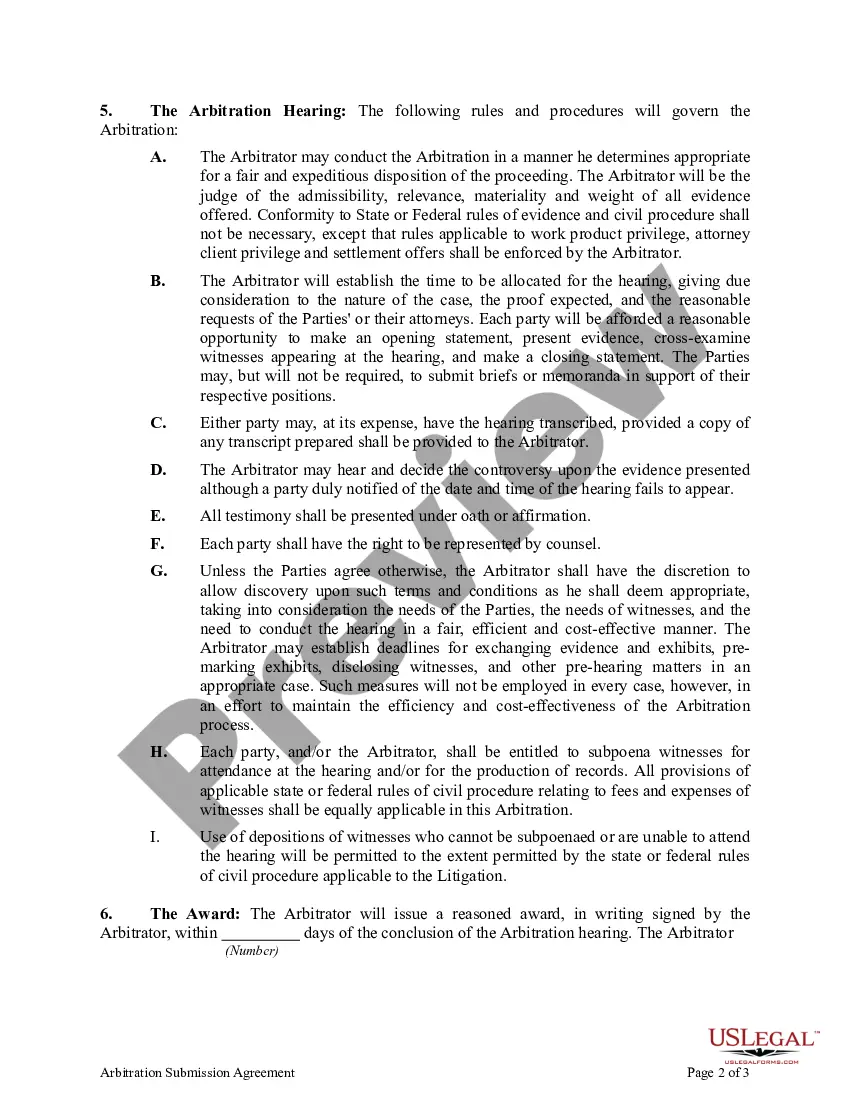
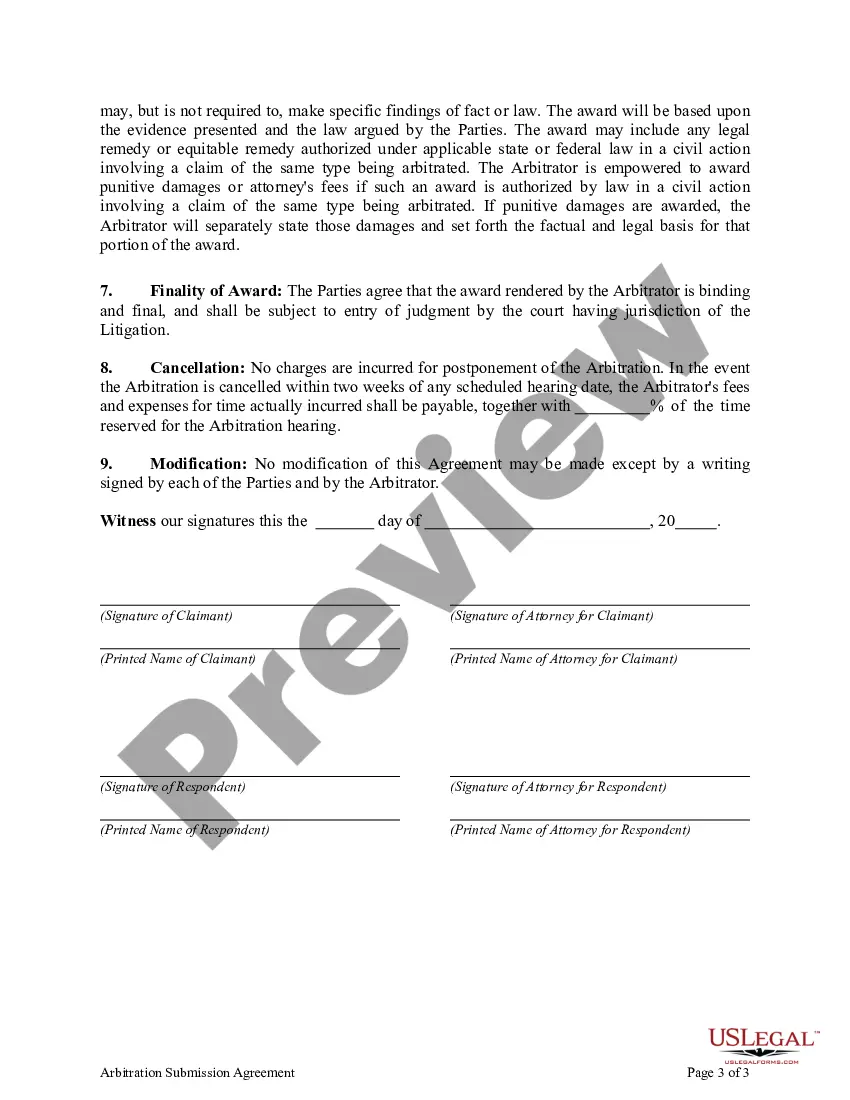
We noted that arbitration clauses are made before any dispute arises. Submission agreements, however, are agreements to arbitrate made after the dispute has arisen.
A “submission agreement” (also called an “agreement to arbitrate”) is a written agreement between two parties that establishes the use of arbitration to settle a dispute (or any and all disputes) that may arise between them.
Submission Agreement: The Submission Agreement lists the parties in the arbitration case and confirms that FINRA will administer it. It also establishes that, if the case ends with a hearing, the parties all agree to abide by the arbitrators' decisions.
A “submission agreement” (also called an “agreement to arbitrate”) is a written agreement between two parties that establishes the use of arbitration to settle a dispute (or any and all disputes) that may arise between them.
We noted that arbitration clauses are made before any dispute arises. Submission agreements, however, are agreements to arbitrate made after the dispute has arisen.
“While arbitration clause is included within a written agreement between the parties, an arbitration agreement is an agreement made after a dispute has arisen between the parties.
The contract might start with a Whereas clause like this: 'Whereas, the parties wish to collaborate in the development of new technology...'. This Whereas clause is setting out the purpose of the contract: to set up a partnership for developing technology.
Draft the agreement using clear and precise language. Specify each party's rights and obligations in detail, including remedies for breaching the agreement. Include all necessary legal clauses in the agreement, such as indemnification and dispute resolution clauses.
Rule 1.110(303.3) 'Whereas' clause of contract is prefatory, not binding.
“Whereas” clauses should be used to explain why the resolution is necessary, and should also provide some background on the issue that the resolution takes a stand on.