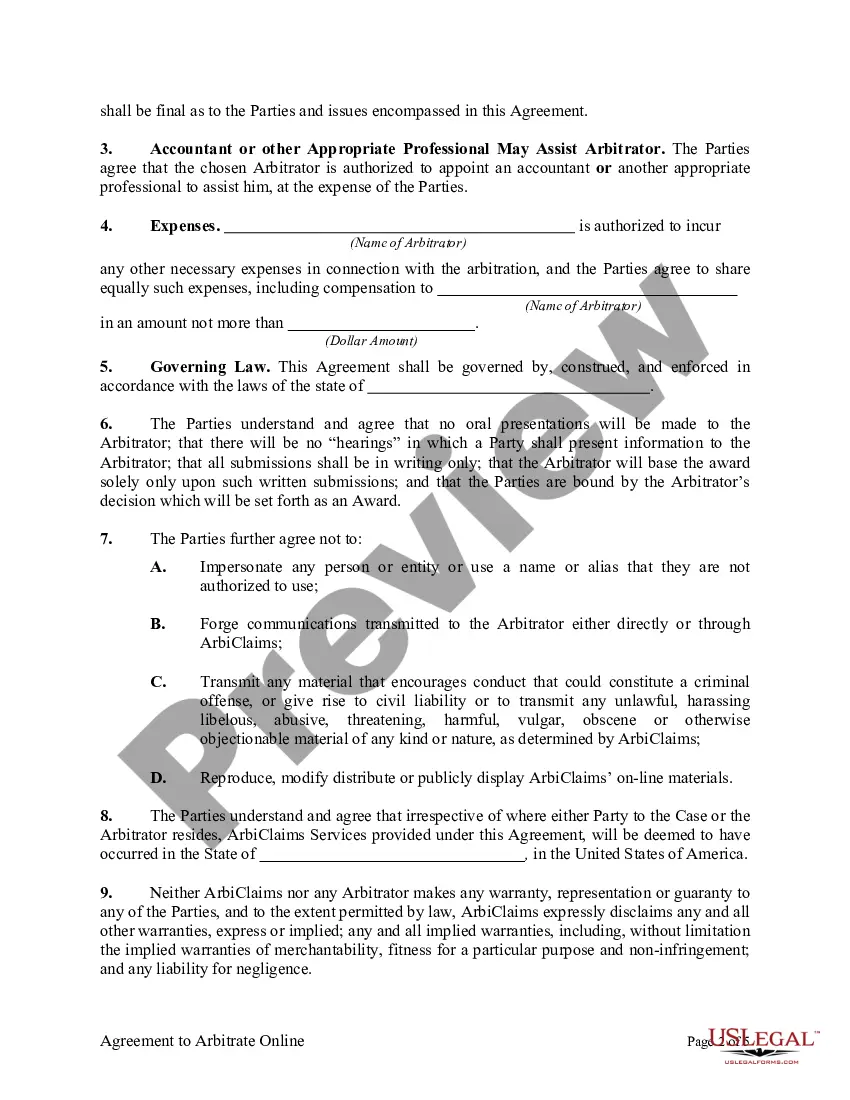
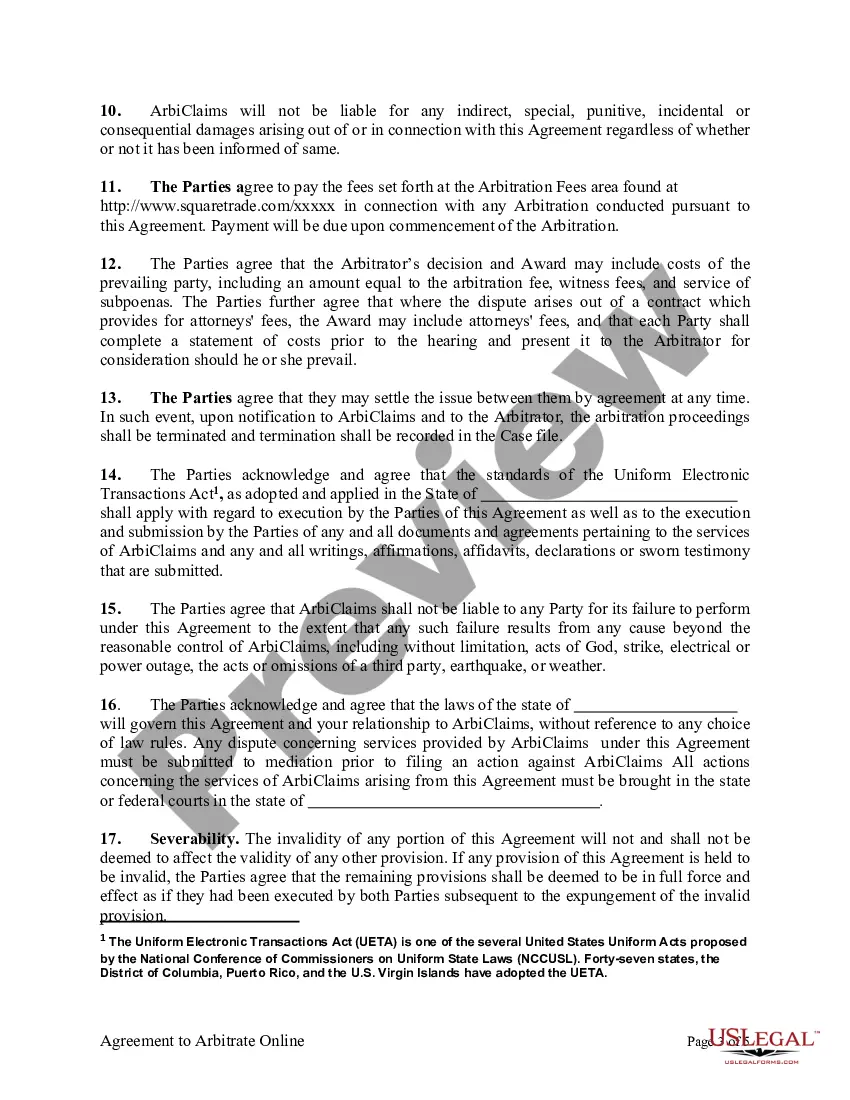
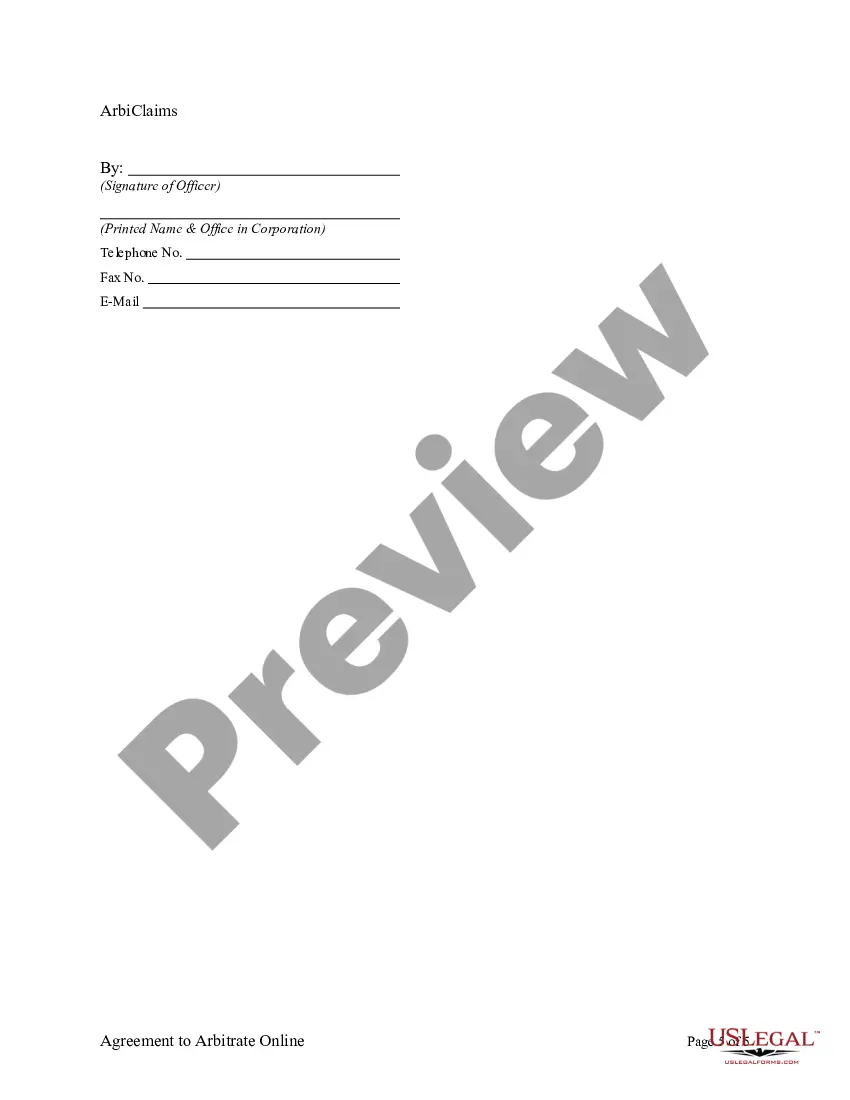
Agreement To Arbitrate Dealership In Texas
Description





Get your form ready online
Our built-in tools help you complete, sign, share, and store your documents in one place.
Make edits, fill in missing information, and update formatting in US Legal Forms—just like you would in MS Word.
Download a copy, print it, send it by email, or mail it via USPS—whatever works best for your next step.
Sign and collect signatures with our SignNow integration. Send to multiple recipients, set reminders, and more. Go Premium to unlock E-Sign.
If this form requires notarization, complete it online through a secure video call—no need to meet a notary in person or wait for an appointment.
We protect your documents and personal data by following strict security and privacy standards.

Make edits, fill in missing information, and update formatting in US Legal Forms—just like you would in MS Word.

Download a copy, print it, send it by email, or mail it via USPS—whatever works best for your next step.

Sign and collect signatures with our SignNow integration. Send to multiple recipients, set reminders, and more. Go Premium to unlock E-Sign.

If this form requires notarization, complete it online through a secure video call—no need to meet a notary in person or wait for an appointment.

We protect your documents and personal data by following strict security and privacy standards.
Looking for another form?
Form popularity
FAQ
In Texas, arbitration agreements can be binding or non-binding. When arbitration is binding, it can be enforced in court. However, if the arbitration is not binding, you may forward the matter to court. The Buzbee Law Firm lawyers can help you better understand the binding nature of your arbitration proceedings.
By signing a contract with a mandatory binding arbitration provision, the dealer or lender can seek to resolve any disputes about the contract with an arbitrator, who is usually chosen by the dealer or lender. The arbitrator decides the dispute instead of a court.
A Texas court that has jurisdiction over the parties and the dispute may enforce an arbitration agreement and render judgment on the award (Tex. Civ. Prac. & Rem.
However, the Texas Supreme Court has ruled that an employer can simply notify at-will employees of the details of an arbitration program it is adopting, and the employees can be bound to that arbitration program by continuing their employment, even if they never sign anything.
Under Section 171.001 of the TAA, written agreements to arbitrate are generally valid and enforceable in Texas.
Arbitration might be the right choice for some cases. Limited discovery rights and costs might be useful when less is at stake. Arbitration might feel less adversarial, which could be an advantage where ongoing relationships are hoped to be preserved. Arbitration lends some confidentiality.
However, the Texas Supreme Court has ruled that an employer can simply notify at-will employees of the details of an arbitration program it is adopting, and the employees can be bound to that arbitration program by continuing their employment, even if they never sign anything.
Top 10 tips for drafting arbitration agreements Introduction. Scope of the arbitration agreement. Seat of the arbitration. Governing law of the arbitration agreement. Choice of rules. Language. Number and appointment of arbitrators. Specifying arbitrator characteristics.
Disadvantages Questionable Fairness. Mandatory arbitration. Finality: No appeals. While this may be a positive if you find the arbitration decision favorable, you should be aware that if arbitration is binding, both sides give up their right to an appeal. Can be more expensive. Unpredictability: Unconventional outcomes.
If neither party appeals the decision, it will be binding, like an order by a judge. However, a party unhappy with the arbitrator's decision can request a new trial before a judge.
