Agreements With Arbitration In Michigan
Description

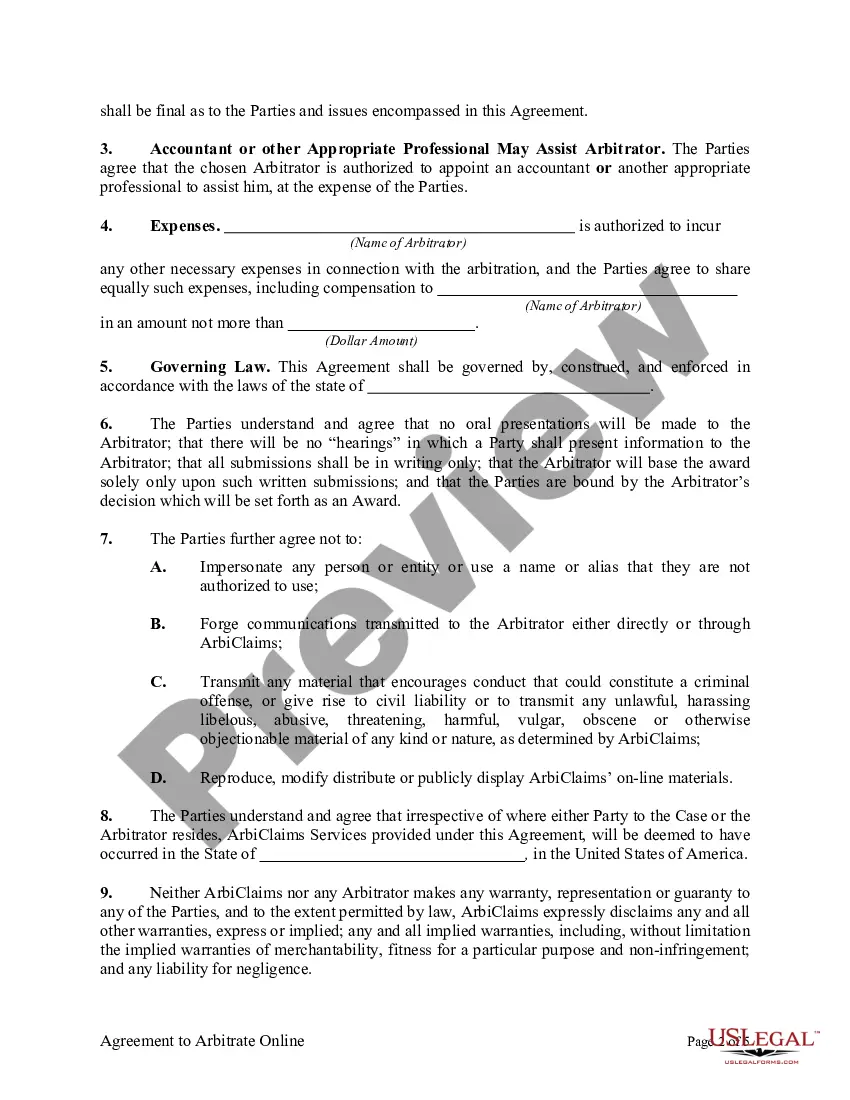




Get your form ready online
Our built-in tools help you complete, sign, share, and store your documents in one place.
Make edits, fill in missing information, and update formatting in US Legal Forms—just like you would in MS Word.
Download a copy, print it, send it by email, or mail it via USPS—whatever works best for your next step.
Sign and collect signatures with our SignNow integration. Send to multiple recipients, set reminders, and more. Go Premium to unlock E-Sign.
If this form requires notarization, complete it online through a secure video call—no need to meet a notary in person or wait for an appointment.
We protect your documents and personal data by following strict security and privacy standards.

Make edits, fill in missing information, and update formatting in US Legal Forms—just like you would in MS Word.

Download a copy, print it, send it by email, or mail it via USPS—whatever works best for your next step.

Sign and collect signatures with our SignNow integration. Send to multiple recipients, set reminders, and more. Go Premium to unlock E-Sign.

If this form requires notarization, complete it online through a secure video call—no need to meet a notary in person or wait for an appointment.

We protect your documents and personal data by following strict security and privacy standards.
Looking for another form?








Form popularity
FAQ
Yes. By agreeing to arbitrate, you and the Company both give up the right to resolve a dispute in a court or an administrative agency.
And, time and again, the Michigan Court of Appeals has explained that Michigan policy “strongly endorses arbitration as an inexpensive and expeditious alternative to litigation.”1 Indeed, the Michigan Legislature recently adopted the Uniform Arbitration Act, providing further support for judicial enforcement of ...
A form of ADR, arbitration involves both parties presenting their case to a neutral third party (an arbitrator) who considers the issues and gives their decision (called an award). An arbitrator has the power to make a range of awards depending on the circumstances of the case. Awards may include: Monetary compensation.
A form of ADR, arbitration involves both parties presenting their case to a neutral third party (an arbitrator) who considers the issues and gives their decision (called an award). An arbitrator has the power to make a range of awards depending on the circumstances of the case. Awards may include: Monetary compensation.
The Scope of the Clause. This section of the clause is critical; it sets the boundaries for which disputes the tribunal is authorised to determine. Choice of Rules. The Number of Arbitrators. Appointing Authority. Choice of Venue. The language of the proceedings. Finality. Exclusion of the right of appeal.
Arbitration agreements are generally enforceable in all 50 states; particularly in commercial settings between sophisticated parties. However, courts in many states are hostile to “fine print” arbitration agreements, particularly between employers and employees.
691.1686 Validity of agreement to arbitrate. 6. (1) An agreement contained in a record to submit to arbitration any existing or subsequent controversy arising between the parties to the agreement is valid, enforceable, and irrevocable except on a ground that exists at law or in equity for the revocation of a contract.
The only disputes which may not be determined by way of arbitration proceedings are matters in respect of any matrimonial cause (or incidental thereto) and matters relating to status, for example sequestration or liquidation proceedings.
