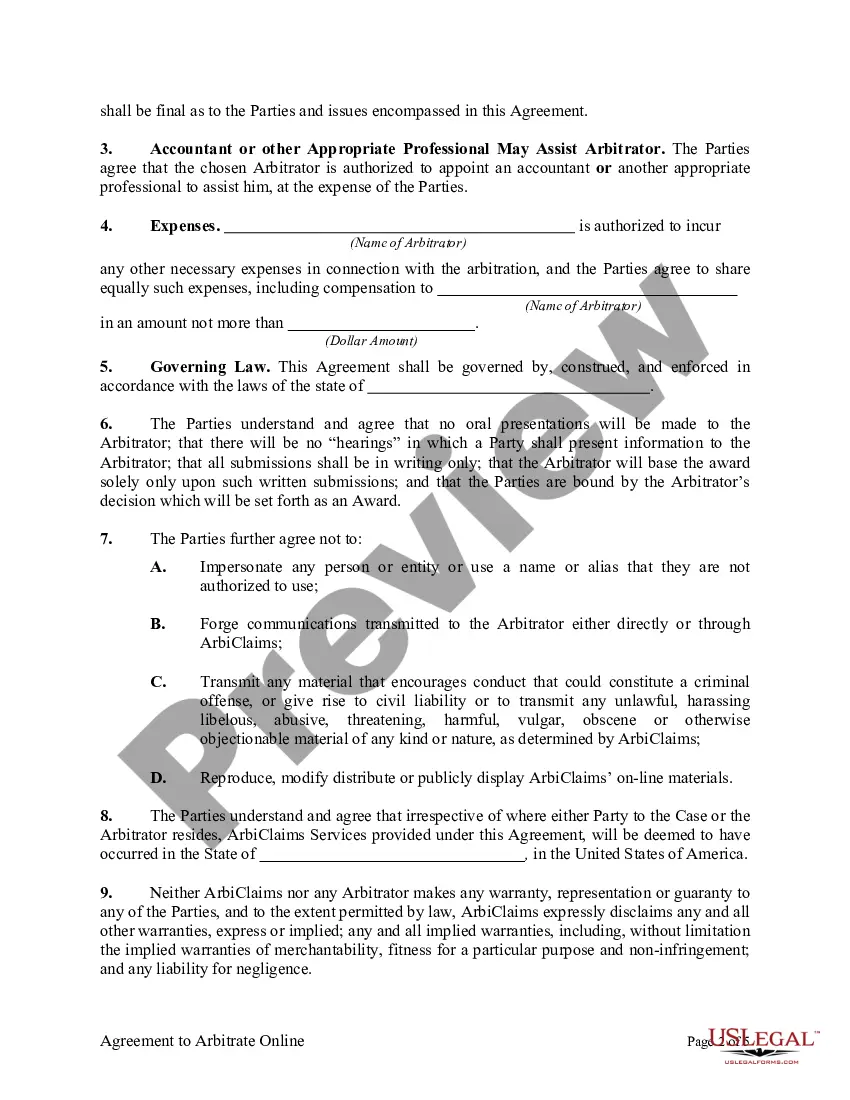
Agreement Arbitration Sample For Divorce In Chicago
Description





Get your form ready online
Our built-in tools help you complete, sign, share, and store your documents in one place.
Make edits, fill in missing information, and update formatting in US Legal Forms—just like you would in MS Word.
Download a copy, print it, send it by email, or mail it via USPS—whatever works best for your next step.
Sign and collect signatures with our SignNow integration. Send to multiple recipients, set reminders, and more. Go Premium to unlock E-Sign.
If this form requires notarization, complete it online through a secure video call—no need to meet a notary in person or wait for an appointment.
We protect your documents and personal data by following strict security and privacy standards.

Make edits, fill in missing information, and update formatting in US Legal Forms—just like you would in MS Word.

Download a copy, print it, send it by email, or mail it via USPS—whatever works best for your next step.

Sign and collect signatures with our SignNow integration. Send to multiple recipients, set reminders, and more. Go Premium to unlock E-Sign.

If this form requires notarization, complete it online through a secure video call—no need to meet a notary in person or wait for an appointment.

We protect your documents and personal data by following strict security and privacy standards.
Looking for another form?





Form popularity
FAQ
The “Judgment for Dissolution of Marriage” need not be signed in front of a Notary, but should be completed and signed by both parties (below the words “Approved as to Form and Content”) before your hearing. The Judge will complete the “Entered” line and sign the Judgment if the dissolution is granted.
It is not necessary for both spouses to agree to a divorce to dissolve a marriage in the state of Illinois. There are legal ways the other spouse can continue the divorce filing if one spouse refuses to go through with a divorce.
For the state of Illinois, there are no restrictions regarding notarizing for relatives.
At the arbitration hearing, the parties present their case to the arbitration panel and the arbitrators make a monetary award based on the evidence. The Illinois Code of Civil Procedure, Illinois Supreme Court Rules and the established rules of evidence all apply in arbitration hearings.
Examples of marital property include the marital home, retirement accounts, and vehicles. Illinois is an equitable division state, so marital property does not have to be split evenly. Marital property is property owned by both parties. This type of property is split during the property division phase of a divorce.
Businesses cannot typically be divided in two. The business operator almost always keeps the business after an Illinois divorce. If the business has been deemed to be marital, a portion of the business's marital value will be awarded to the spouse that will not operate the business in the future.
Illinois became a no-fault divorce state on January 1, 2016, when Public Act 99-90 went into effect. This act eliminated all fault-based grounds for divorce, including adultery, physical or mental cruelty, abandonment, habitual drunkenness, impotence, and substance abuse.
Illinois Does Not Require A 50/50 Split Of Assets It is commonly assumed by many that you must give up 50% of what you own during a divorce. But Illinois requires an equitable division of assets, which does not necessarily mean 50/50.
Each spouse is entitled to a fair share of the couple's marital estate taking into account factors such as the duration of the marriage, financial and non-financial contributions, access to separate assets, child custody responsibilities, and post-divorce economic circumstances.