Letter Job Offer Sample With Time In Ohio
Description

Get your form ready online
Our built-in tools help you complete, sign, share, and store your documents in one place.
Make edits, fill in missing information, and update formatting in US Legal Forms—just like you would in MS Word.
Download a copy, print it, send it by email, or mail it via USPS—whatever works best for your next step.
Sign and collect signatures with our SignNow integration. Send to multiple recipients, set reminders, and more. Go Premium to unlock E-Sign.
If this form requires notarization, complete it online through a secure video call—no need to meet a notary in person or wait for an appointment.
We protect your documents and personal data by following strict security and privacy standards.

Make edits, fill in missing information, and update formatting in US Legal Forms—just like you would in MS Word.

Download a copy, print it, send it by email, or mail it via USPS—whatever works best for your next step.

Sign and collect signatures with our SignNow integration. Send to multiple recipients, set reminders, and more. Go Premium to unlock E-Sign.

If this form requires notarization, complete it online through a secure video call—no need to meet a notary in person or wait for an appointment.

We protect your documents and personal data by following strict security and privacy standards.
Looking for another form?






Form popularity
FAQ
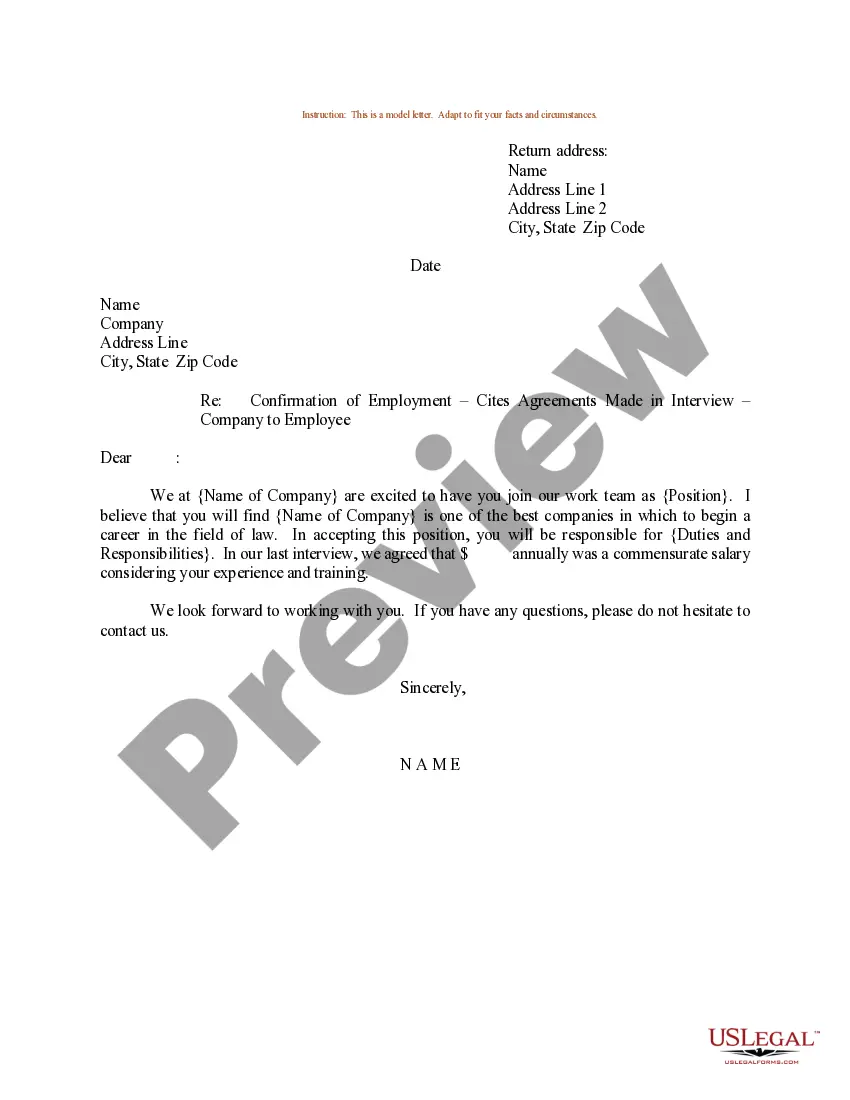
It includes the salary, benefits, and other important information that will help you determine whether or not you want to accept the job. As a candidate, you may be offered a job verbally—over the phone or in person—and then receive an official offer letter after.
The timing of the offer letter will vary depending on the employer and the specific hiring process. In some cases, an offer letter may be sent on the same day as the verbal offer, while in others, it may take several days or even a week or more.
What is included in an offer letter? A job offer letter provides an overview of the job position and company as well as specific job details such as the start rate, remuneration, work schedule, benefits, and more.
Work schedule: Employers may outline our work schedule , comprising the hours they expect you to work each week, including if your position requires you to work weekends, evenings or holidays. The job offer letter also includes your expected start date, which you likely discussed during an interview.
Clearly state the job title and position being offered. Include the key details of the offer, such as salary, benefits and any additional compensation. Outline the start date and working hours, including full-time, part-time, contract or internship duration.
DON'T include: Language that makes the letter sound like a contract. A place for the employee to sign the letter, which also makes it seem like a contract. Language that implies job security or longevity, such as “You'll be able to grow here” or “You will enjoy a long career here.”
Here are some examples of what to say when asking for time to consider a job offer: "Thank you so much for the opportunity! I look forward to working with your company and helping grow the business. I'd like to ask for a few days to consider the offer in its entirety."
Reach out to the employer and politely request an extension on the deadline to accept the offer. Most employers will be willing to grant a reasonable extension, such as 1-2 weeks. When requesting more time, provide a specific date by which you'll give them your final decision.
It's important to approach the request for an extension professionally and respectfully to maintain a positive relationship with the potential employer. You want to ensure that you have ample time to weigh the pros and cons, perhaps compare it with other offers, or simply to discuss it with family or mentors.
Work schedule: Employers may outline our work schedule , comprising the hours they expect you to work each week, including if your position requires you to work weekends, evenings or holidays. The job offer letter also includes your expected start date, which you likely discussed during an interview.