Sample Letter Acceptance Job Offer With No Response In Los Angeles
Description
Get your form ready online
Our built-in tools help you complete, sign, share, and store your documents in one place.
Make edits, fill in missing information, and update formatting in US Legal Forms—just like you would in MS Word.
Download a copy, print it, send it by email, or mail it via USPS—whatever works best for your next step.
Sign and collect signatures with our SignNow integration. Send to multiple recipients, set reminders, and more. Go Premium to unlock E-Sign.
If this form requires notarization, complete it online through a secure video call—no need to meet a notary in person or wait for an appointment.
We protect your documents and personal data by following strict security and privacy standards.

Make edits, fill in missing information, and update formatting in US Legal Forms—just like you would in MS Word.

Download a copy, print it, send it by email, or mail it via USPS—whatever works best for your next step.

Sign and collect signatures with our SignNow integration. Send to multiple recipients, set reminders, and more. Go Premium to unlock E-Sign.

If this form requires notarization, complete it online through a secure video call—no need to meet a notary in person or wait for an appointment.

We protect your documents and personal data by following strict security and privacy standards.
Looking for another form?





Form popularity
FAQ
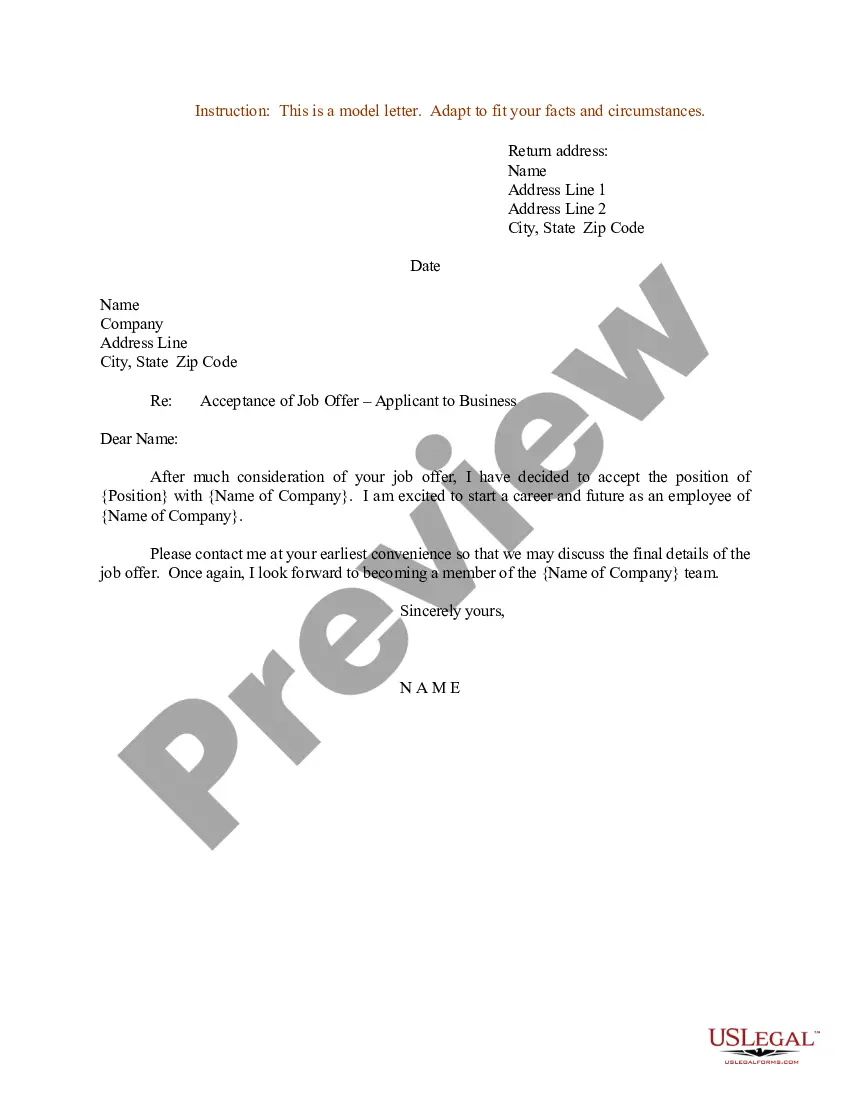
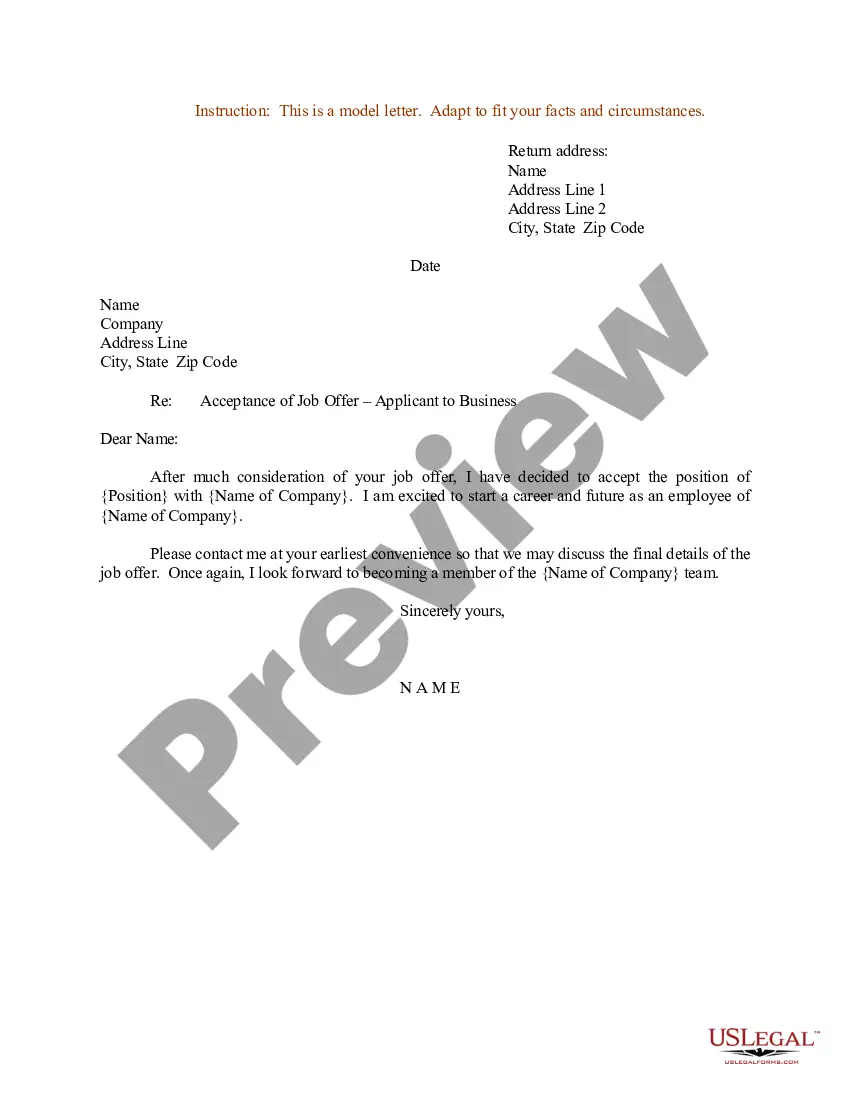
When accepting a job offer, it is typically appropriate to respond with a formal letter or email that includes the following: Express gratitude and excitement about the opportunity. For example, ``I am excited and grateful to accept the position of (job title) at (company name).''
``Thank you for the offer. It wasn't an easy decision, but I've decided to take a role with another company. I really respect the catalogue of work from (your company), and hope we have a chance to work with each other at a later time.''
You don't burn bridges if you respectfully decline any offer of employment. Just say, ``Thanks for the wonderful opportunity; I really wish I could work with you but I just accepted something else.'' You don't owe them an explanation of why.
Start by thanking the employer for the offer. Show appreciation for their interest in you. If you're happy in your current job but are considering the offer, it's fine to mention that. You can say you're evaluating your options but want to be transparent about your current employment.
Wait a Reasonable Amount of Time: Allow a few days to a week for HR to respond. Sometimes, internal processes can cause delays. Follow Up with a Polite Email: If you haven't heard back after a week, send a polite follow-up email.
If you do not receive a response, you may send a second follow-up email to confirm receipt of your initial message. This email can be even shorter, limited to a single paragraph.
Here are the essential steps involved in writing a good job offer acceptance letter: Review your job offer. Add date at the top. Include your name and address. Include the recipient's name and address. Add a subject line. Add a salutation. Express gratitude for the offer. Accept the offer and terms of employment.
The response time from HR can vary widely depending on the company and their internal processes. Generally, you might expect a response within a few days to a week. If it's been longer than that, it's reasonable to send a polite follow-up email to inquire about the next steps.
Dealing with unresponsive HR can be a frustrating experience, but remember that you have options. By documenting incidents, communicating with your manager, utilizing your company's ethics hotline, and seeking legal advice when necessary, you can take control of your situation.

