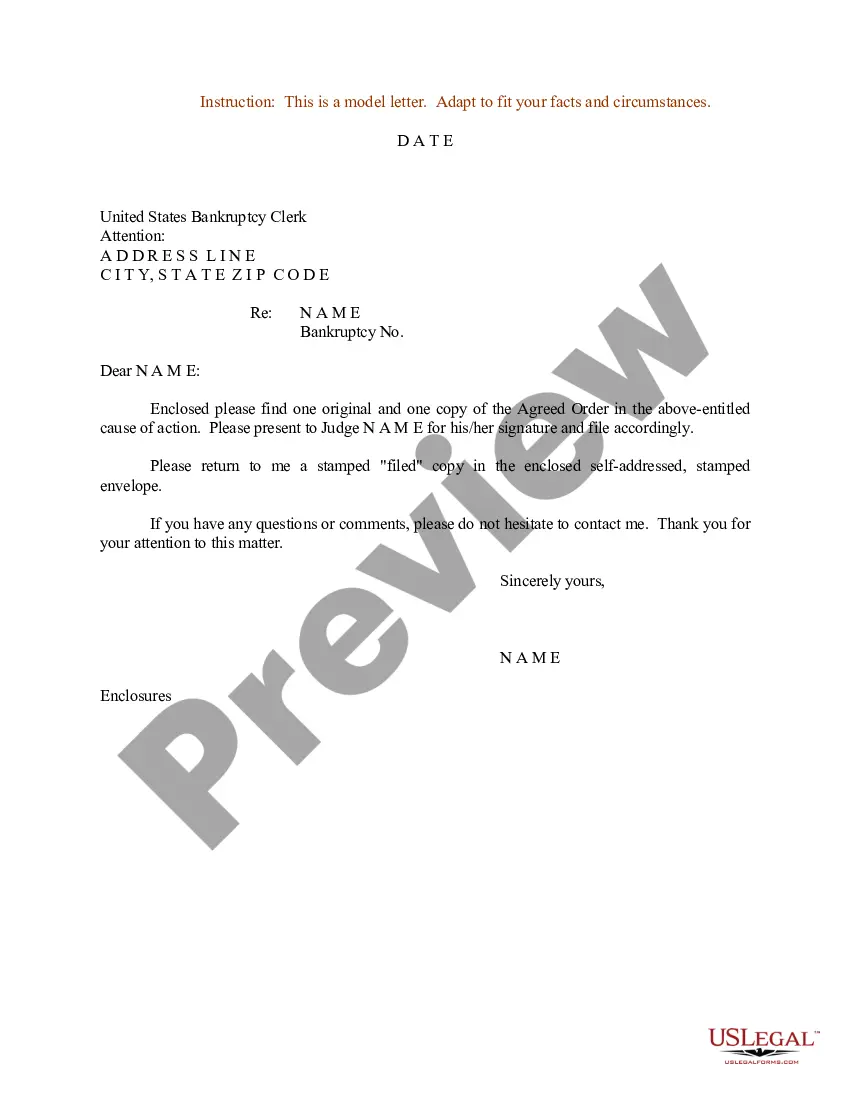
Sample Letter Judge With Proposed Order In Texas
Description


Get your form ready online
Our built-in tools help you complete, sign, share, and store your documents in one place.
Make edits, fill in missing information, and update formatting in US Legal Forms—just like you would in MS Word.
Download a copy, print it, send it by email, or mail it via USPS—whatever works best for your next step.
Sign and collect signatures with our SignNow integration. Send to multiple recipients, set reminders, and more. Go Premium to unlock E-Sign.
If this form requires notarization, complete it online through a secure video call—no need to meet a notary in person or wait for an appointment.
We protect your documents and personal data by following strict security and privacy standards.

Make edits, fill in missing information, and update formatting in US Legal Forms—just like you would in MS Word.

Download a copy, print it, send it by email, or mail it via USPS—whatever works best for your next step.

Sign and collect signatures with our SignNow integration. Send to multiple recipients, set reminders, and more. Go Premium to unlock E-Sign.

If this form requires notarization, complete it online through a secure video call—no need to meet a notary in person or wait for an appointment.

We protect your documents and personal data by following strict security and privacy standards.
Looking for another form?



Form popularity
FAQ
Avoid using emotive language or making personal attacks. Instead, focus on the facts and present a clear, logical argument for your objection. Avoid making vague or general statements. Instead, provide specific examples and evidence to support your objections.
Steps to respond to a request for a court order Respond. Fill out court form to tell the court if you agree or disagree. File forms. File the forms with the court. Serve other side. Serve copies of the forms on the other side (or their lawyer if they have one). Attend hearing.
At or before the hearing, give the judge a “proposed order.” A proposed order is a document describing the things you want the judge to order. Make sure you give a copy of the proposed order to the lawyer or person on the other side of the case.
With documentary and testimonial evidence being differentiated, and lay from expert testimony, the blog focuses on what is by far the three (3) most common trial objections made in response to lay testimony: Hearsay, Leading and Relevancy.
Your letter or e-mail should state clearly the points you wish to make about an application. You can support a planning application as well as object to it. If you wish to object to a proposal, you should set out the reasons for your objection with reference to the items in the list of 'Valid Reasons for Comment below.
Tip Three: Avoid Undermining the Case It is often tempting for a person writing a character letter to discuss how the defendant isn't really guilty, how this “isn't like him,” how the defendant only pleaded guilty to the crime to get a better sentence, or even how the jury got it wrong.
A proposed Order means that someone filed a motion and submitted an Order that they want the judge to sign.
At or before the hearing, give the judge a “proposed order.” A proposed order is a document describing the things you want the judge to order. Make sure you give a copy of the proposed order to the lawyer or person on the other side of the case.
You simply write the letter and address to the judge, at his court. It's best to keep such a letter concise, like no more than one page, and when addressing it, it should be directed to ``The Honorable So-and-So, Judge,'' at the court address, the proper salutation being either ``Dear Judge So-and...
A proposed order is a legal document that outlines the terms of a court order that one party proposes to the court for approval.
