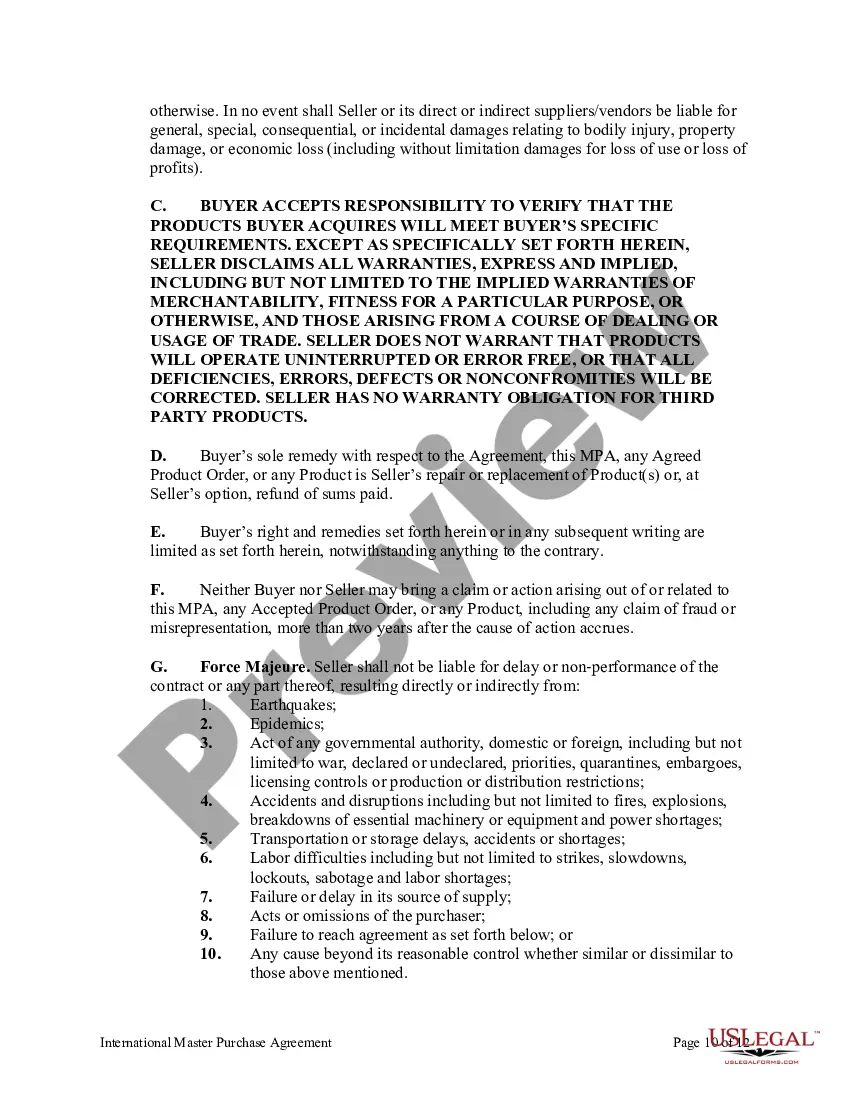
Master Supply Agreement With In Collin
Description





Get your form ready online
Our built-in tools help you complete, sign, share, and store your documents in one place.
Make edits, fill in missing information, and update formatting in US Legal Forms—just like you would in MS Word.
Download a copy, print it, send it by email, or mail it via USPS—whatever works best for your next step.
Sign and collect signatures with our SignNow integration. Send to multiple recipients, set reminders, and more. Go Premium to unlock E-Sign.
If this form requires notarization, complete it online through a secure video call—no need to meet a notary in person or wait for an appointment.
We protect your documents and personal data by following strict security and privacy standards.

Make edits, fill in missing information, and update formatting in US Legal Forms—just like you would in MS Word.

Download a copy, print it, send it by email, or mail it via USPS—whatever works best for your next step.

Sign and collect signatures with our SignNow integration. Send to multiple recipients, set reminders, and more. Go Premium to unlock E-Sign.

If this form requires notarization, complete it online through a secure video call—no need to meet a notary in person or wait for an appointment.

We protect your documents and personal data by following strict security and privacy standards.
Looking for another form?








Form popularity
FAQ
A master supply agreement, sometimes called a master service agreement, is a legal contract between two parties that consolidates two or more current contracts into one streamlined agreement.
A master service agreement, sometimes known as a framework agreement, is a contract reached between parties, in which the parties agree to most of the terms that will govern future transactions or future agreements.
The master agreement is a contract between a provider and another company, which you use to manage B2B scenarios and in which you can define the following individual sales agreements for a defined validity period: Authorized groups. Individual products (define specific product attributes) Individual prices and ...
Unlike contracts that typically apply to a one-time transaction between two parties, a Master Service Agreement is intended to outline the rights and responsibility of the parties involved in an ongoing relationship, including those that pertain to: The ownership rights of a property.
Do you know the difference between the different types of supply chain contracts? In total, there are 6 types of supply chain contracts, with the three main contracts being; continuous, fast, and flexible.
The agreement should include details about payment expectations, delivery responsibilities, liability provisions and warranties in order for it to be valid. The agreement also serves as an assurance that both parties can count on high-quality goods/services throughout their relationship.
It functions as a contract between two or more parties to guarantee that essential agreements are in place before any service commences. An MSA serves to minimize disagreements by providing an unmistakable description of what the parties can expect from one another.
A master service agreement (MSA) is a legal contract that establishes fundamental agreements between two parties. MSAs allow vendors and clients to agree on basic terms at the outset of a business relationship before any business commences.
Prepare a contract Provide details of the parties. Describe services or results. Set out payment details. Assign intellectual property rights. Explain how to treat confidential information. Identify who is liable – indemnity. Provide insurance obligations. Outline any subcontracting agreements.