Template For Bonus Structure In Phoenix
Description
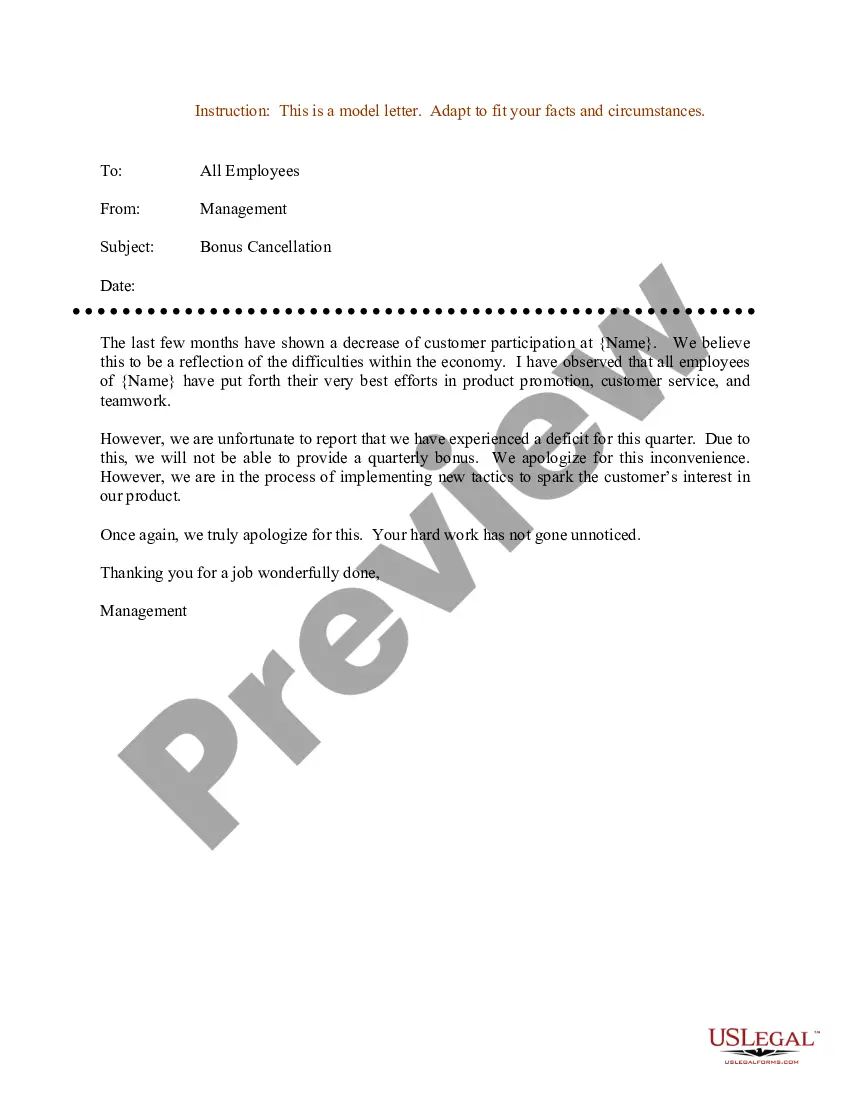
Get your form ready online
Our built-in tools help you complete, sign, share, and store your documents in one place.
Make edits, fill in missing information, and update formatting in US Legal Forms—just like you would in MS Word.
Download a copy, print it, send it by email, or mail it via USPS—whatever works best for your next step.
Sign and collect signatures with our SignNow integration. Send to multiple recipients, set reminders, and more. Go Premium to unlock E-Sign.
If this form requires notarization, complete it online through a secure video call—no need to meet a notary in person or wait for an appointment.
We protect your documents and personal data by following strict security and privacy standards.

Make edits, fill in missing information, and update formatting in US Legal Forms—just like you would in MS Word.

Download a copy, print it, send it by email, or mail it via USPS—whatever works best for your next step.

Sign and collect signatures with our SignNow integration. Send to multiple recipients, set reminders, and more. Go Premium to unlock E-Sign.

If this form requires notarization, complete it online through a secure video call—no need to meet a notary in person or wait for an appointment.

We protect your documents and personal data by following strict security and privacy standards.
Looking for another form?




Form popularity
FAQ
Put all the details of the Bonus Scheme in writing so the terms are easily understandable. Make sure the scheme is separate to the contract of employment so it can be easily reviewed and amended or updated as necessary. You should evaluate the scheme regularly to see if it is producing the results you want.
Anything close to the nationwide average of 8% or above might be considered a good bonus percentage. If 8% isn't possible, employers could go down to around 5% for it to still be seen as worthwhile. Around 20% of an annual salary is usually considered generous but this could still depend on the industry.
A common structure is tiered bonuses. Here, employees can achieve different "levels" of bonuses based on their performance metrics. For instance, reaching 80% of a target might secure a smaller bonus, while achieving 120% may earn a significantly larger one.
The typical bonus amount can range from 1% to 15% of an employee's salary, usually depending on a number of factors such as industry, company performance, and individual or team accomplishments. The average bonus for employees continues to rise over time. In 2020, the average employee bonus was only 8.1%.
HR leaders can incorporate these steps to create a dynamic performance bonus system: Define criteria. Train managers to coach their teams. Invite teams to take part in target-setting. Offer performance bonuses consistently. Align performance bonus goals with company goals.
Examples of performance bonus metrics typically include project milestones, sales targets, service quality, skill development, and customer satisfaction ratings. Straightforward metrics allow employees to adjust their performance and approaches ingly and track their progress for attaining bonuses.
Here are some key factors to consider: Alignment with company goals: The bonus structure should be aligned with the overall goals and objectives of the company. Fairness and equity: The bonus structure should be fair and equitable, with clear and transparent criteria for determining eligibility and payouts.
Designing your scheme Bonus Schemes can be single-factor or multi-factor. A single factor scheme will focus on one specific goal, e.g. an individual employee achieving more sales. A multi-factor scheme includes other goals and is multi-layered (but don't make it too complicated!).

