Temporary Restraining Order Requirements In King
Description
















Get your form ready online
Our built-in tools help you complete, sign, share, and store your documents in one place.
Make edits, fill in missing information, and update formatting in US Legal Forms—just like you would in MS Word.
Download a copy, print it, send it by email, or mail it via USPS—whatever works best for your next step.
Sign and collect signatures with our SignNow integration. Send to multiple recipients, set reminders, and more. Go Premium to unlock E-Sign.
If this form requires notarization, complete it online through a secure video call—no need to meet a notary in person or wait for an appointment.
We protect your documents and personal data by following strict security and privacy standards.

Make edits, fill in missing information, and update formatting in US Legal Forms—just like you would in MS Word.

Download a copy, print it, send it by email, or mail it via USPS—whatever works best for your next step.

Sign and collect signatures with our SignNow integration. Send to multiple recipients, set reminders, and more. Go Premium to unlock E-Sign.

If this form requires notarization, complete it online through a secure video call—no need to meet a notary in person or wait for an appointment.

We protect your documents and personal data by following strict security and privacy standards.
Looking for another form?







Form popularity
FAQ
If the judge decides that there was abuse and that there is also a credible threat to the plaintiff's safety, a final order of protection will be granted and will last for up to one year. The plaintiff will be directed to go to the clerks counter to wait for the order.
You can sue anyone for anything, but to win you'll need significantly more than an allegation that they filed a restraining order that was not made permanent. Your most likely claim would be abuse of process and that would require proof that the case was filed for an improper purpose.
An order of protection is issued by the court to limit the behavior of someone who harms or threatens to harm another person. It is used to address various types of safety issues, including, but not limited to situations involving domestic violence.
If the judge or referee believes you have adequately established the elements of a restraining order (more on that below), it can issue a temporary restraining order. If the order is issued without notifying the other person, it's called an ex parte order.
Under California law, if your wife obtains a restraining order against you, you will be officially served with the order. This means that a process server, sheriff, or other authorized individual will deliver the documents to you in person.
New York Restraining Orders Disorderly conduct. Harassment (1st degree, 2nd degree) Aggravated harassment (2nd degree) Stalking (1st degree, 2nd degree, 3rd degree, 4th degree) Menacing (2nd degree, 3rd degree) Reckless endangerment (1st degree, 2nd degree) Assault (2nd degree, 3rd degree) Attempted assault.
In New York, a restraining order, called an Order of Protection, can be repeatedly issued and re-issued for as long as a criminal case or a Family Court case lasts. Once the case is over, a final Order of Protection can be issued that lasts for any period of time up to 10 years.
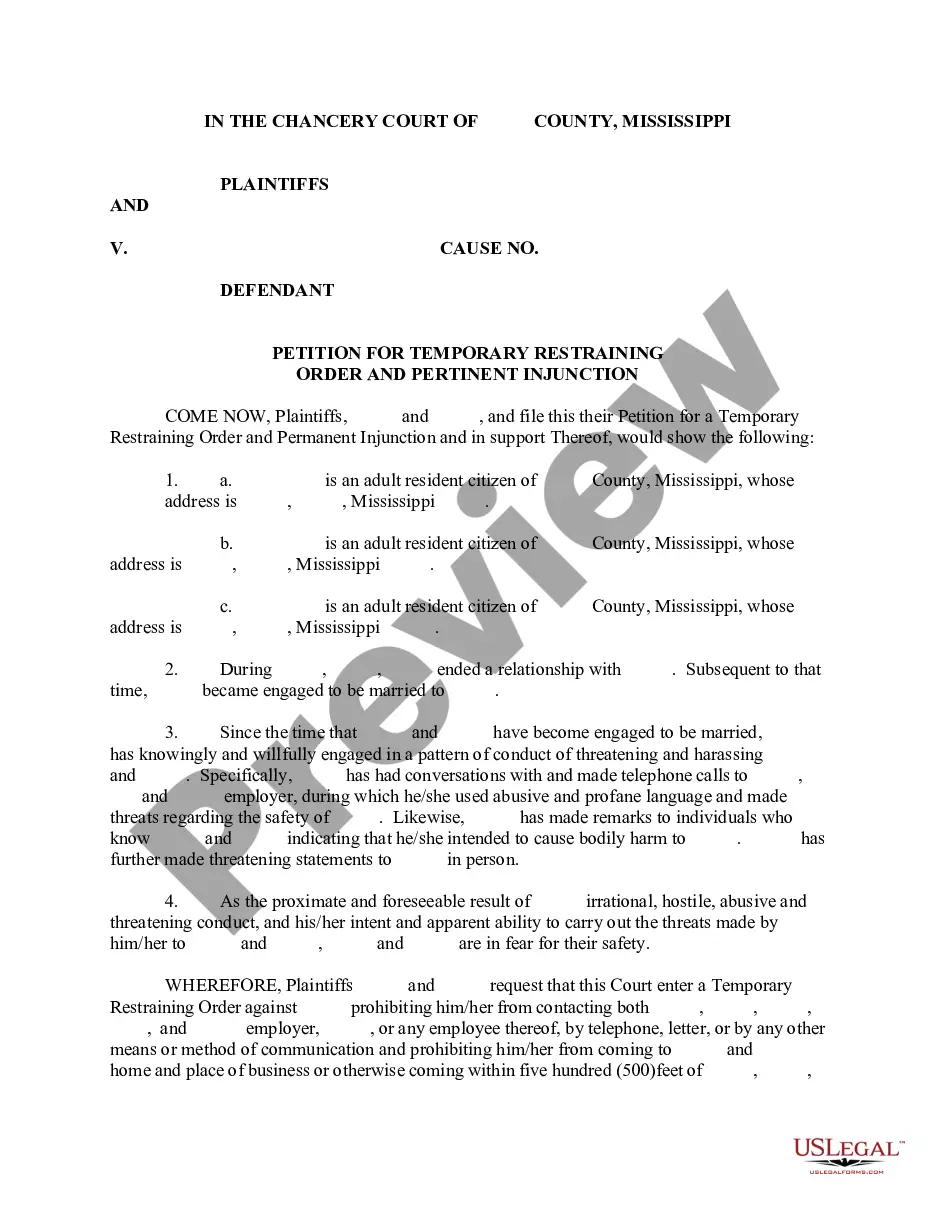
A temporary restraining order may be issued with or without notice, based on a declaration that, to the satisfaction of the court, shows reasonable proof of harassment of the petitioner by the respondent, and that great or irreparable harm would result to the petitioner.
A permanent order of protection is not really permanent. It typically is for one year, but sometimes expires after 5 years. If There Is an Order of Protection Against Me, Will I Have a Criminal Record? An order of protection alone will not cause you to have a criminal history.
