Motion For Temporary Restraining Order And Preliminary Injunction In Illinois
Description
















Get your form ready online
Our built-in tools help you complete, sign, share, and store your documents in one place.
Make edits, fill in missing information, and update formatting in US Legal Forms—just like you would in MS Word.
Download a copy, print it, send it by email, or mail it via USPS—whatever works best for your next step.
Sign and collect signatures with our SignNow integration. Send to multiple recipients, set reminders, and more. Go Premium to unlock E-Sign.
If this form requires notarization, complete it online through a secure video call—no need to meet a notary in person or wait for an appointment.
We protect your documents and personal data by following strict security and privacy standards.

Make edits, fill in missing information, and update formatting in US Legal Forms—just like you would in MS Word.

Download a copy, print it, send it by email, or mail it via USPS—whatever works best for your next step.

Sign and collect signatures with our SignNow integration. Send to multiple recipients, set reminders, and more. Go Premium to unlock E-Sign.

If this form requires notarization, complete it online through a secure video call—no need to meet a notary in person or wait for an appointment.

We protect your documents and personal data by following strict security and privacy standards.
Looking for another form?



Form popularity
FAQ
After a motion for a preliminary injunction has been filed, the court will often hold a hearing to determine whether to issue it. The preliminary injunction hearing can serve as a “mini-trial” on the merits of the plaintiff's case, albeit on an expedited basis with limited evidence.
A temporary restraining order (TRO) is a short-term pre-trial temporary injunction. To obtain a TRO, a party must convince the judge that they will suffer immediate irreparable injury unless the order is issued.
To get a preliminary injunction, the plaintiff must show four things: Likelihood of success on the merits: They must show they will win the case. Irreparable harm: They must prove that without the injunction, they will suffer harm that can't be fixed later, like losing something valuable or unique.
Taking a medical malpractice lawsuit as an example, if a patient believes that their doctor has provided negligent medical care that has caused them harm, the patient may seek a preliminary injunction to prevent the doctor from continuing to provide care.
TROs: A TRO can be requested if immediate harm or danger is shown. Preliminary Injunctions: These are used in serious cases where the harm to the plaintiff is significant and immediate, and the other party is not greatly affected.
To cover those situations in which notice cannot be reasonably given, Rule 65 provides for temporary restraining orders (or TROs), A temporary restraining order is like a preliminary injunction but, if it is issued without notice to the adverse party, its duration is limited to ten days.
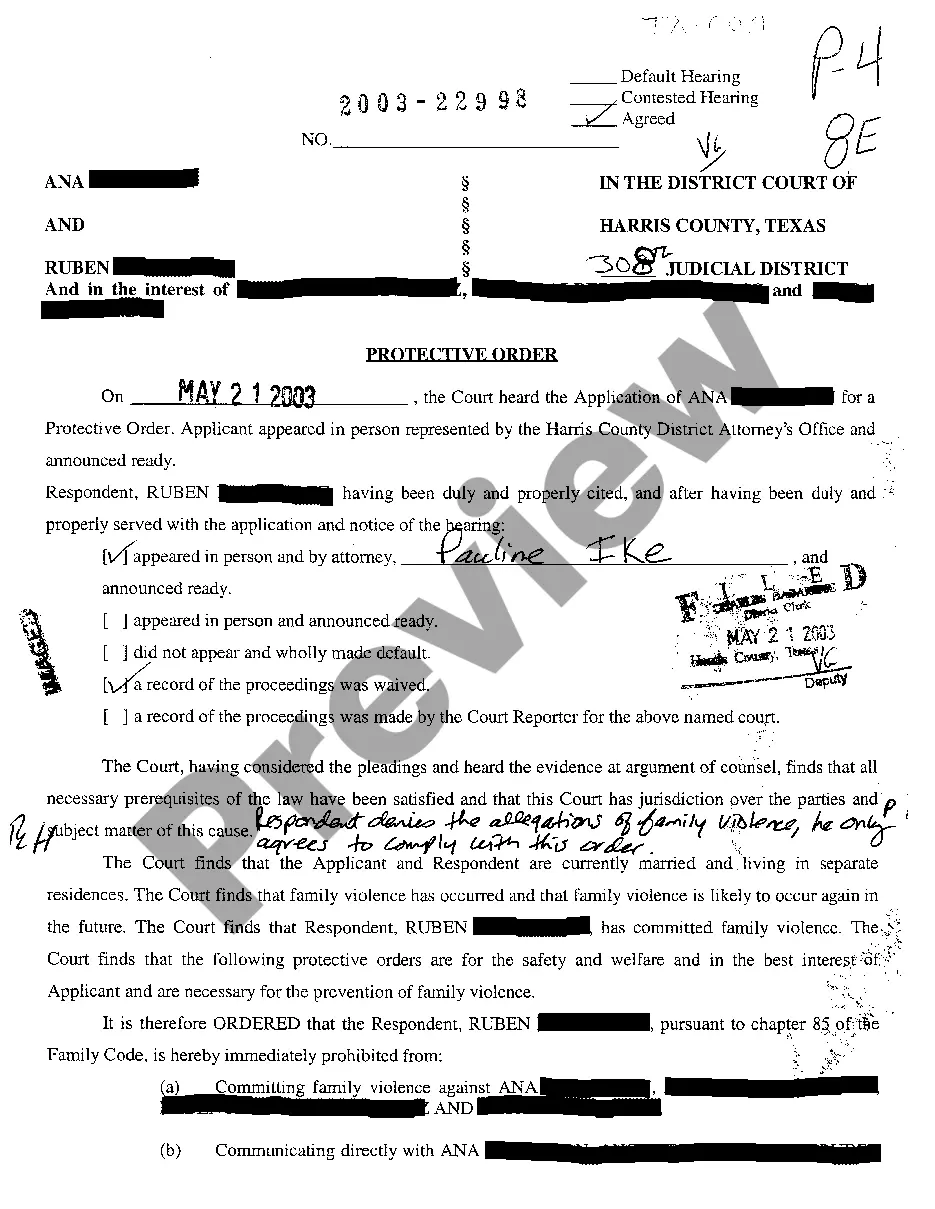
To obtain an Order of Protection, you can: Contact a domestic violence program for assistance. Ask an attorney to file in civil court. Request an order with your divorce. Request an order during a criminal prosecution.
Injunctions may preserve and safeguard assets or evidence, or may restrain people from committing certain acts. Mandatory orders require the other party to perform certain acts such as returning property.
Temporary restraining orders (TROs) are a type of short-term injunction issued to prevent a party from taking a certain action until the court is able to issue a more enduring order, such as a preliminary injunction. TROs are a type of equitable remedy.
