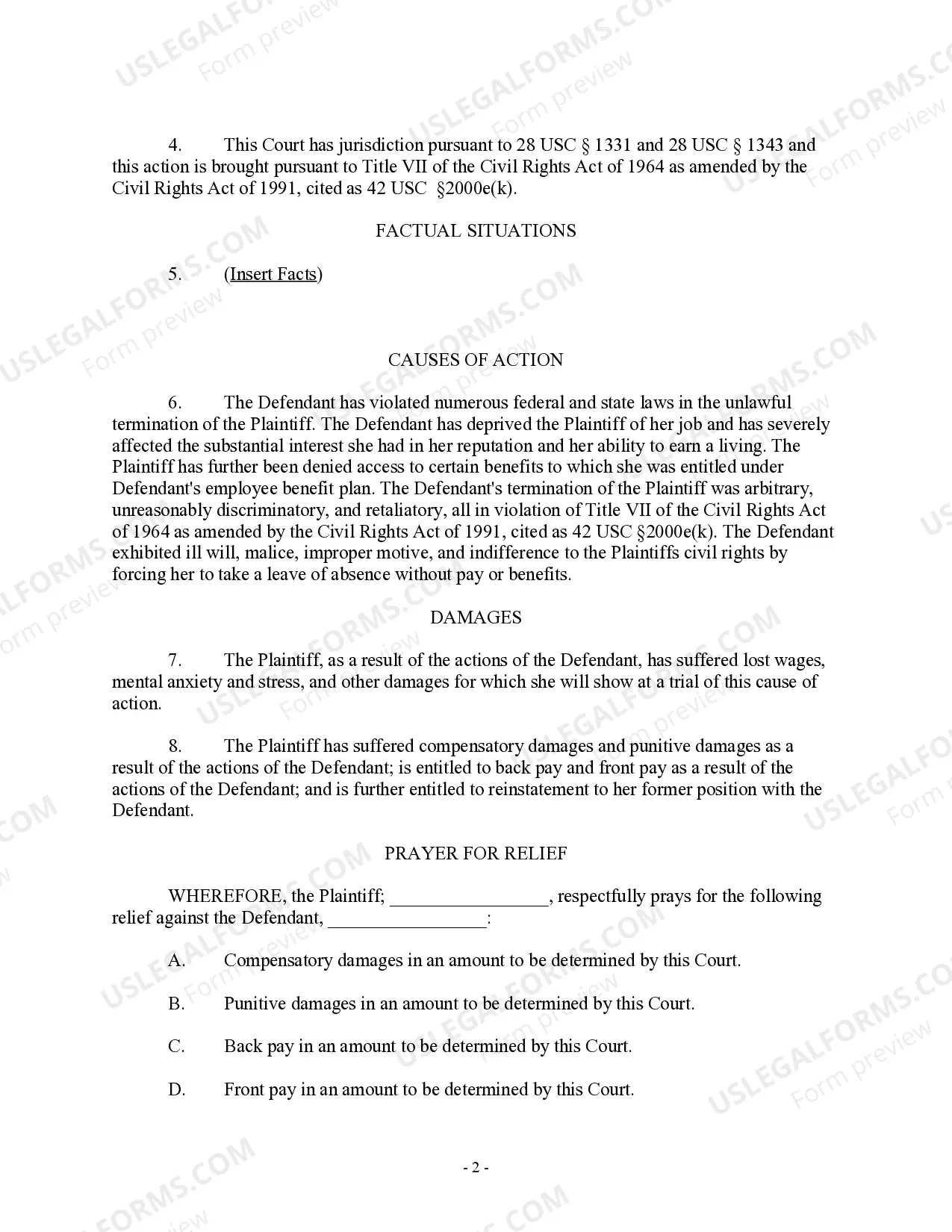
This is a multi-state form covering the subject matter of the title.
Wrongful Termination Court Form California In Georgia
State:
Multi-State
Category:
Control #:
US-000291
Format:
Word;
Rich Text
99 downloads
Description
Free preview




Get your form ready online
Our built-in tools help you complete, sign, share, and store your documents in one place.
Built-in online Word editor
Make edits, fill in missing information, and update formatting in US Legal Forms—just like you would in MS Word.
Export easily
Download a copy, print it, send it by email, or mail it via USPS—whatever works best for your next step.
E-sign your document
Sign and collect signatures with our SignNow integration. Send to multiple recipients, set reminders, and more. Go Premium to unlock E-Sign.
Notarize online 24/7
If this form requires notarization, complete it online through a secure video call—no need to meet a notary in person or wait for an appointment.
Store your document securely
We protect your documents and personal data by following strict security and privacy standards.

Make edits, fill in missing information, and update formatting in US Legal Forms—just like you would in MS Word.

Download a copy, print it, send it by email, or mail it via USPS—whatever works best for your next step.

Sign and collect signatures with our SignNow integration. Send to multiple recipients, set reminders, and more. Go Premium to unlock E-Sign.

If this form requires notarization, complete it online through a secure video call—no need to meet a notary in person or wait for an appointment.

We protect your documents and personal data by following strict security and privacy standards.
Looking for another form?








Form popularity
FAQ
Georgia also does not recognize a claim for “wrongful termination,” as Georgia is an “employment-at-will” state. This means that, in the absence of an enforceable employment contract or a violation of any anti-discrimination laws or federal statutes, employees in Georgia can be terminated at will.
Proving a case of wrongful termination involves presenting compelling evidence, such as the following: Employment Records: Maintain detailed records of employment, including performance evaluations, commendations, and any documents indicating positive job performance.
Georgia also does not recognize a claim for “wrongful termination,” as Georgia is an “employment-at-will” state. This means that, in the absence of an enforceable employment contract or a violation of any anti-discrimination laws or federal statutes, employees in Georgia can be terminated at will.
In almost all cases, you cannot sue your employer for a workplace injury in Georgia. This is because accepting Workers' Compensation means you forfeit the right to sue your employer for a worksite injury.
They have to show that being fired broke a contract, a law against discrimination, or public policy. This usually means showing proof, like written contracts, comments from their bosses, or records of discriminatory behavior, retaliation, or violations of their protected rights that led to their firing.
Discrimination and retaliation claims are typically proven either by: (1) direct evidence—i.e., and admission by the decision-maker that the termination was based on the employee's age, race/color, gender, disability, national origin, religion, pregnancy, genetic information or veteran status, or retaliation for ...
At-Will Employment in Florida and Georgia Florida and Georgia are both “at-will” employment states. This term essentially means that your employer can terminate your employment at any time, for almost any reason—or no reason at all—without prior notice.