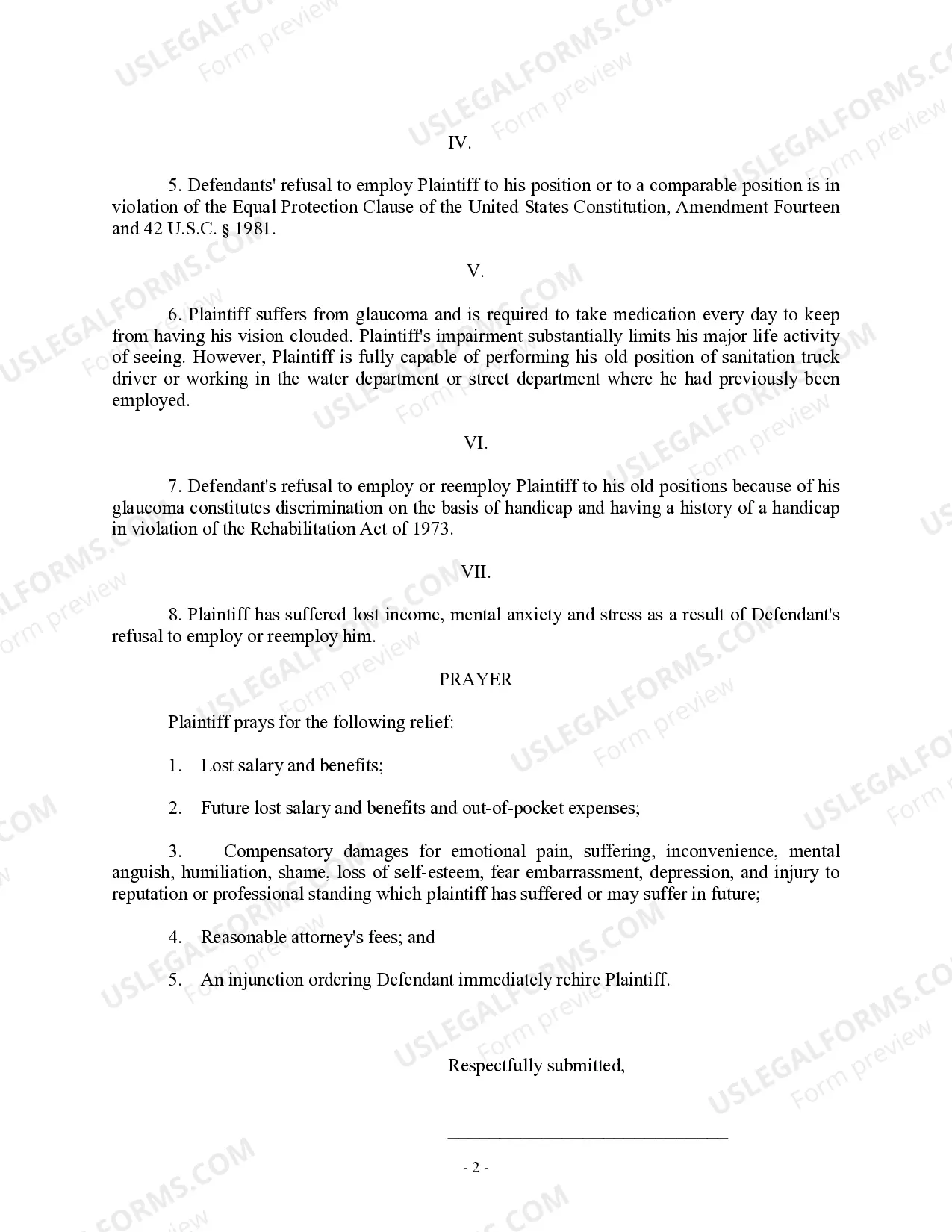
Plaintiff seeks to recover actual, compensatory, liquidated, and punitive damages for discrimination based upon discrimination concerning his disability. Plaintiff submits a request to the court for lost salary and benefits, future lost salary and benefits, and compensatory damages for emotional pain and suffering.
Discrimination For Pregnancy In Texas
State:
Multi-State
Category:
Control #:
US-000286
Format:
Word;
Rich Text
143 downloads
Description
Free preview





Get your form ready online
Our built-in tools help you complete, sign, share, and store your documents in one place.
Built-in online Word editor
Make edits, fill in missing information, and update formatting in US Legal Forms—just like you would in MS Word.
Export easily
Download a copy, print it, send it by email, or mail it via USPS—whatever works best for your next step.
E-sign your document
Sign and collect signatures with our SignNow integration. Send to multiple recipients, set reminders, and more. Go Premium to unlock E-Sign.
Notarize online 24/7
If this form requires notarization, complete it online through a secure video call—no need to meet a notary in person or wait for an appointment.
Store your document securely
We protect your documents and personal data by following strict security and privacy standards.

Make edits, fill in missing information, and update formatting in US Legal Forms—just like you would in MS Word.

Download a copy, print it, send it by email, or mail it via USPS—whatever works best for your next step.

Sign and collect signatures with our SignNow integration. Send to multiple recipients, set reminders, and more. Go Premium to unlock E-Sign.

If this form requires notarization, complete it online through a secure video call—no need to meet a notary in person or wait for an appointment.

We protect your documents and personal data by following strict security and privacy standards.
Looking for another form?







Form popularity
FAQ
Proving pregnancy discrimination requires more than a victim's claim. There must be evidence that the employer acted against the individual exclusively based on their pregnancy. That evidence must be clear, inarguable, and documented.
Generally, the Pregnant Workers Fairness Act (PWFA) requires a covered employer to provide a “reasonable accommodation” to a qualified employee's or applicant's known limitations related to, affected by, or arising out of pregnancy, childbirth, or related medical conditions, unless the accommodation will cause the ...
Violations have involved a variety of fact patterns, including: refusing to hire, failing to promote, demoting, or firing pregnant workers after learning they are pregnant; discharging workers who take medical leave for pregnancy-related conditions (such as a miscarriage);
The PWFA requires “covered employers” to provide “reasonable accommodations” to an employee's known limitations due to pregnancy, childbirth, or related medical conditions unless the employer can prove “undue hardship” due to such accommodations.
The long-awaited Pregnant Workers Fairness Act (PWFA) went into effect Tuesday, June 27, 2023. This exciting new law will increase protections for many pregnant workers who previously may not have been entitled to reasonable accommodations related to their pregnancy under other federal laws.
Employers must treat employees who are pregnant the same as they would treat any other employee who is temporarily disabled or restricted in work abilities. A pregnant employee who has work limitations must receive the same reasonable accommodations that other employees with work restrictions receive.
To successfully win a pregnancy discrimination claim, an employee must provide evidence showing that her pregnancy was a substantial motivating reason for an adverse employment (such as a demotion, a write up and, of course, a termination) and that other employees in similar situations were treated differently.
The Pregnancy Discrimination Act (PDA) prohibits employers with a minimum of 15 employees from: Refusing to hire a woman because of pregnancy. Firing or forcing a woman to leave her position because of pregnancy.
To successfully win a pregnancy discrimination claim, an employee must provide evidence showing that her pregnancy was a substantial motivating reason for an adverse employment (such as a demotion, a write up and, of course, a termination) and that other employees in similar situations were treated differently.