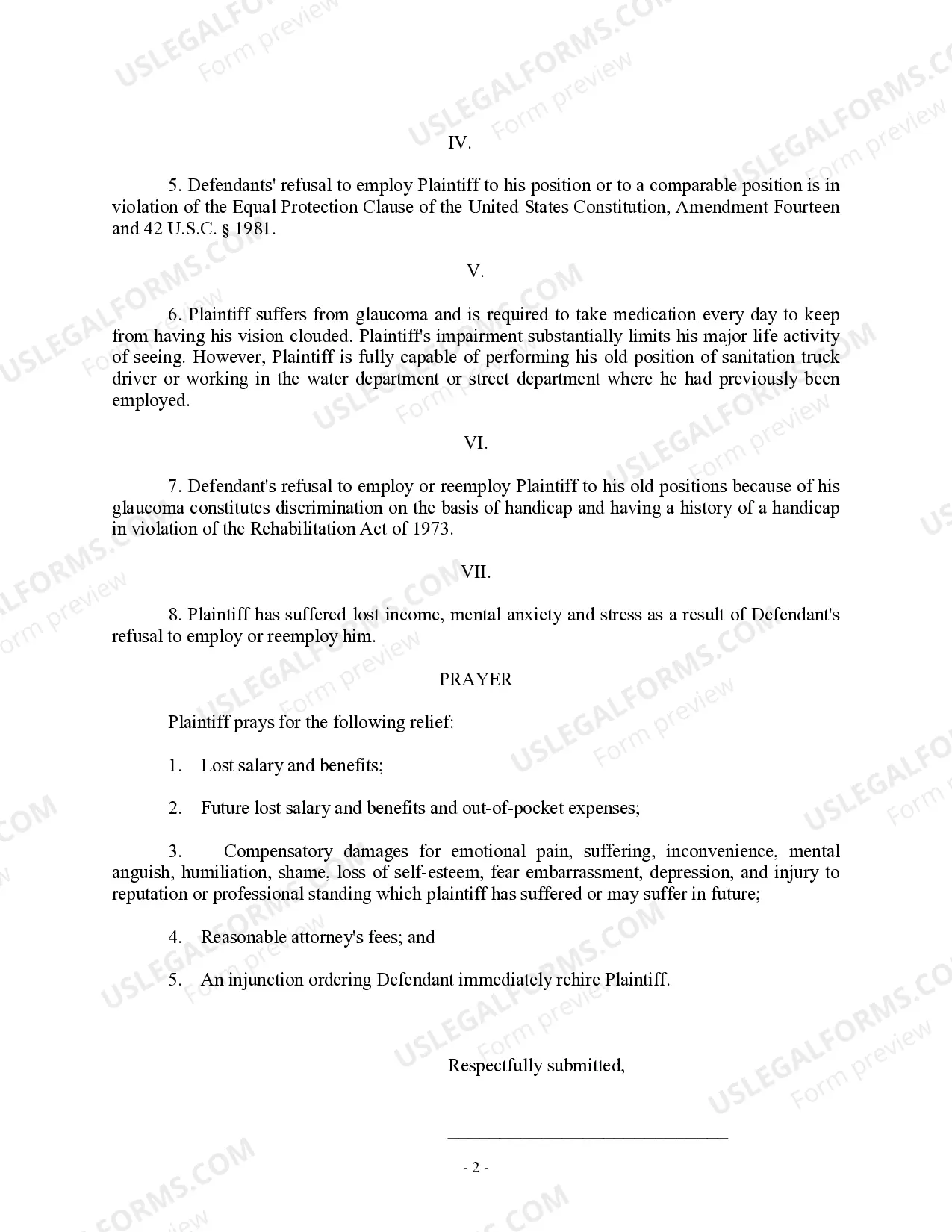
Plaintiff seeks to recover actual, compensatory, liquidated, and punitive damages for discrimination based upon discrimination concerning his disability. Plaintiff submits a request to the court for lost salary and benefits, future lost salary and benefits, and compensatory damages for emotional pain and suffering.
Discriminant Formula In Santa Clara
State:
Multi-State
Category:
County:
Santa Clara
Control #:
US-000286
Format:
Word;
Rich Text
143 downloads
Description
Free preview





Get your form ready online
Our built-in tools help you complete, sign, share, and store your documents in one place.
Built-in online Word editor
Make edits, fill in missing information, and update formatting in US Legal Forms—just like you would in MS Word.
Export easily
Download a copy, print it, send it by email, or mail it via USPS—whatever works best for your next step.
E-sign your document
Sign and collect signatures with our SignNow integration. Send to multiple recipients, set reminders, and more. Go Premium to unlock E-Sign.
Notarize online 24/7
If this form requires notarization, complete it online through a secure video call—no need to meet a notary in person or wait for an appointment.
Store your document securely
We protect your documents and personal data by following strict security and privacy standards.

Make edits, fill in missing information, and update formatting in US Legal Forms—just like you would in MS Word.

Download a copy, print it, send it by email, or mail it via USPS—whatever works best for your next step.

Sign and collect signatures with our SignNow integration. Send to multiple recipients, set reminders, and more. Go Premium to unlock E-Sign.

If this form requires notarization, complete it online through a secure video call—no need to meet a notary in person or wait for an appointment.

We protect your documents and personal data by following strict security and privacy standards.
Looking for another form?










Form popularity
FAQ
To find the discriminant given the quadratic equation f(x)=ax^2+bx+c, simply record the values of a, b, and c and then substitute them into the discriminant formula: d=b^2-4ac. This will give the value of the discriminant. This also tells the number of roots and whether or not the roots are real or imaginary.
The discriminant is the part of the quadratic formula underneath the square root symbol: b²-4ac.
The discriminant is the part of the quadratic formula underneath the square root symbol: b²-4ac. The discriminant tells us whether there are two solutions, one solution, or no solutions.
A root is nothing but the x-coordinate of the x-intercept of the quadratic function. The graph of a quadratic function in each of these 3 cases can be as follows. Important Notes on Discriminant: The discriminant of a quadratic equation ax2 + bx + c = 0 is Δ OR D = b2 − 4ac.
The value of the discriminant shows how many roots f(x) has: - If b2 – 4ac > 0 then the quadratic function has two distinct real roots. - If b2 – 4ac = 0 then the quadratic function has one repeated real root. - If b2 – 4ac < 0 then the quadratic function has no real roots.
The roots are calculated using the formula, x = (-b ± √ (b2 - 4ac) )/2a. Discriminant is, D = b2 - 4ac.
Quadratic Polynomials The quantity b2−4ac is called the discriminant of the polynomial. If b2−4ac < 0 the equation has no real number solutions, but it does have complex solutions. If b2−4ac = 0 the equation has a repeated real number root. If b2−4ac > 0 the equation has two distinct real number roots.
To find the discriminant given the quadratic equation f(x)=ax^2+bx+c, simply record the values of a, b, and c and then substitute them into the discriminant formula: d=b^2-4ac. This will give the value of the discriminant. This also tells the number of roots and whether or not the roots are real or imaginary.
Examples of quadratic equations include all of these: y = x^2 + 3x + 1. y = x^2. y = 2x^2 + 4x - 9.