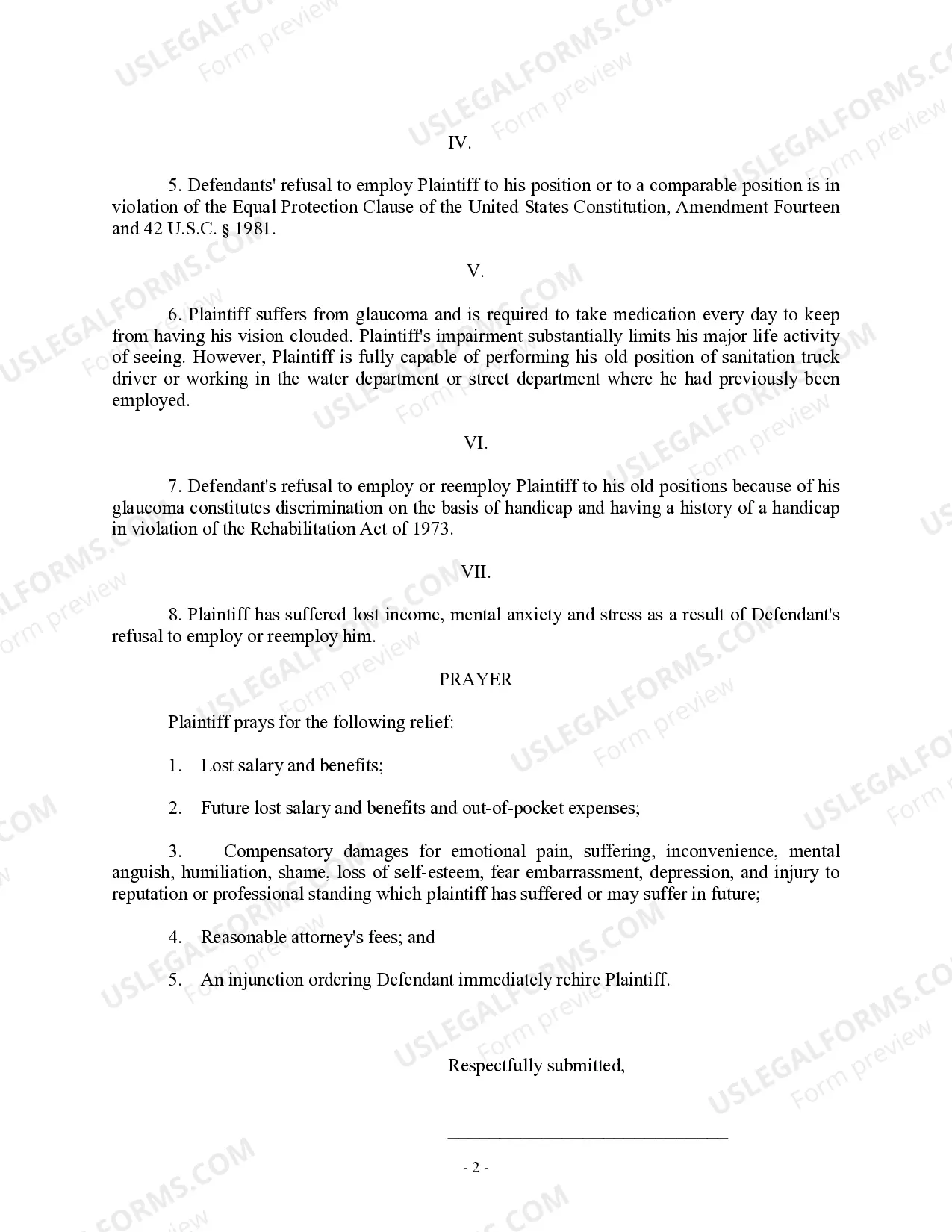
Plaintiff seeks to recover actual, compensatory, liquidated, and punitive damages for discrimination based upon discrimination concerning his disability. Plaintiff submits a request to the court for lost salary and benefits, future lost salary and benefits, and compensatory damages for emotional pain and suffering.
Discrimination For Religion In Ohio
State:
Multi-State
Category:
Control #:
US-000286
Format:
Word;
Rich Text
143 downloads
Description
Free preview





Get your form ready online
Our built-in tools help you complete, sign, share, and store your documents in one place.
Built-in online Word editor
Make edits, fill in missing information, and update formatting in US Legal Forms—just like you would in MS Word.
Export easily
Download a copy, print it, send it by email, or mail it via USPS—whatever works best for your next step.
E-sign your document
Sign and collect signatures with our SignNow integration. Send to multiple recipients, set reminders, and more. Go Premium to unlock E-Sign.
Notarize online 24/7
If this form requires notarization, complete it online through a secure video call—no need to meet a notary in person or wait for an appointment.
Store your document securely
We protect your documents and personal data by following strict security and privacy standards.

Make edits, fill in missing information, and update formatting in US Legal Forms—just like you would in MS Word.

Download a copy, print it, send it by email, or mail it via USPS—whatever works best for your next step.

Sign and collect signatures with our SignNow integration. Send to multiple recipients, set reminders, and more. Go Premium to unlock E-Sign.

If this form requires notarization, complete it online through a secure video call—no need to meet a notary in person or wait for an appointment.

We protect your documents and personal data by following strict security and privacy standards.
Looking for another form?
Form popularity
FAQ
A. Religious discrimination is treating individuals differently because of their religious beliefs and practices, and/or their request for accommodations of their religious beliefs and practices. It also includes treating individuals differently because of their lack of religious beliefs or practices.
No person shall be compelled to attend, erect, or support any place of worship, or maintain any form of worship, against his consent; and no preference shall be given, by law, to any religious society; nor shall any interference with the rights of conscience be permitted.
Charges of discrimination can be filed against employers with four (4) or more employees. The act of discrimination must have occurred no more than two years prior to the date of filing.
Each state institution of higher education, as defined in section 3345.011 of the Revised Code, shall adopt a policy that reasonably accommodates the sincerely held religious beliefs and practices of individual students with regard to all examinations or other academic requirements and absences for reasons of faith or ...
The following would be considered illegal discrimination if there is evidence that the decision was made based on a protected characteristic: Sexual Harassment. Refusal to Provide Services. Unfair Lending Practices. Misrepresenting the Availability of Housing. Refusal to Allow “Reasonable Modifications” Refusing Rental.
If you win your case, you are eligible to recover income you would have earned had there been no discrimination. For instance, if you made a salary of $85,000 per year, and were terminated because of your religious beliefs, you could be awarded $85,000 for every year you couldn't find work.
Discrimination and retaliation settlements can range from the millions to just a few thousand, or even less. There is no magic formula to figure out what your case is worth. And while every case is different, some factors come up in most cases. The amount of the employee's economic loss is always important to consider.
Proving religious discrimination The harassment occurred because of, or was motivated by, religion. The conduct was pervasive or severe. The conduct had a detrimental effect on the plaintiff and. The harassment would have had such an effect on a reasonable person of the same religion in that position.
If you win your case, you are eligible to recover income you would have earned had there been no discrimination. For instance, if you made a salary of $85,000 per year, and were terminated because of your religious beliefs, you could be awarded $85,000 for every year you couldn't find work.
However, discrimination is a state of mind and, therefore, notoriously hard to prove. Sophisticated employers are well aware that discrimination is illegal. Thus, most cases are established through circumstantial evidence.