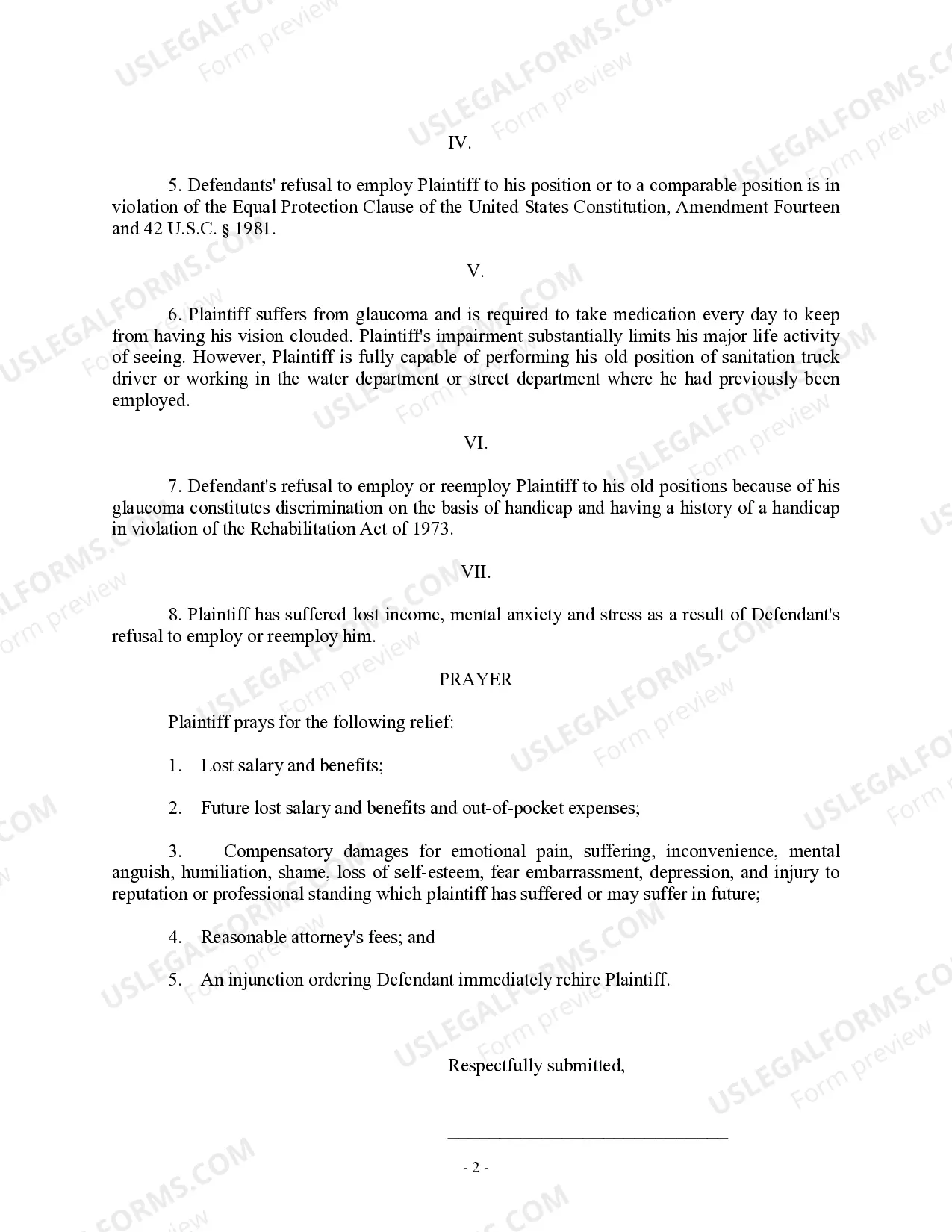
Plaintiff seeks to recover actual, compensatory, liquidated, and punitive damages for discrimination based upon discrimination concerning his disability. Plaintiff submits a request to the court for lost salary and benefits, future lost salary and benefits, and compensatory damages for emotional pain and suffering.
Discrimination With Ai In King
State:
Multi-State
Category:
County:
King
Control #:
US-000286
Format:
Word;
Rich Text
143 downloads
Description
Free preview





Get your form ready online
Our built-in tools help you complete, sign, share, and store your documents in one place.
Built-in online Word editor
Make edits, fill in missing information, and update formatting in US Legal Forms—just like you would in MS Word.
Export easily
Download a copy, print it, send it by email, or mail it via USPS—whatever works best for your next step.
E-sign your document
Sign and collect signatures with our SignNow integration. Send to multiple recipients, set reminders, and more. Go Premium to unlock E-Sign.
Notarize online 24/7
If this form requires notarization, complete it online through a secure video call—no need to meet a notary in person or wait for an appointment.
Store your document securely
We protect your documents and personal data by following strict security and privacy standards.

Make edits, fill in missing information, and update formatting in US Legal Forms—just like you would in MS Word.

Download a copy, print it, send it by email, or mail it via USPS—whatever works best for your next step.

Sign and collect signatures with our SignNow integration. Send to multiple recipients, set reminders, and more. Go Premium to unlock E-Sign.

If this form requires notarization, complete it online through a secure video call—no need to meet a notary in person or wait for an appointment.

We protect your documents and personal data by following strict security and privacy standards.
Looking for another form?







Form popularity
FAQ
An example is when a facial recognition system is less accurate in identifying people of color or when a language translation system associates certain languages with certain genders or stereotypes.
The “Online Civil Rights Act” seeks to both mitigate and prevent current, ongoing harms while also providing a broad, tech-neutral regulatory and governance regime to sufficiently address generative AI and further technological development in this space.
Disability bias is rife in trained AI models, ing to recent research from Penn State. Here's what we can do about it. AI continues to pervade our work lives. ing to recent research by the Society for Human Resource Management, one in four employers use AI in human resources functions.
5 strategies to mitigate AI bias Diverse data collection. AI systems are better equipped to make fair and accurate decisions when your training data includes a wide range of scenarios and demographic groups. Bias testing. Human oversight. Algorithmic fairness techniques. Transparency and accountability.
Types of Bias in AI Selection bias: This happens when the data used to train an AI system is not representative of the reality it's meant to model. It can occur due to various reasons, such as incomplete data, biased sampling, or other factors that may lead to an unrepresentative dataset.
Researchers have identified three categories of bias in AI: algorithmic prejudice, negative legacy, and underestimation. Algorithmic prejudice occurs when there is a statistical dependence between protected features and other information used to make a decision.
The most common classification of bias in artificial intelligence takes the source of prejudice as the base criterion, putting AI biases into three categories—algorithmic, data, and human.
“When women use some AI-powered systems to diagnose illnesses, they often receive inaccurate answers, because the AI is not aware of symptoms that may present differently in women.”
What are the three sources of bias in AI? Researchers have identified three types of bias in AI: algorithmic, data, and human.