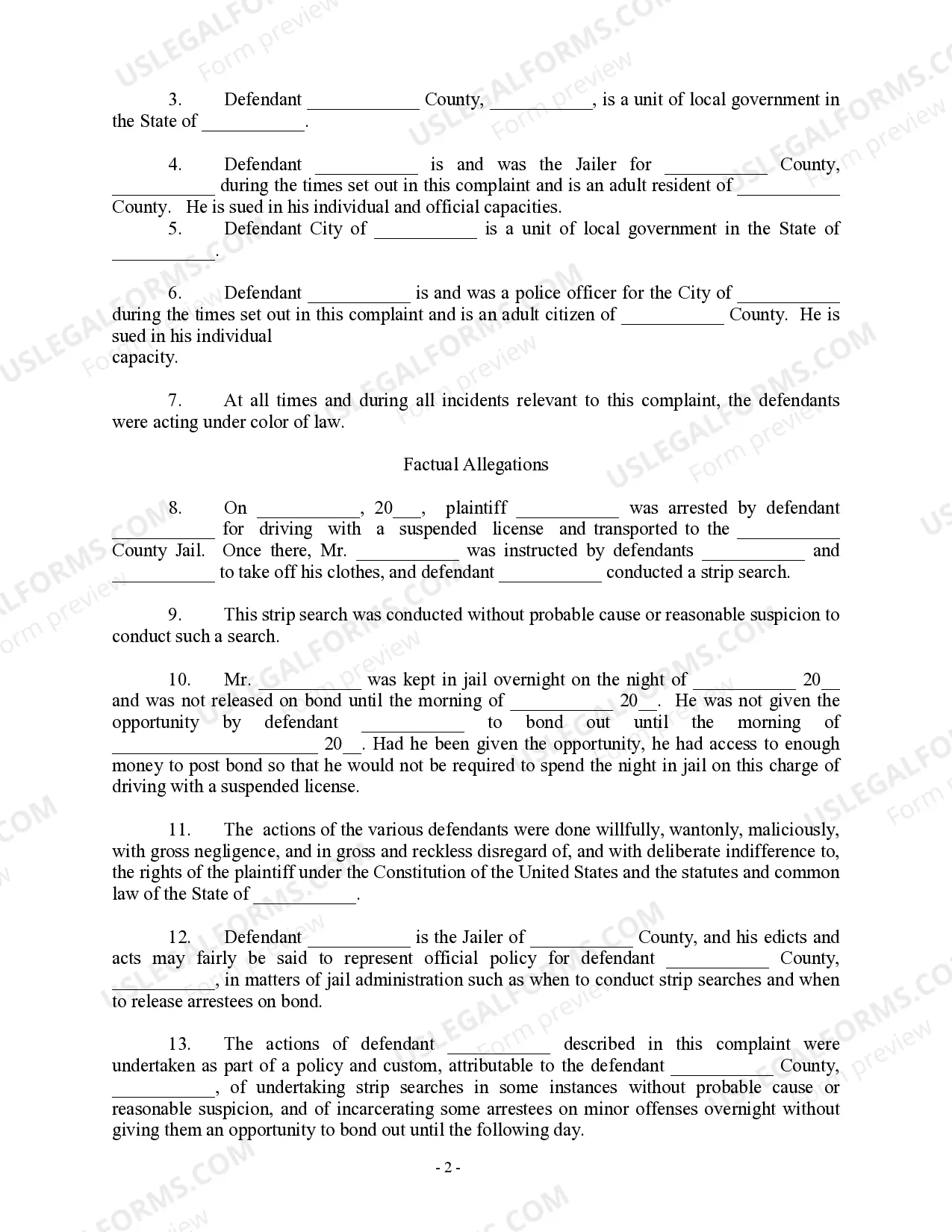
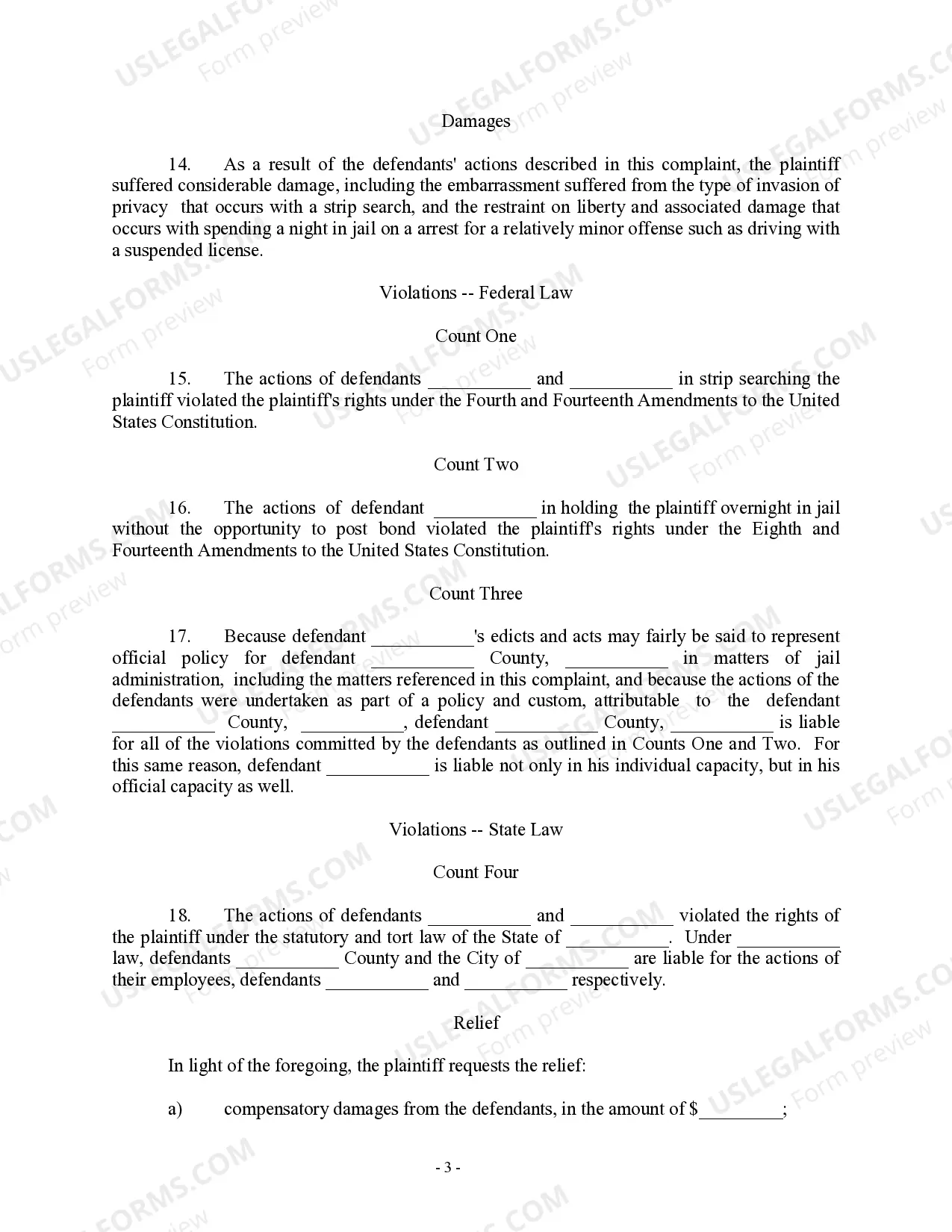
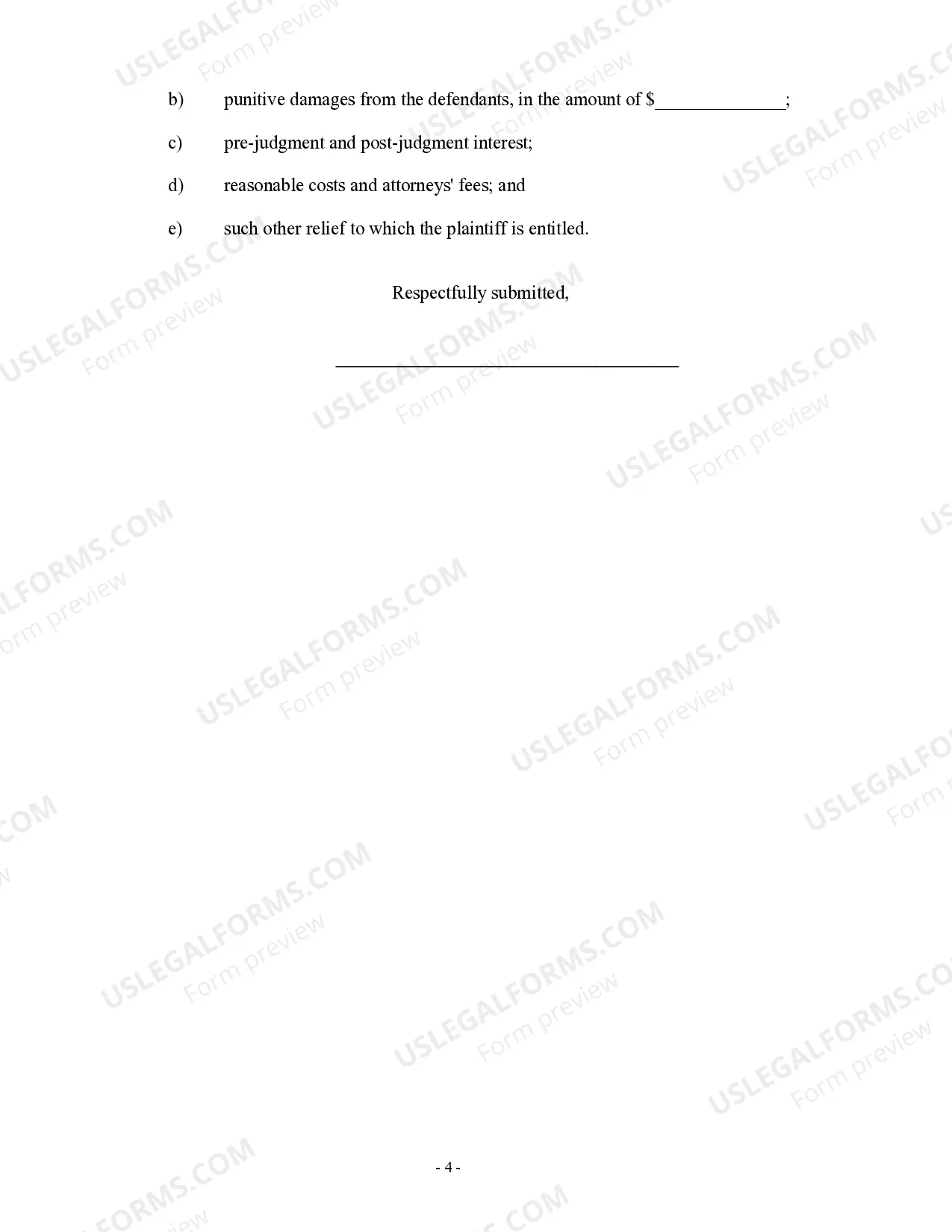
This form is a Complaint. This action was filed by the plaintiff due to a strip search which was conducted upon his/her person after an arrest. The plaintiff requests that he/she be awarded compensatory damages and punitive damages for the alleged violation of his/her constitutional rights.
Search Amendment With Schools In Kings
State:
Multi-State
Category:
County:
Kings
Control #:
US-000282
Format:
Word;
Rich Text
81 downloads
Description
Free preview




Get your form ready online
Our built-in tools help you complete, sign, share, and store your documents in one place.
Built-in online Word editor
Make edits, fill in missing information, and update formatting in US Legal Forms—just like you would in MS Word.
Export easily
Download a copy, print it, send it by email, or mail it via USPS—whatever works best for your next step.
E-sign your document
Sign and collect signatures with our SignNow integration. Send to multiple recipients, set reminders, and more. Go Premium to unlock E-Sign.
Notarize online 24/7
If this form requires notarization, complete it online through a secure video call—no need to meet a notary in person or wait for an appointment.
Store your document securely
We protect your documents and personal data by following strict security and privacy standards.

Make edits, fill in missing information, and update formatting in US Legal Forms—just like you would in MS Word.

Download a copy, print it, send it by email, or mail it via USPS—whatever works best for your next step.

Sign and collect signatures with our SignNow integration. Send to multiple recipients, set reminders, and more. Go Premium to unlock E-Sign.

If this form requires notarization, complete it online through a secure video call—no need to meet a notary in person or wait for an appointment.

We protect your documents and personal data by following strict security and privacy standards.
Looking for another form?





Form popularity
FAQ
If you go to a private school, your due process rights may be different, because private schools are not required to obey the Constitution. Some state laws, however, may give you some due process protection in school.
On , U.S. Supreme Court Justice Earl Warren delivered the unanimous ruling in the landmark civil rights case Brown v. Board of Education of Topeka, Kansas. State-sanctioned segregation of public schools was a violation of the 14th amendment and was therefore unconstitutional.
The Equal Protection Clause of the 14th Amendment provides that a state may not “deny to any person within its jurisdiction the equal protection of the laws.” It applies to public elementary and secondary schools, as they are considered to be state actors.
The Fourteenth Amendment to the Constitution of the United States granted citizenship and equal civil and legal rights to anyone born in the United States or who became a citizen of the country. This included African Americans and slaves who had been freed after the American Civil War.
The Fourth Amendment applies to searches conducted by public school officials because “school officials act as representatives of the State, not merely as surrogates for the parents.” 350 However, “the school setting requires some easing of the restrictions to which searches by public authorities are ordinarily subject ...
While education may not be a "fundamental right" under the Constitution, the equal protection clause of the 14th Amendment requires that when a state establishes a public school system (as in Texas), no child living in that state may be denied equal access to schooling.
A: In the United States, including California, the Fifth Amendment right against self-incrimination applies to criminal proceedings, not to academic settings like high schools.
Corporal punishment in schools is not criminal in nature, the court concluded that the eighth amendment was inapplicable in a school setting. The court also held that the due process clause does not require schools to conduct pre- paddling hearings.
Corporal punishment in schools is not criminal in nature, the court concluded that the eighth amendment was inapplicable in a school setting. The court also held that the due process clause does not require schools to conduct pre- paddling hearings.
The cruel and unusual punishment clause of the Eighth Amendment does not apply to disciplinary corporal punishment in the public schools. Students subjected to corporal punishment in the schools have a "liberty" interest for purposes of procedural due process.