Tort Negligence Liability For Psychiatric Damage In San Bernardino
Description





Get your form ready online
Our built-in tools help you complete, sign, share, and store your documents in one place.
Make edits, fill in missing information, and update formatting in US Legal Forms—just like you would in MS Word.
Download a copy, print it, send it by email, or mail it via USPS—whatever works best for your next step.
Sign and collect signatures with our SignNow integration. Send to multiple recipients, set reminders, and more. Go Premium to unlock E-Sign.
If this form requires notarization, complete it online through a secure video call—no need to meet a notary in person or wait for an appointment.
We protect your documents and personal data by following strict security and privacy standards.

Make edits, fill in missing information, and update formatting in US Legal Forms—just like you would in MS Word.

Download a copy, print it, send it by email, or mail it via USPS—whatever works best for your next step.

Sign and collect signatures with our SignNow integration. Send to multiple recipients, set reminders, and more. Go Premium to unlock E-Sign.

If this form requires notarization, complete it online through a secure video call—no need to meet a notary in person or wait for an appointment.

We protect your documents and personal data by following strict security and privacy standards.
Looking for another form?







Form popularity
FAQ
There are four basic elements of negligence under California state law: duty, breach, causation, and damages. Duty demonstrates the expectation to use reasonable care with regard to others, i.e, “ a duty of care”. This duty is covered by the law.
To file a claim, complete these steps: Complete Standard Form 95. Explain in detail what happened, using additional pages if necessary. Attach all documents that support your claim, which may include the following. Submit the completed Standard Form 95 and supporting documents to the OPM Office of the General Counsel.
As for types of injurious accidents that involve negligence, they run the gamut. Anything from a car accident to a slip-and-fall accident at a restaurant can be grounds for filing a personal injury claim in California.
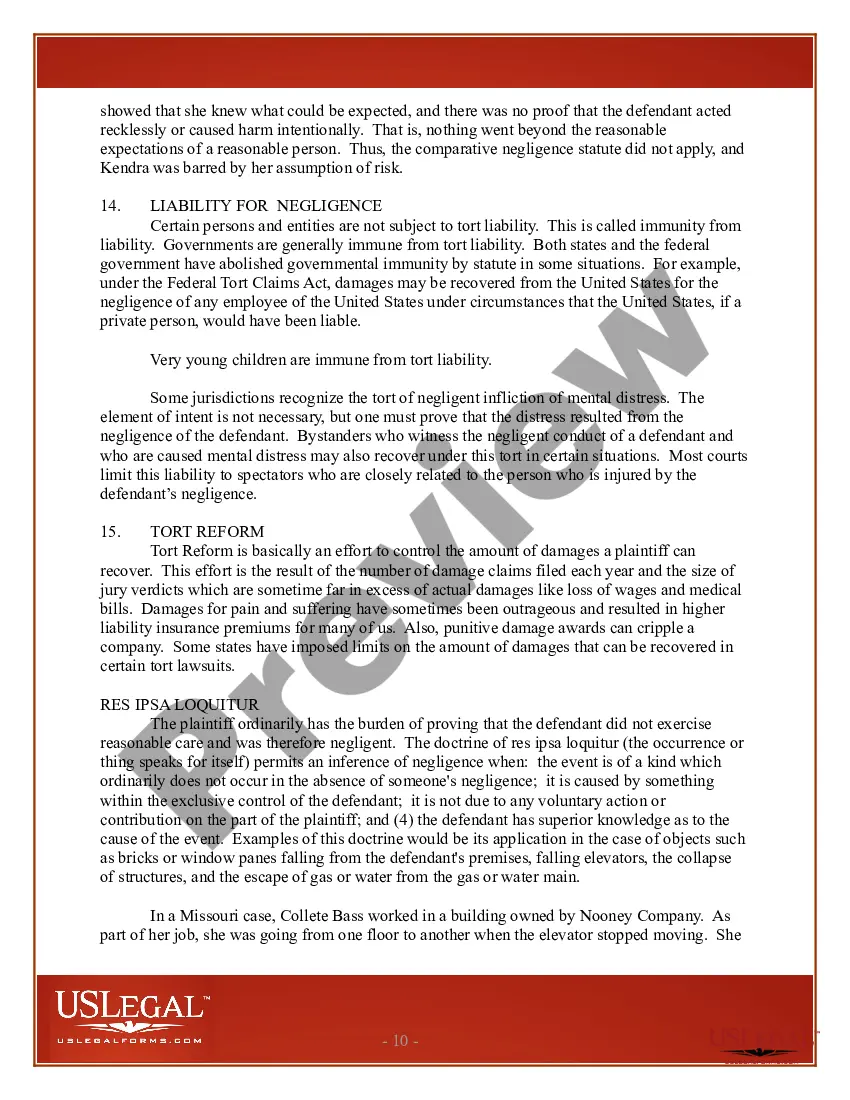
When a person commits a wrongful act that infringes upon the safety, peace or freedom of someone else, it's called a tort. When a person commits a tort on purpose, it's called an intentional tort. When a person commits a tort because they don't act carefully enough, it's called negligence or negligence torts.
California Civil Code 1714 explains that a person can be held responsible for injuries resulting from their reckless, negligent, or intentional actions, even if they didn't mean to cause harm.
The claim form that you submit must contain the following information (1) the name and address of the claimant, (2) the date, place, and circumstances of the occurrence which gave rise to the claim, (3) a general description of the injury and damages to date, (4) the names of the public employee or employees that ...
Torts can be intentional (assault and battery, fraud, conversion, etc.) or negligent (personal injury caused by negligent driving or operating a machine or maintenance of property, etc.)
Under the California Tort Claims Act, any person seeking to recover monetary damages for personal injuries, wrongful death and/or personal property, must file a government claim with each public entity defendant within six months of the accrual of the cause of action.
To file a claim under the CTCA, one must provide timely notice, which includes detailed information such as the claimant's name, address, and description of the incident and loss. There's a six-month deadline for filing a claim from the event causing injury.
There are no general rules related to the time period to file a case. However, you almost always have at least a year to file a civil lawsuit. Depending on the type of case or civil action, it could be much longer. Different statutes of limitations apply to different types of cases and causes of action.
