Tort Negligence Liability For Principals And Agents In Kings
Description




Get your form ready online
Our built-in tools help you complete, sign, share, and store your documents in one place.
Make edits, fill in missing information, and update formatting in US Legal Forms—just like you would in MS Word.
Download a copy, print it, send it by email, or mail it via USPS—whatever works best for your next step.
Sign and collect signatures with our SignNow integration. Send to multiple recipients, set reminders, and more. Go Premium to unlock E-Sign.
If this form requires notarization, complete it online through a secure video call—no need to meet a notary in person or wait for an appointment.
We protect your documents and personal data by following strict security and privacy standards.

Make edits, fill in missing information, and update formatting in US Legal Forms—just like you would in MS Word.

Download a copy, print it, send it by email, or mail it via USPS—whatever works best for your next step.

Sign and collect signatures with our SignNow integration. Send to multiple recipients, set reminders, and more. Go Premium to unlock E-Sign.

If this form requires notarization, complete it online through a secure video call—no need to meet a notary in person or wait for an appointment.

We protect your documents and personal data by following strict security and privacy standards.
Looking for another form?
Form popularity
FAQ
Similarly, if the agent or principal loses capacity to enter into an agency relationship, it is suspended or terminated. The agency terminates if its purpose becomes illegal. Even though authority has terminated, whether by action of the parties or operation of law, the principal may still be subject to liability.
A principal can also be held vicariously liable - or indirectly liable - for their agent's tortious conduct. In this context, the agent is not acting with actual authority when committing the tort, so it is not as if the principal itself committed the tort.
An agent is liable to a principal when he/she acts without actual authority, but with apparent authority. An agent is liable to indemnify a principal for loss or damage resulting from his/her act. A principal owes certain contractual duties to his/her agent.
This is especially true if the third party is made aware of the agent's authority limitations. In this situation, the third party may still attempt to sue the principal for any damages caused. However, the principal can then turn around and sue the agent to recover any damages caused.
A principal can be directly liable for the agent's actions when the agent is acting with actual or true authority on the principal's behalf, or the agent's conduct is ratified by the principal. Restatement (3d) of the Law of Agency, § 7.03; Restatement (3d) of the Law of Agency, § 7.04; Court Opinions.
A person is always liable for her own torts, so an agent who commits a tort is liable; if the tort was in the scope of employment the principal is liable too. Unless the principal put the agent up to committing the tort, the agent will have to reimburse the principal.
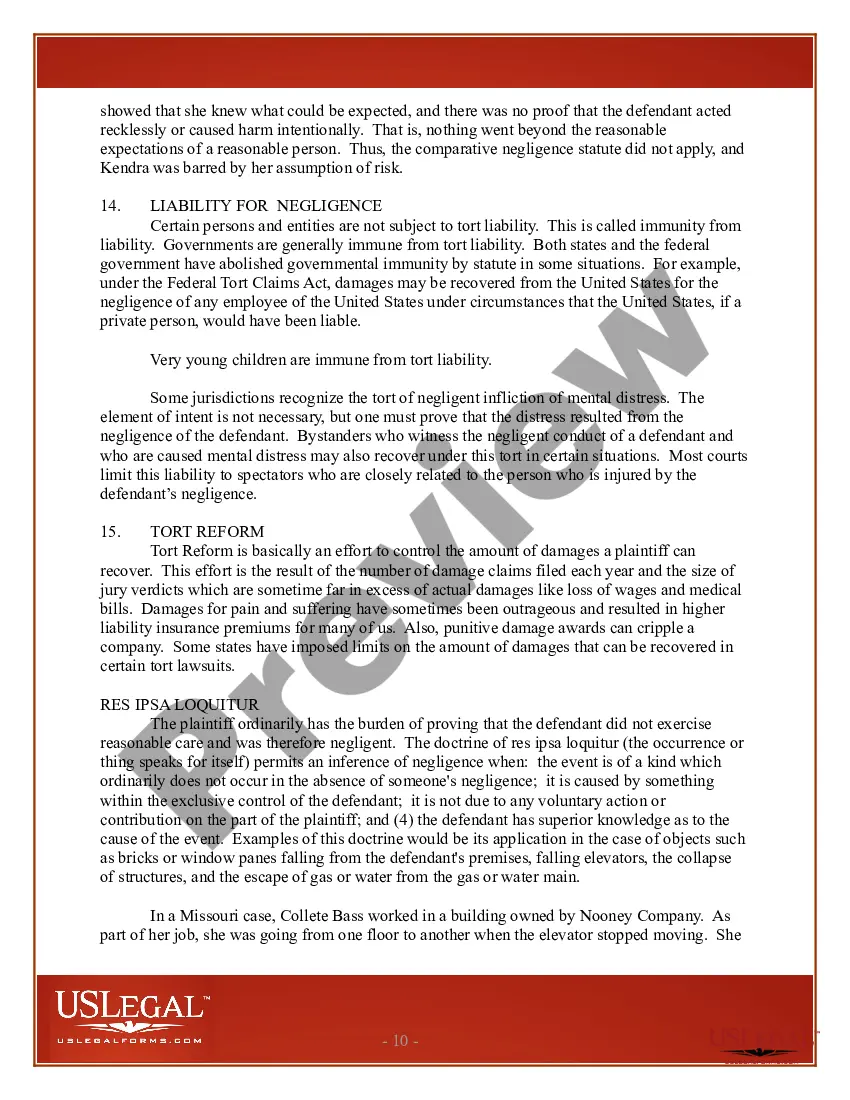
Tort liability is predicated on the existence of proximate cause, which consists of both: (1) causation in fact, and (2) foreseeability. A plaintiff must prove that his or her injuries were the actual or factual result of the defendant's actions.
There are several key responsibilities an agent has with respect to the principal. This includes the duty of loyalty, duty to act in ance with the express and implied terms of a contract, duty of care competence, and diligence, duty of good conduct, and duty to comply with the principal's lawful instructions.
