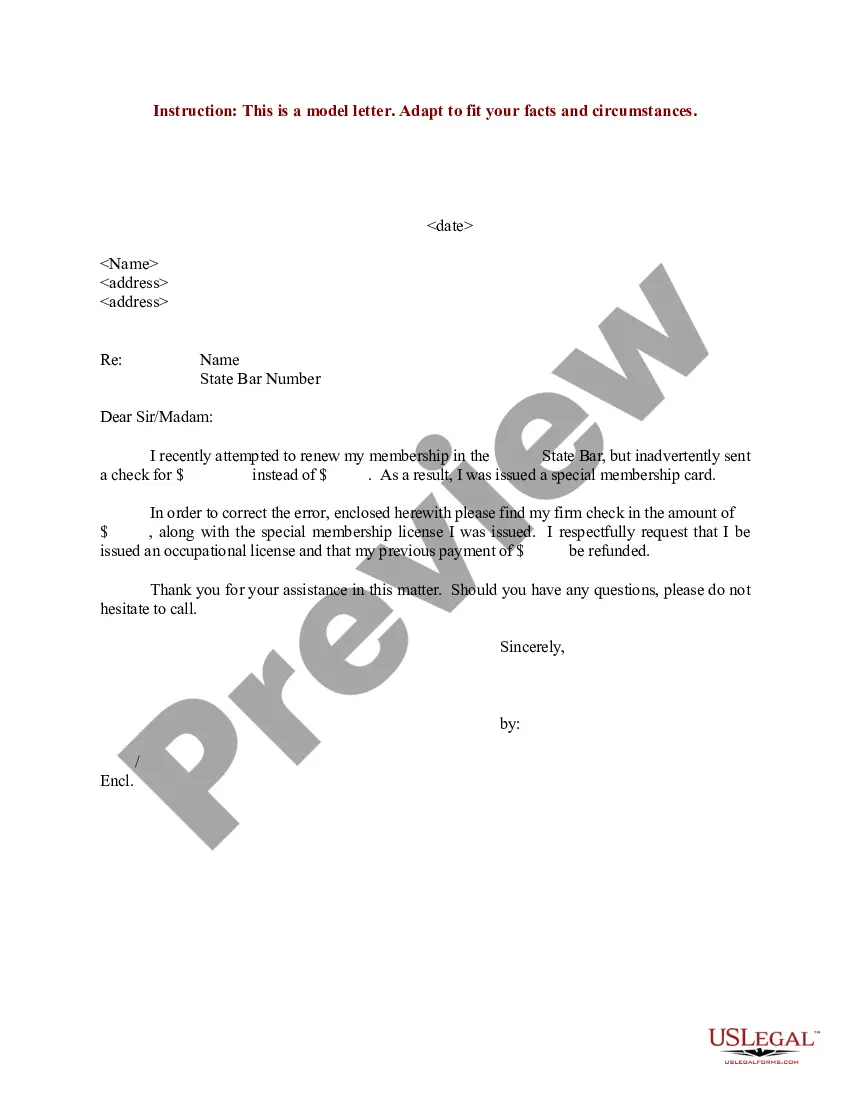
State Bar Of Wisconsin In Massachusetts
Description
Get your form ready online
Our built-in tools help you complete, sign, share, and store your documents in one place.
Make edits, fill in missing information, and update formatting in US Legal Forms—just like you would in MS Word.
Download a copy, print it, send it by email, or mail it via USPS—whatever works best for your next step.
Sign and collect signatures with our SignNow integration. Send to multiple recipients, set reminders, and more. Go Premium to unlock E-Sign.
If this form requires notarization, complete it online through a secure video call—no need to meet a notary in person or wait for an appointment.
We protect your documents and personal data by following strict security and privacy standards.

Make edits, fill in missing information, and update formatting in US Legal Forms—just like you would in MS Word.

Download a copy, print it, send it by email, or mail it via USPS—whatever works best for your next step.

Sign and collect signatures with our SignNow integration. Send to multiple recipients, set reminders, and more. Go Premium to unlock E-Sign.

If this form requires notarization, complete it online through a secure video call—no need to meet a notary in person or wait for an appointment.

We protect your documents and personal data by following strict security and privacy standards.
Looking for another form?
Form popularity
FAQ
Limited reciprocity: New York currently has full reciprocity with only four states: Massachusetts, Ohio, Pennsylvania, and Vermont.
Wisconsin does not offer formal reciprocity with other jurisdictions, but candidates can be accepted to the WI Bar without examination if they can prove that they have been substantially engaged in the practice of law in any US jurisdiction for 3 of the 5 years preceding application submission.
There is no bar reciprocity in California, though the state does offer a modified bar exam to those who have actively practiced law for at least four years immediately preceding their bar application.
Massachusetts has entered into agreements for reciprocity with Connecticut, Kentucky, Maryland, New Jersey, Tennessee, Vermont, and Washington D.C. The Board of Bar Examiners is continuing to work with a number of jurisdictions that will administer the same remote exam to expand this list of reciprocal jurisdictions.
Massachusetts has entered into agreements for reciprocity with Connecticut, Kentucky, Maryland, New Jersey, Tennessee, Vermont, and Washington D.C. The Board of Bar Examiners is continuing to work with a number of jurisdictions that will administer the same remote exam to expand this list of reciprocal jurisdictions.
An attorney from another state may be permitted to practice in Massachusetts if he or she gets permission from the court, but only a local attorney can file that motion for admission pro hac vice. It is not a good idea however to use an out of state attorney.
To become a licensed attorney in MA, you must graduate from an ABA-approved law school or one approved by the Commonwealth, pass the UBE, the MLC, and the MPRE, and apply for the state bar.
In the United States, the diploma privilege is a method for lawyers to be admitted to the bar (i.e. authorized to practice law) without taking a bar examination. Wisconsin is the only jurisdiction that currently allows diploma privilege as an alternative to the bar examination.
The directory maintained by the state bar or its disciplinary board is sometimes called the "Roster of Attorneys" or the "Roll of Attorneys." Six (6) states do not publish a searchable database online. In those jurisdictions, you must call or email the state bar to confirm a lawyer's bar license status or bar number.