Tx Deed Form With Notary
Description
Get your form ready online
Our built-in tools help you complete, sign, share, and store your documents in one place.
Make edits, fill in missing information, and update formatting in US Legal Forms—just like you would in MS Word.
Download a copy, print it, send it by email, or mail it via USPS—whatever works best for your next step.
Sign and collect signatures with our SignNow integration. Send to multiple recipients, set reminders, and more. Go Premium to unlock E-Sign.
If this form requires notarization, complete it online through a secure video call—no need to meet a notary in person or wait for an appointment.
We protect your documents and personal data by following strict security and privacy standards.

Make edits, fill in missing information, and update formatting in US Legal Forms—just like you would in MS Word.

Download a copy, print it, send it by email, or mail it via USPS—whatever works best for your next step.

Sign and collect signatures with our SignNow integration. Send to multiple recipients, set reminders, and more. Go Premium to unlock E-Sign.

If this form requires notarization, complete it online through a secure video call—no need to meet a notary in person or wait for an appointment.

We protect your documents and personal data by following strict security and privacy standards.
Looking for another form?
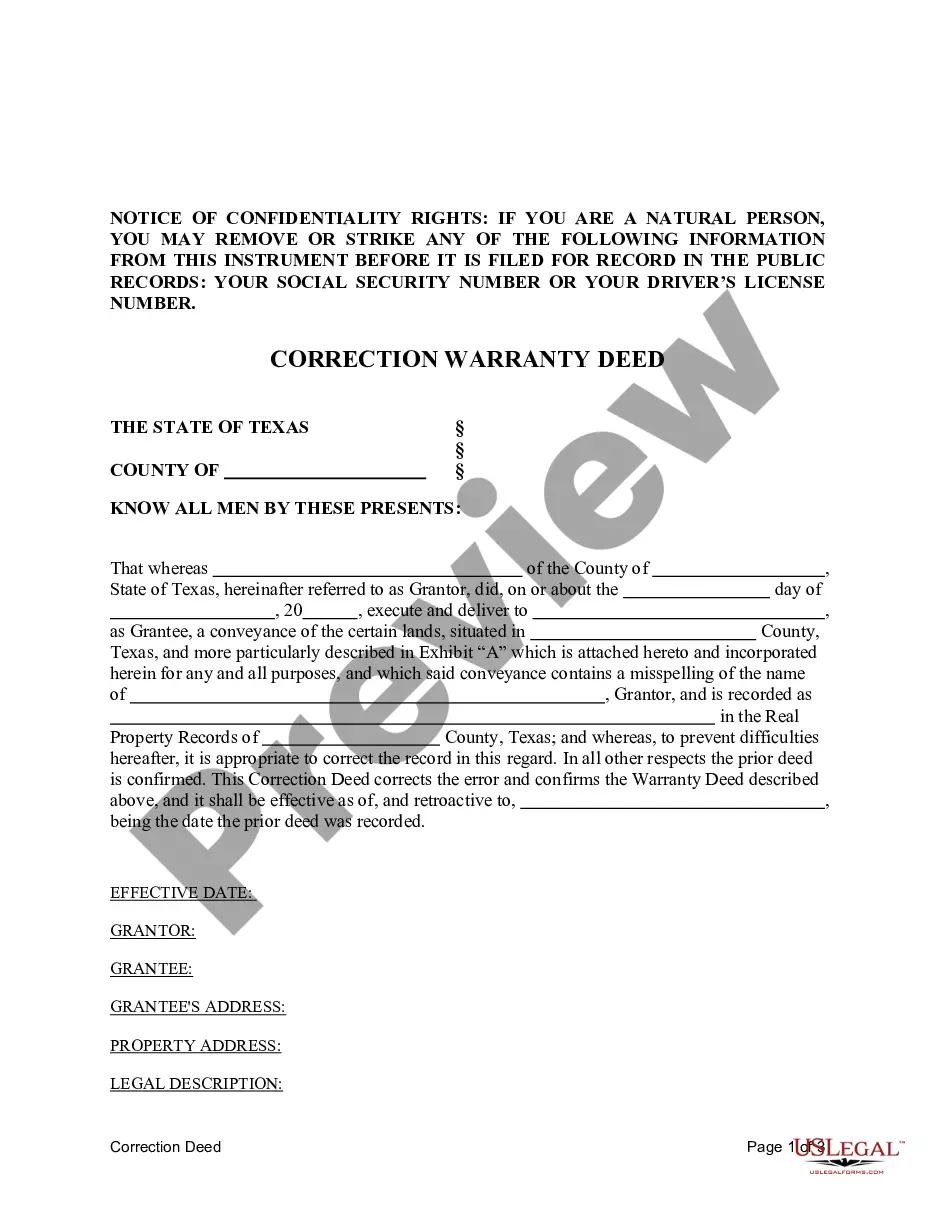
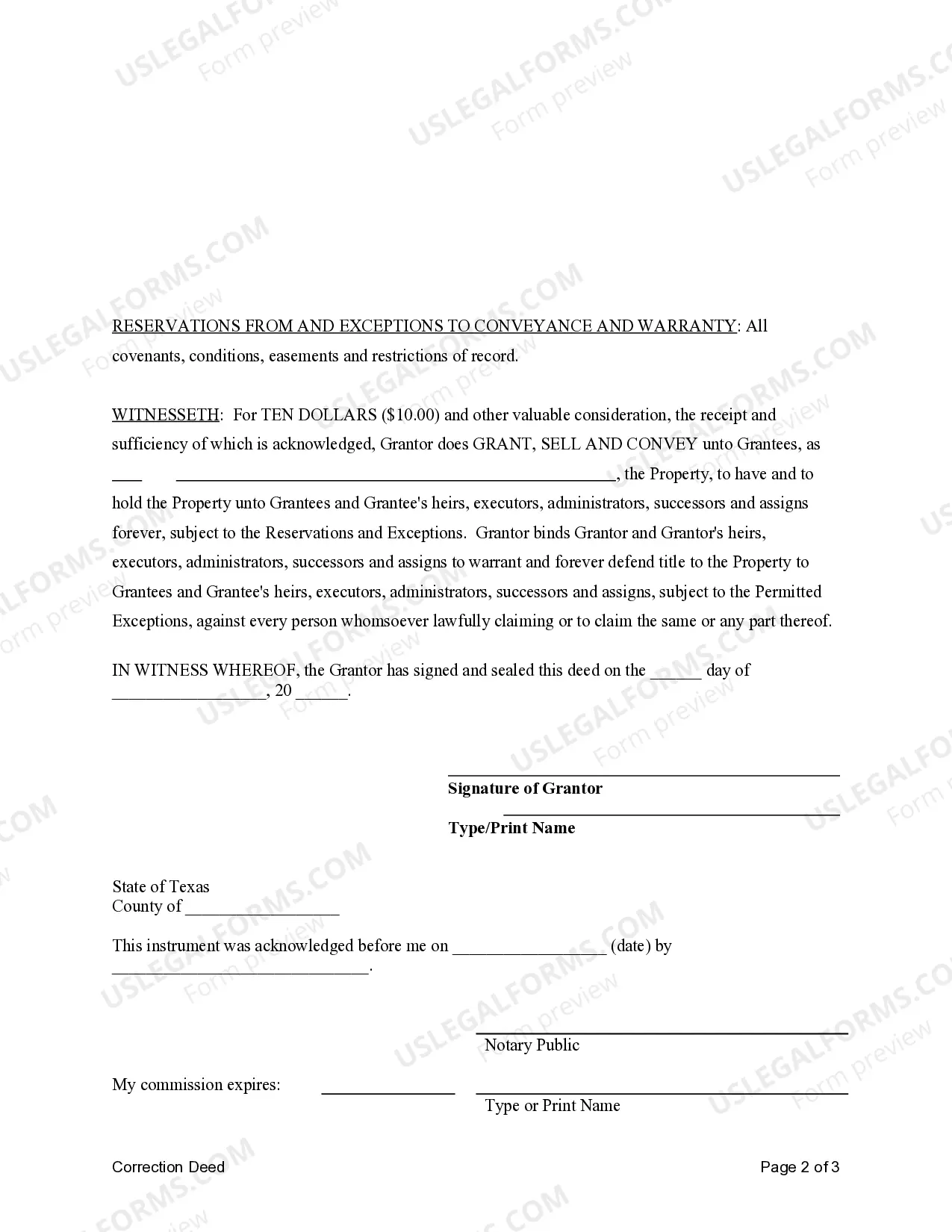
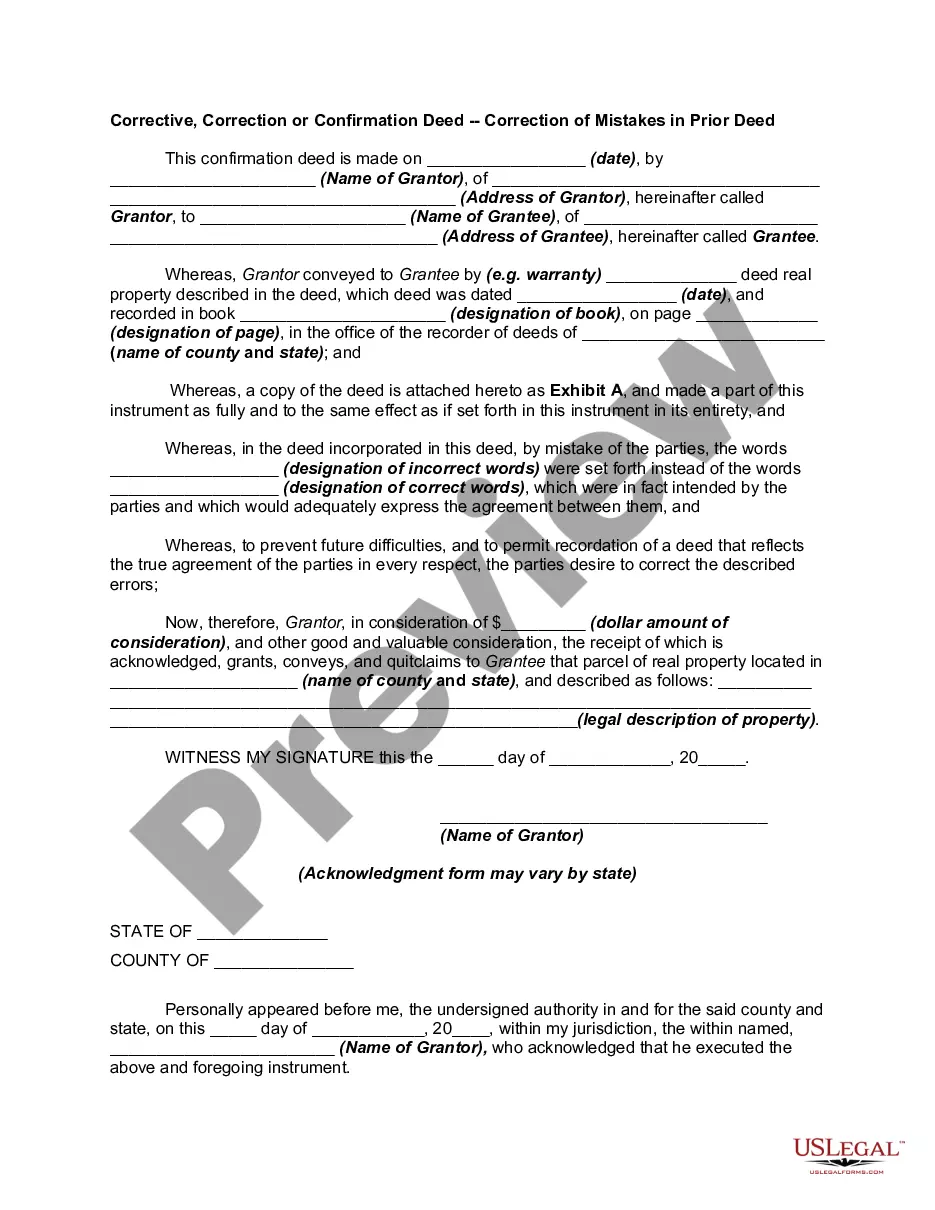
How to fill out Texas Correction Warranty Deed?
Creating legal documents from the ground up can occasionally be daunting.
Certain situations may require extensive research and substantial financial investment.
If you’re seeking a simpler and more cost-effective method of preparing Tx Deed Form With Notary or any other documentation without unnecessary complications, US Legal Forms is always available to assist you.
Our online library of over 85,000 current legal forms covers nearly every facet of your financial, legal, and personal affairs.
Examine the document preview and descriptions to confirm that you are viewing the document you need. Verify that the template you select meets the criteria of your state and county. Choose the most appropriate subscription option to acquire the Tx Deed Form With Notary. Download the file, then complete, sign, and print it. US Legal Forms has an excellent reputation and over 25 years of experience. Join us today and make form execution a straightforward and efficient process!
- With just a few clicks, you can swiftly access state- and county-specific forms carefully compiled for you by our legal experts.
- Utilize our website whenever you require a dependable and trustworthy service through which you can effortlessly locate and download the Tx Deed Form With Notary.
- If you’re already familiar with our services and have previously registered an account with us, simply Log In to your account, find the template, and download it or re-download it later in the My documents section.
- Don’t have an account? No problem. Setting it up takes just a few minutes, allowing you to browse the catalog.
- However, before rushing to download the Tx Deed Form With Notary, please adhere to these guidelines.
Form popularity
FAQ
Completing a notary acknowledgement in Texas involves filling out the Tx deed form with notary details. You should ensure that the signer is present and can provide valid identification. The notary will then confirm the signer’s identity, witness the signing, and complete the acknowledgement section by signing and stamping the document. Using a reliable platform like uslegalforms can simplify this process, ensuring that you have all necessary forms and guidance.
To notarize a land deed, you first need to prepare the Tx deed form with notary included. Make sure that all parties involved are present during the notarization process. The notary public will verify the identities of the signers and witness the signing of the document. Once the deed is signed, the notary will place their seal on it, officially completing the notarization.
In Texas, a deed must be notarized to be valid. Notarization confirms that the signatures are genuine and that the signers understood the transaction. Utilizing a Tx deed form with notary provides peace of mind, knowing that your deed complies with state requirements. For an easy and efficient solution, consider using uslegalforms, which offers user-friendly templates and guidance for notarizing your deed.
Yes, Texas law requires a notary for title transfer documents, including deeds. This requirement helps protect all parties involved by ensuring that the transaction is properly documented. By using a Tx deed form with notary, you can facilitate a smooth transfer of title and meet legal standards. This approach minimizes the risk of disputes and enhances the security of your property transaction.
Yes, a notary can notarize a deed. This process involves verifying the identities of the signers and witnessing their signatures. Notarizing a Tx deed form with notary helps ensure that the document is legally binding and recognized by the state. It adds an important layer of authenticity to your deed, making it more credible.
Failing to require signers to be present at the notarization is the number one claim of misconduct against Notaries.
Given under my hand and seal of office this day of , (year). This instrument was acknowledged before me on (date) by (name or names of person or persons acknowledging). This instrument was acknowledged before me on (date) by (name of attorney-in- fact) as attorney-in-fact on behalf of (name of principal).
Notarized letter format Add the relevant content in the letter. I, [add name], can verify that I have lived at [address] in [state, city] for a period [date]. In line with the perjury penalty, I also confirm that the statements and facts in this letter are true.
Typically, a public notary can correct information if a mistake exists within a notarial certificate. However, public notaries cannot change the specifics of the document. In fact, the signer has the sole right to make changes to the document.
Transfers of title for cars or real estate, powers of attorney, wills and trusts, advanced directives and other healthcare-related forms, and handgun permits, are just a few examples of the many types of documents that often require notarization.