Texas Form Deed Of Trust
Description
Get your form ready online
Our built-in tools help you complete, sign, share, and store your documents in one place.
Make edits, fill in missing information, and update formatting in US Legal Forms—just like you would in MS Word.
Download a copy, print it, send it by email, or mail it via USPS—whatever works best for your next step.
Sign and collect signatures with our SignNow integration. Send to multiple recipients, set reminders, and more. Go Premium to unlock E-Sign.
If this form requires notarization, complete it online through a secure video call—no need to meet a notary in person or wait for an appointment.
We protect your documents and personal data by following strict security and privacy standards.

Make edits, fill in missing information, and update formatting in US Legal Forms—just like you would in MS Word.

Download a copy, print it, send it by email, or mail it via USPS—whatever works best for your next step.

Sign and collect signatures with our SignNow integration. Send to multiple recipients, set reminders, and more. Go Premium to unlock E-Sign.

If this form requires notarization, complete it online through a secure video call—no need to meet a notary in person or wait for an appointment.

We protect your documents and personal data by following strict security and privacy standards.
Looking for another form?
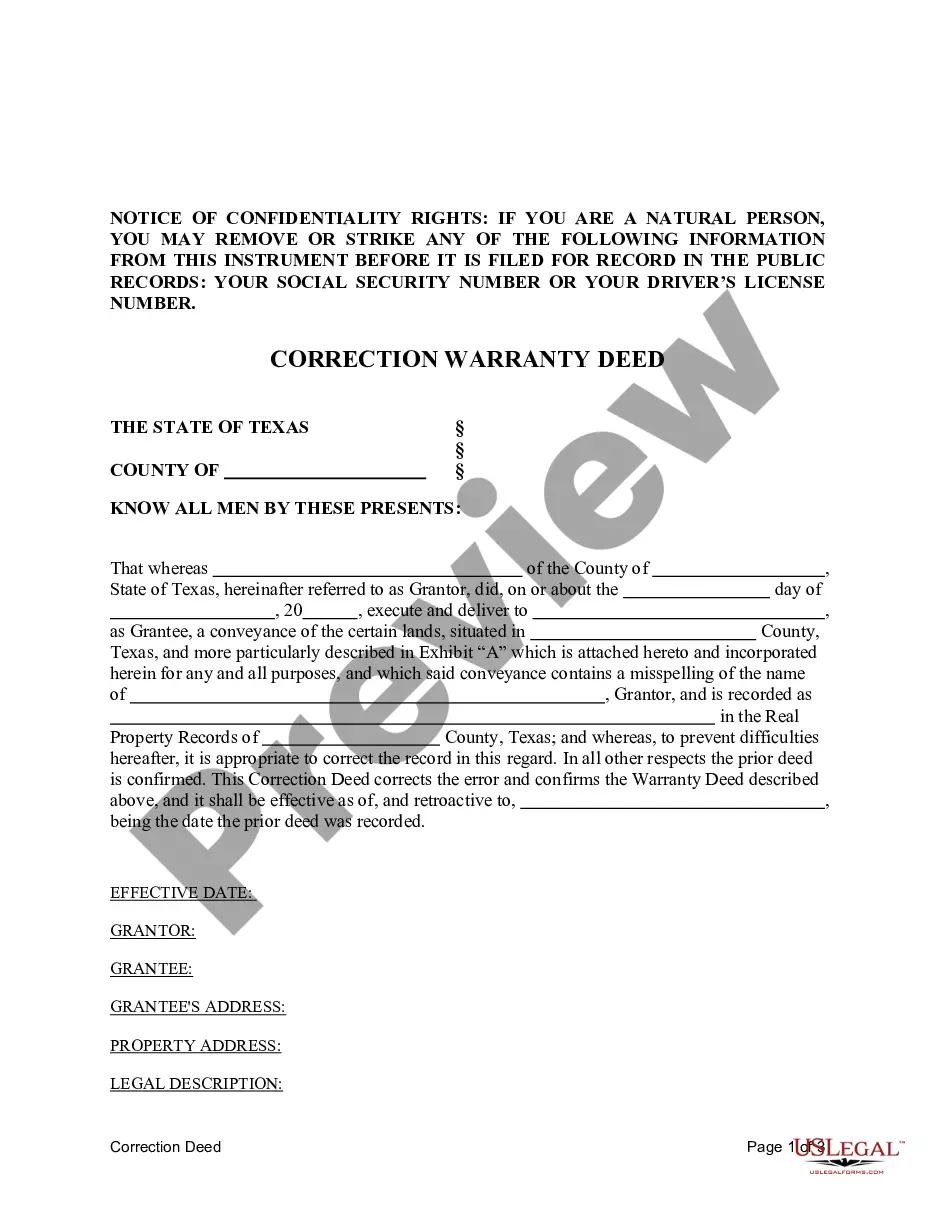
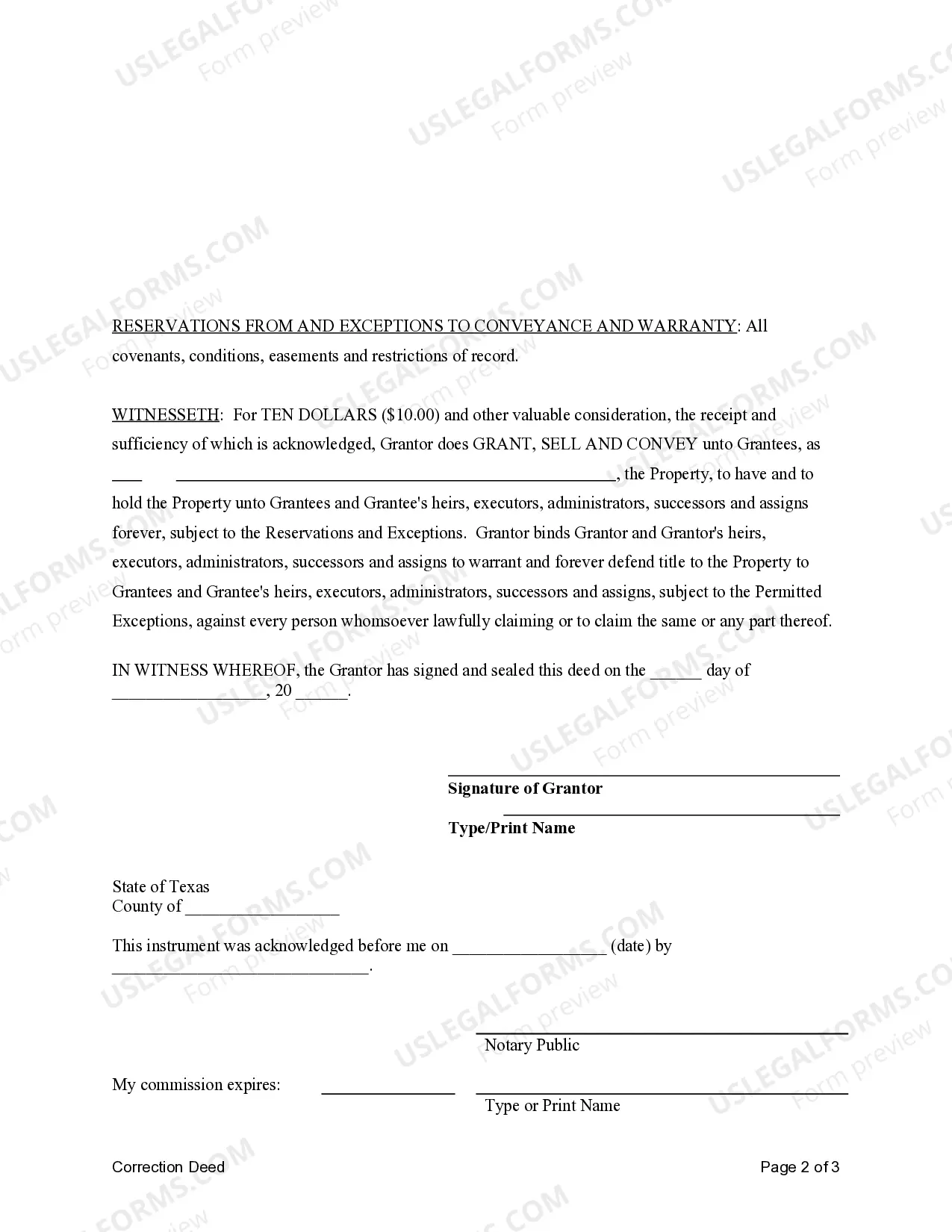
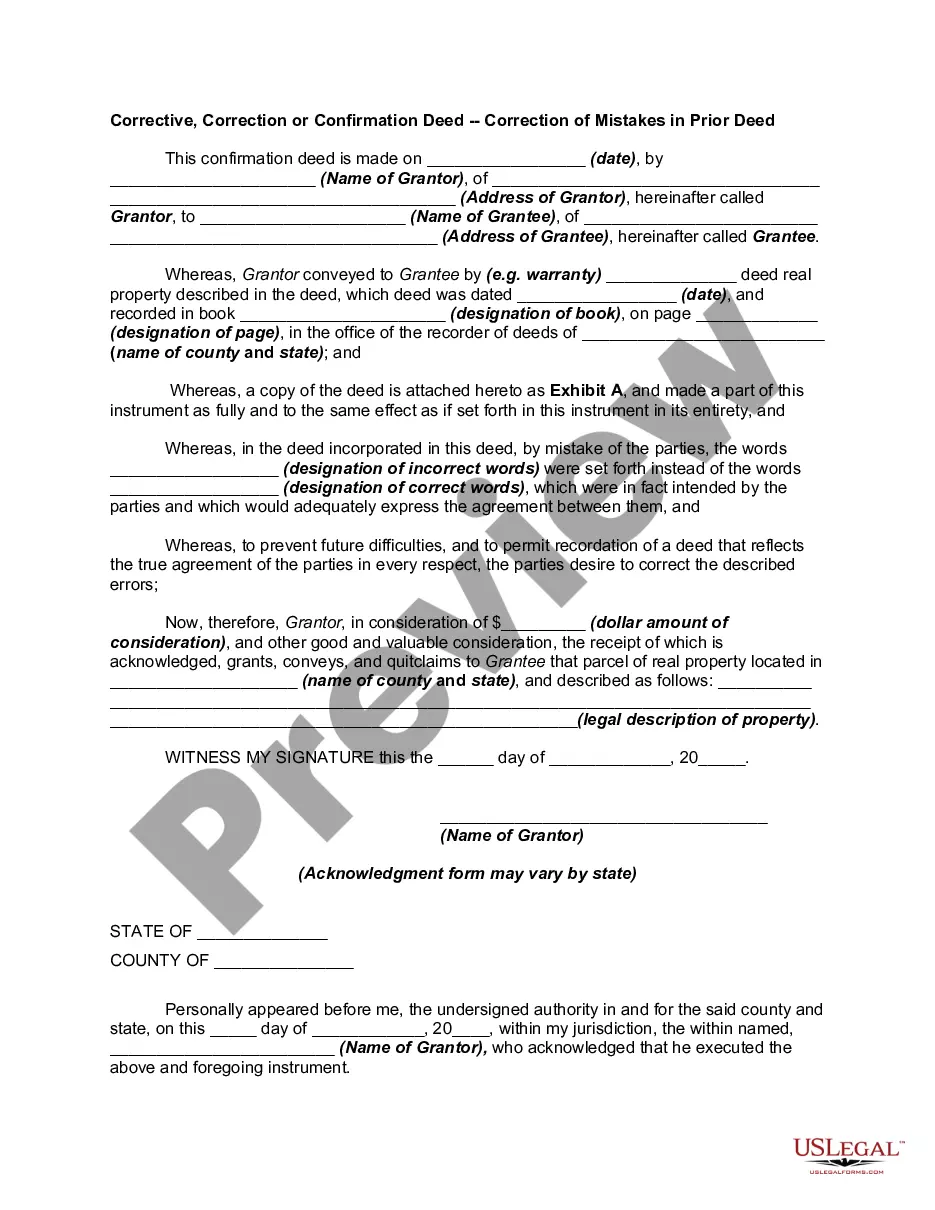
How to fill out Texas Correction Warranty Deed?
Managing legal documents can be daunting, even for experienced professionals.
When you are looking for a Texas Form Deed Of Trust and lack the time to search for the right and current version, the process can be challenging.
US Legal Forms caters to any needs you might have, from individual to business documents, all consolidated in one location.
Utilize advanced tools to complete and manage your Texas Form Deed Of Trust.
Here are the steps to follow after acquiring the form you require: Ensure it is the correct document by previewing it and checking its description, confirm that the template is accepted in your state or county, click Buy Now when you are prepared, select a subscription plan, find the format you need, and Download, fill out, eSign, print, and send your document. Take advantage of the US Legal Forms online library, supported by 25 years of expertise and trustworthiness. Streamline your daily document management into a seamless and user-friendly experience today.
- Access a valuable database of articles, guides, handbooks, and resources relevant to your circumstances and requirements.
- Save effort and time searching for the documents you need, and leverage US Legal Forms’ advanced search and Review feature to locate Texas Form Deed Of Trust and obtain it.
- If you possess a subscription, Log In to your US Legal Forms account, search for the form, and download it.
- Visit the My documents tab to view the documents you have previously obtained and manage your folders as you prefer.
- If it is your first experience with US Legal Forms, create an account and gain unlimited access to all the library's benefits.
- A comprehensive online form repository can significantly benefit anyone aiming to handle these matters effectively.
- US Legal Forms stands as a leader in digital legal documents, offering over 85,000 state-specific legal forms accessible to you anytime.
- With US Legal Forms, you can access state or county-specific legal and organizational documents.
Form popularity
FAQ
Filing a deed of trust in Texas involves several key steps. First, prepare your Texas form deed of trust with accurate information and signatures from all parties involved. Next, take the completed document to your county clerk's office for filing. Lastly, make sure to keep a copy of the filed deed for your records. If you need assistance, US Legal Forms offers resources to simplify this process for you.
Yes, a deed of trust must be filed to be legally enforceable in Texas. This document acts as a security agreement between a borrower and a lender, and filing it provides public notice of the lender's interest in the property. Without proper filing, you may encounter issues regarding the validity of the Texas form deed of trust. To ensure compliance, consider using US Legal Forms to guide you through the filing process.
To get a copy of a deed in Texas, visit the county clerk's office where the property is located. You can request a copy of the deed by providing information about the property and the parties involved. Many counties also offer online services, allowing you to search for and obtain copies of deeds, including the Texas form deed of trust, digitally. If you need assistance, platforms like US Legal Forms can guide you through the process.
Yes, Texas does have Transfer on Death (TOD) deeds, which allow property owners to transfer real estate upon their death without going through probate. This type of deed can simplify the transfer process and is a useful estate planning tool. However, it is important to understand the specifics of the Texas form deed of trust in conjunction with TOD deeds. Consulting with a legal professional or utilizing services like US Legal Forms can provide clarity on how these deeds work.
Deed of Trust The trustee (someone other than the buyer and the lender) gets the deed and technically owns the property while the loan exists. The trustee cannot sell the property unless the borrower defaults on the loan. The trustee transfers the property to the buyer when the borrower repays the loan.
In Texas, the seller signs the deed over to you in front of a notary public and the deed is then filed in the county clerk's office so that the transfer of property is officially recorded. At this point, the trustee holds the physical deed, you hold equitable title and the lender holds the legal title.
This Deed of Trust (the ?Trust Deed?) sets out the terms and conditions upon which: [Settlor Name] (the ?Settlor?), of [Settlor Address], settles that property set out in Schedule A (the ?Property?) upon [Trustee Name] (the ?Trustee?), being a Company duly registered under the laws of [state] with registered number [ ...
The Trustee, usually chosen by the lender, is the person who represents both the Grantor and the Grantee (Beneficiary) if there is a default under a Deed of Trust. When no specific trustee is required by the lender, someone willing and able to hold a foreclosure sale if necessary may be selected.
An assignment of deed of trust under Texas law. This Standard Document can be used to assign and transfer the beneficial interest under a Texas deed of trust from one lender to another lender.