Tenant Landlord With Forgiveness
Description


Get your form ready online
Our built-in tools help you complete, sign, share, and store your documents in one place.
Make edits, fill in missing information, and update formatting in US Legal Forms—just like you would in MS Word.
Download a copy, print it, send it by email, or mail it via USPS—whatever works best for your next step.
Sign and collect signatures with our SignNow integration. Send to multiple recipients, set reminders, and more. Go Premium to unlock E-Sign.
If this form requires notarization, complete it online through a secure video call—no need to meet a notary in person or wait for an appointment.
We protect your documents and personal data by following strict security and privacy standards.

Make edits, fill in missing information, and update formatting in US Legal Forms—just like you would in MS Word.

Download a copy, print it, send it by email, or mail it via USPS—whatever works best for your next step.

Sign and collect signatures with our SignNow integration. Send to multiple recipients, set reminders, and more. Go Premium to unlock E-Sign.

If this form requires notarization, complete it online through a secure video call—no need to meet a notary in person or wait for an appointment.

We protect your documents and personal data by following strict security and privacy standards.
Looking for another form?







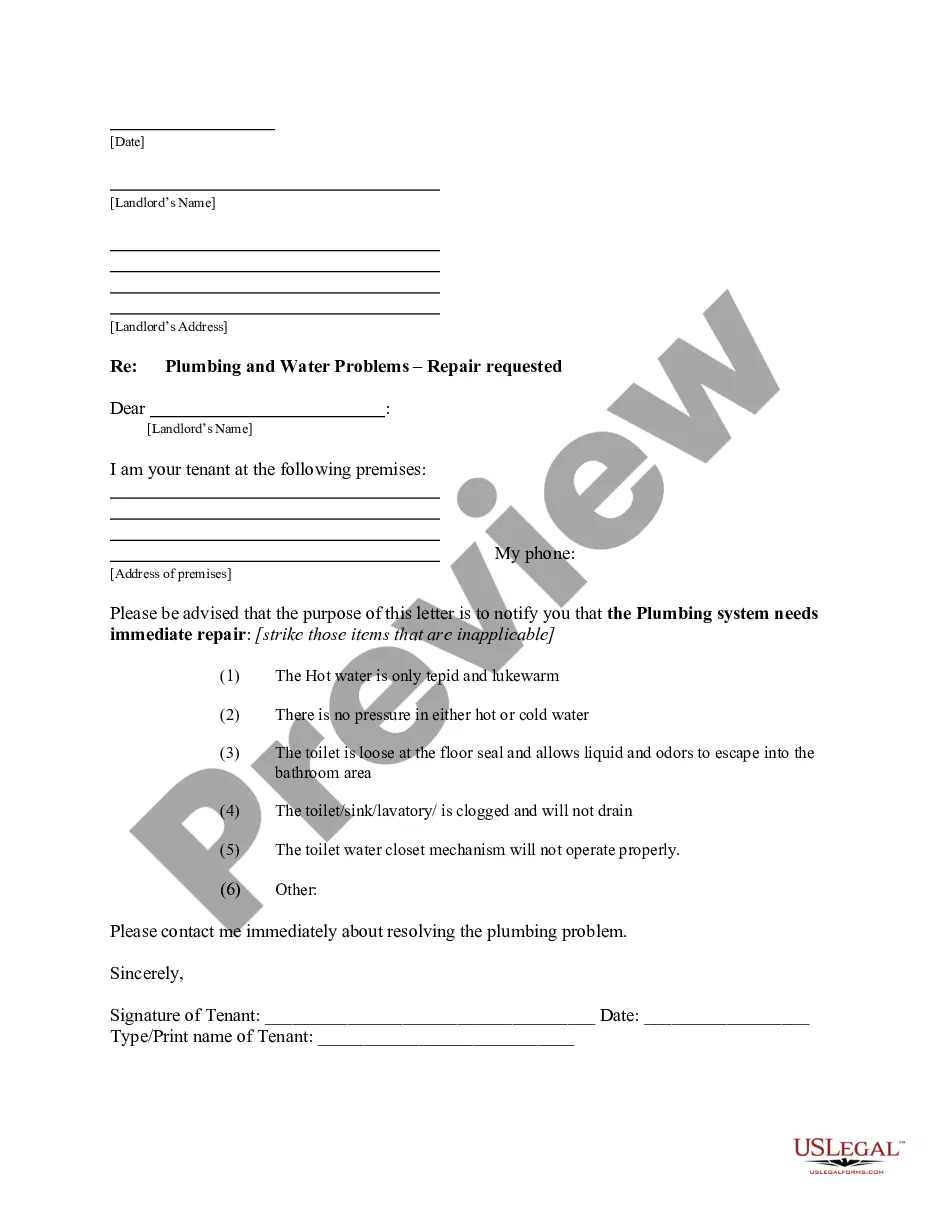
How to fill out Tennessee Letter From Tenant To Landlord With Demand That Landlord Repair Plumbing Problem?
- Log into your US Legal Forms account if you're a returning user, ensuring your subscription is active. If necessary, renew it based on your payment plan.
- If new to the service, start by inspecting the Preview mode and form description to find a template that meets your local jurisdiction's requirements.
- Should you require a different document, utilize the Search tab to locate the appropriate template that suits your needs.
- Purchase your selected document by clicking the Buy Now button, and choose your preferred subscription plan while creating an account for access to the library.
- Complete your purchase by entering your payment details via credit card or PayPal.
- Finally, download the completed template to your device and access it anytime from the My Forms section in your profile.
With US Legal Forms, individuals and attorneys can quickly create accurate legal documents using a rich library of over 85,000 forms. This ensures that every agreement, including tenant landlord with forgiveness documents, is not only accessible but also meets legal standards.
Start your journey towards hassle-free legal documentation today. Dive into US Legal Forms and see how easy it can be!
Form popularity
FAQ
When communicating with a landlord, it is wise to avoid confrontational language and ultimatums that can escalate tensions. Phrases that imply a lack of respect, or that challenge their authority, can sour the relationship. Instead, focusing on solutions and expressing willingness to cooperate can lead to better outcomes. Always keep the principles of a tenant-landlord relationship with forgiveness in mind to ensure a positive dialogue.
Settling disputes between tenants often begins with open communication and negotiation. Encouraging tenants to discuss their issues can help facilitate understanding and compromise. If direct communication fails, mediation services, including those provided by platforms like US Legal Forms, can be beneficial in finding a peaceful resolution. Implementing a tenant-landlord relationship based on forgiveness can make settling disputes much more manageable.
The most common action taken by landlords against tenants in breach of contract is the initiation of eviction proceedings. This process allows landlords to regain possession of their property when offenses like non-payment of rent occur. However, landlords also have the option to negotiate settlements that can foster forgiveness and a smoother resolution. Exploring options for communication and flexibility can be beneficial.
Yes, a landlord can sue a tenant for emotional distress in certain situations, but it is not common. Landlords typically focus on breaches of contract, but severe cases involving harassment or negligence may lead to such claims. It is important to document evidence and consider mediation before pursuing legal action. Utilizing services that promote a tenant-landlord relationship with forgiveness may prevent such issues from escalating.
Landlords often fear financial loss, property damage, and tenant disputes. The uncertainty of tenants not paying rent is a common concern. Moreover, landlords worry about the legal complexities involved in tenant-landlord relationships and the potential of having to navigate the eviction process. Seeking resources that address the tenant-landlord situation with forgiveness can significantly reduce these fears.
A lease amendment modifies the terms of the original lease agreement between a landlord and tenant. This process can address changes such as rent adjustments, lease termination, or specific conditions like tenant landlord with forgiveness. It is a formal way to ensure that both parties agree to the updated terms, preventing future misunderstandings. Always make sure to document any amendments in writing.
Suing your landlord can be a complex decision and may not always lead to the best outcome. Tenants might consider legal action if there are significant violations of lease terms, but this process can be time-consuming. Instead, explore options such as negotiating a tenant landlord with forgiveness agreement or finding a mutual resolution. Often, open communication is more effective than litigation.
A rent forgiveness lease amendment allows tenants to adjust their rental obligations under specific circumstances. This amendment can provide relief for tenants experiencing financial difficulties, making it easier to manage payments. By implementing a tenant landlord with forgiveness approach, both parties can maintain a positive relationship and avoid potential eviction. It's essential to document any changes to the original lease agreement.
One of the most common disputes between tenants and landlords involves unpaid rent. This often leads to disagreements about lease terms and rental payments. The issue can escalate if the landlord does not provide a tenant landlord with forgiveness option during financial hardship. Understanding your rights and exploring various solutions can help ease tensions.
You can report your landlord to various authorities in California, such as the local housing department or the California Department of Consumer Affairs. Tenants can also seek assistance from legal aid organizations or tenant association groups. If your landlord's actions warrant it, you might explore options for potential rent forgiveness. Consider visiting US Legal Forms for tools to guide you through the reporting process.