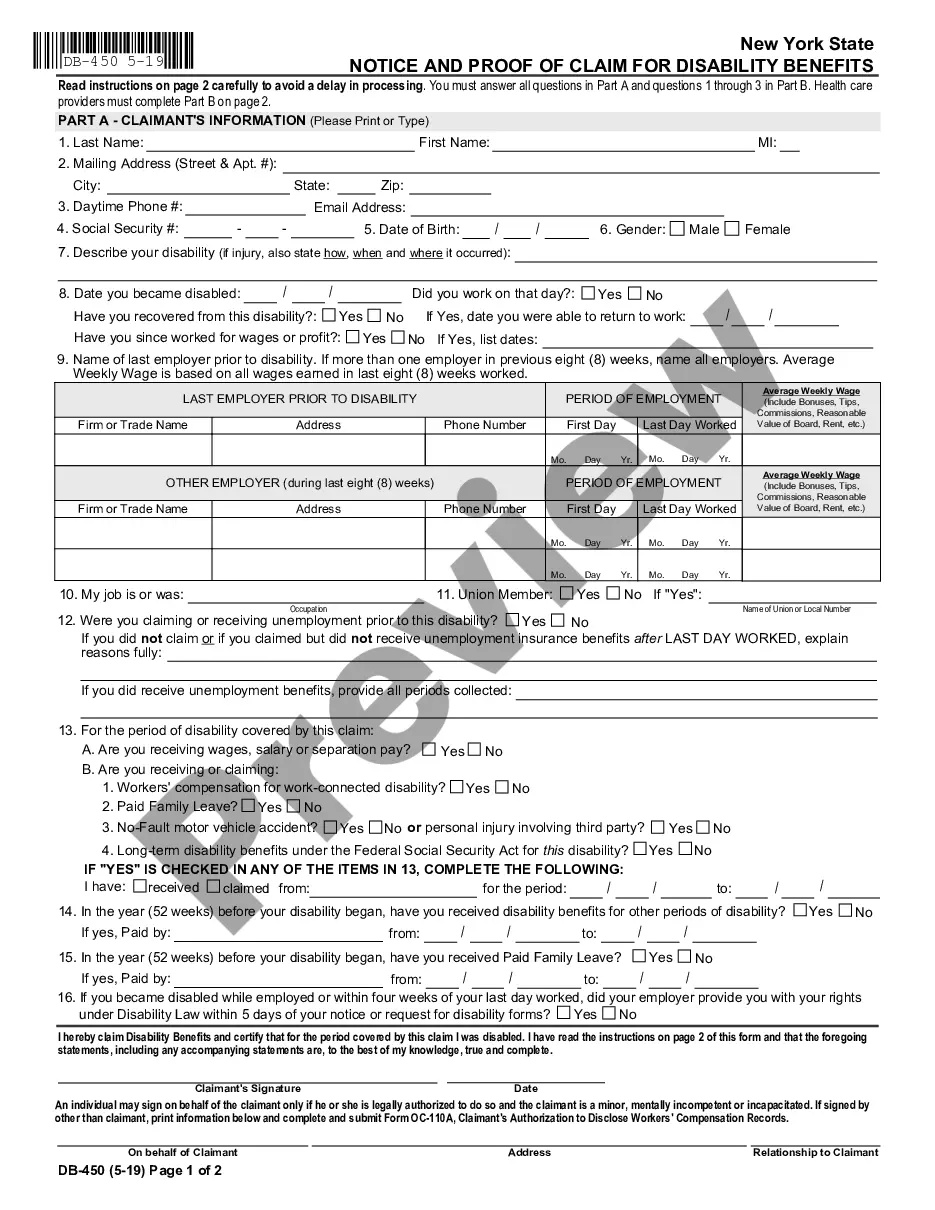
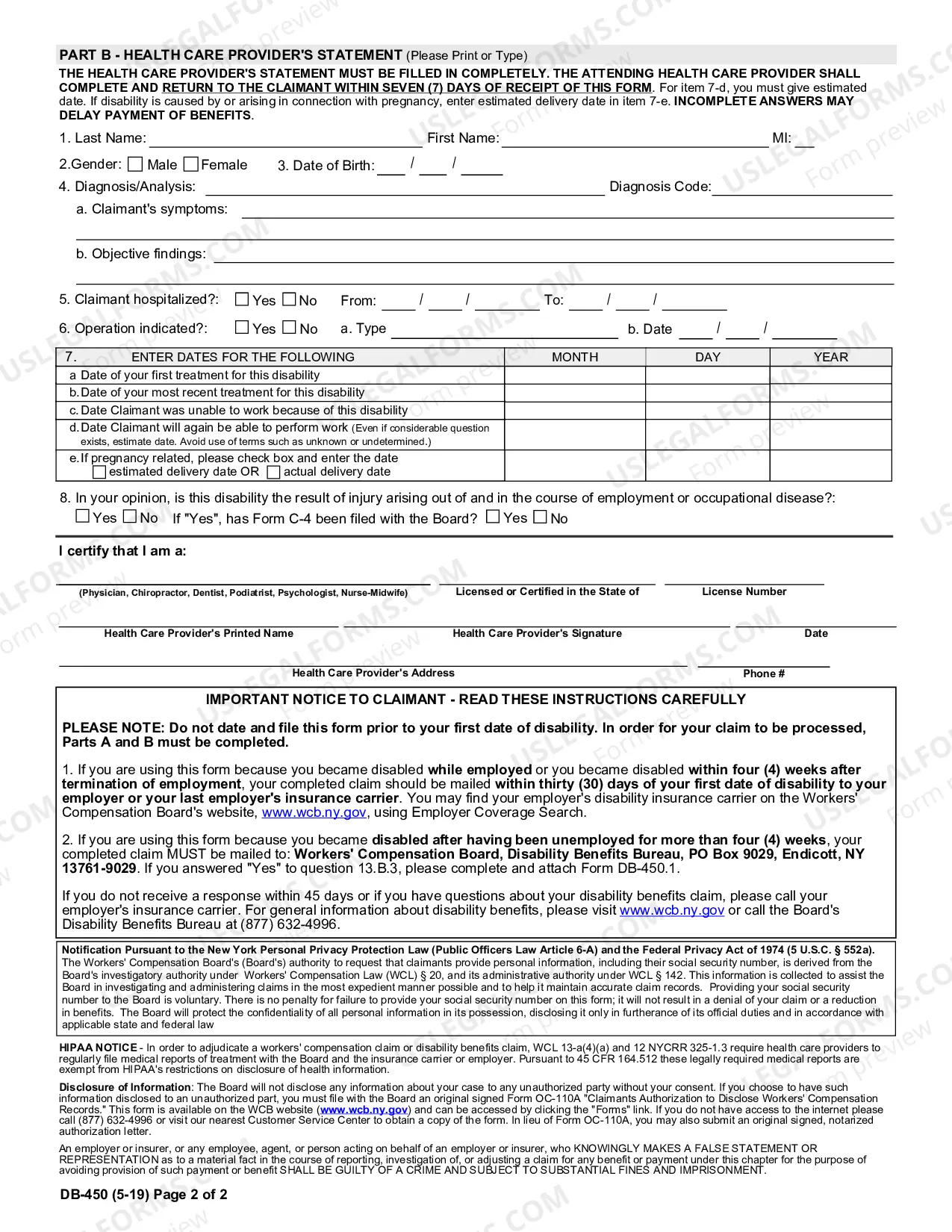
Nys Disability Form Db 450 Part C With The Tail
Description
Get your form ready online
Our built-in tools help you complete, sign, share, and store your documents in one place.
Make edits, fill in missing information, and update formatting in US Legal Forms—just like you would in MS Word.
Download a copy, print it, send it by email, or mail it via USPS—whatever works best for your next step.
Sign and collect signatures with our SignNow integration. Send to multiple recipients, set reminders, and more. Go Premium to unlock E-Sign.
If this form requires notarization, complete it online through a secure video call—no need to meet a notary in person or wait for an appointment.
We protect your documents and personal data by following strict security and privacy standards.

Make edits, fill in missing information, and update formatting in US Legal Forms—just like you would in MS Word.

Download a copy, print it, send it by email, or mail it via USPS—whatever works best for your next step.

Sign and collect signatures with our SignNow integration. Send to multiple recipients, set reminders, and more. Go Premium to unlock E-Sign.

If this form requires notarization, complete it online through a secure video call—no need to meet a notary in person or wait for an appointment.

We protect your documents and personal data by following strict security and privacy standards.
Looking for another form?

How to fill out New York Notice And Proof Of Claim For Disability Benefits?
The Nys Disability Form Db 450 Part C With The Tail you observe on this page is a reusable official template crafted by skilled attorneys in accordance with federal and state statutes and regulations.
For over 25 years, US Legal Forms has supplied individuals, businesses, and legal professionals with more than 85,000 authenticated, state-specific forms for any professional and personal circumstance. It’s the quickest, simplest, and most dependable way to obtain the documentation you require, as the service assures the utmost level of data protection and anti-malware security.
Subscribe to US Legal Forms to have authenticated legal templates for all of life’s scenarios at your fingertips.
- Search for the document you require and examine it.
- Choose the pricing plan that fits your needs and establish an account.
- Select the format you prefer for your Nys Disability Form Db 450 Part C With The Tail (PDF, Word, RTF) and store the sample on your device.
- Print the template to fill it out by hand or use an online multifunctional PDF editor to swiftly and accurately complete and sign your form with a legally binding electronic signature.
- Access the same document again whenever necessary. Visit the My documents tab in your profile to redownload any previously acquired forms.
Form popularity
FAQ
The easiest disabilities to get approved for often include conditions like anxiety disorders, depression, and certain physical disabilities. Each case is unique, and the approval process typically requires substantial documentation. Utilizing the Nys disability form db 450 part c with the tail can help streamline your application. It is crucial to provide detailed medical records and evidence to support your claim.
The best way to fill out a function report for disability is to be precise and comprehensive about your daily activities and limitations. Describe how your medical condition affects your ability to perform tasks at home and work. When utilizing the NYS disability form DB 450 part c, ensure that each section reflects your true situation. For additional help, consider using USLegalForms, which can provide guidance on how to convey your information effectively.
To fill out DB 450 successfully, start by reading the instructions carefully. Provide detailed information about your medical condition, treatments, and how it affects your daily life and work capabilities. As you complete the NYS disability form DB 450 part c, be honest and thorough in your responses. If you encounter challenges, USLegalForms offers step-by-step assistance to help you navigate the form.
To file a New York State disability claim, you need to complete the necessary forms, including the NYS disability form DB 450 part c. Once your form is filled out, submit it to the appropriate agency, either online or by mail. Be sure to keep copies of all documents you send. Using USLegalForms can simplify this process, as it provides resources and templates to help you file your claim accurately and efficiently.
Filling out the DB450 requires careful attention to detail. Start by gathering your personal information, including your social security number and medical history. When completing the NYS disability form DB 450 part c, ensure that you provide clear and concise answers to all questions, especially those regarding your medical condition and its limitations. If you need assistance, consider using platforms like USLegalForms to guide you through the process.
The NYS disability application DB 450 is a crucial form used in New York State for individuals applying for disability benefits. Specifically, this form collects essential information about your medical condition and its impact on your ability to work. Completing the NYS disability form DB 450 part c accurately is vital for a successful claim. It serves as a key document in the assessment of your eligibility for benefits.
The employee is ineligible for disability benefits if they perform any type of work for which wages or profit were received, even if performed at home. If an employee is unemployed, disability benefits may also be paid to replace unemployment insurance benefits lost because of illness or injury (WCL §207).
If you became sick or disabled while employed or you became sick or disabled within four (4) weeks after termination of employment, file with your employer or its insurance carrier. File no later than 30 days after becoming sick or disabled. File with Form DB-450.
If your claim is denied, your employer or employer's insurer is required to send you a Notice of Rejection (Form DB-451), within 45 days of your claim filing, with the reason(s) benefits are not being paid.
Premiums for disability insurance policies are paid directly to the insurance carrier by the employer. A covered employer is allowed, but not required, to collect from each employee, through payroll deduction, a contribution of 1/2 of 1% of wages paid, but not in excess of 60 cents per week.