Brick Masonry With Dry Joints
Description
Get your form ready online
Our built-in tools help you complete, sign, share, and store your documents in one place.
Make edits, fill in missing information, and update formatting in US Legal Forms—just like you would in MS Word.
Download a copy, print it, send it by email, or mail it via USPS—whatever works best for your next step.
Sign and collect signatures with our SignNow integration. Send to multiple recipients, set reminders, and more. Go Premium to unlock E-Sign.
If this form requires notarization, complete it online through a secure video call—no need to meet a notary in person or wait for an appointment.
We protect your documents and personal data by following strict security and privacy standards.

Make edits, fill in missing information, and update formatting in US Legal Forms—just like you would in MS Word.

Download a copy, print it, send it by email, or mail it via USPS—whatever works best for your next step.

Sign and collect signatures with our SignNow integration. Send to multiple recipients, set reminders, and more. Go Premium to unlock E-Sign.

If this form requires notarization, complete it online through a secure video call—no need to meet a notary in person or wait for an appointment.

We protect your documents and personal data by following strict security and privacy standards.
Looking for another form?








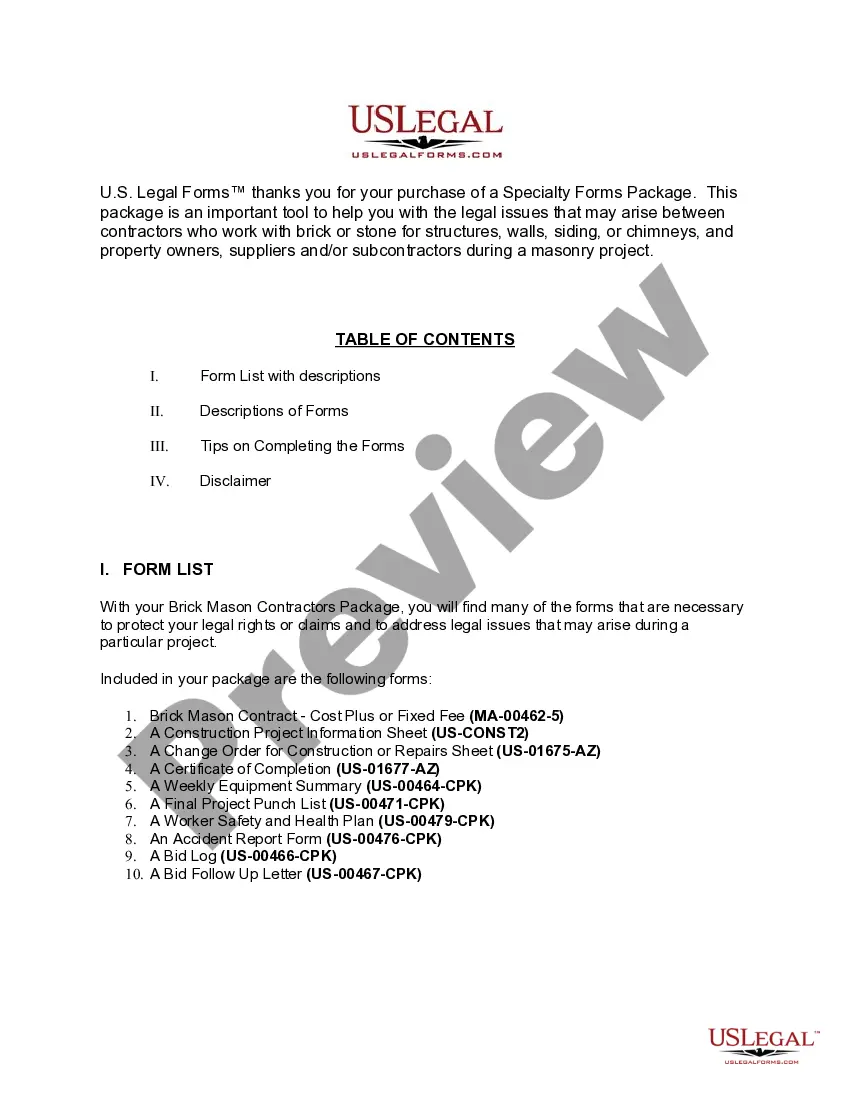
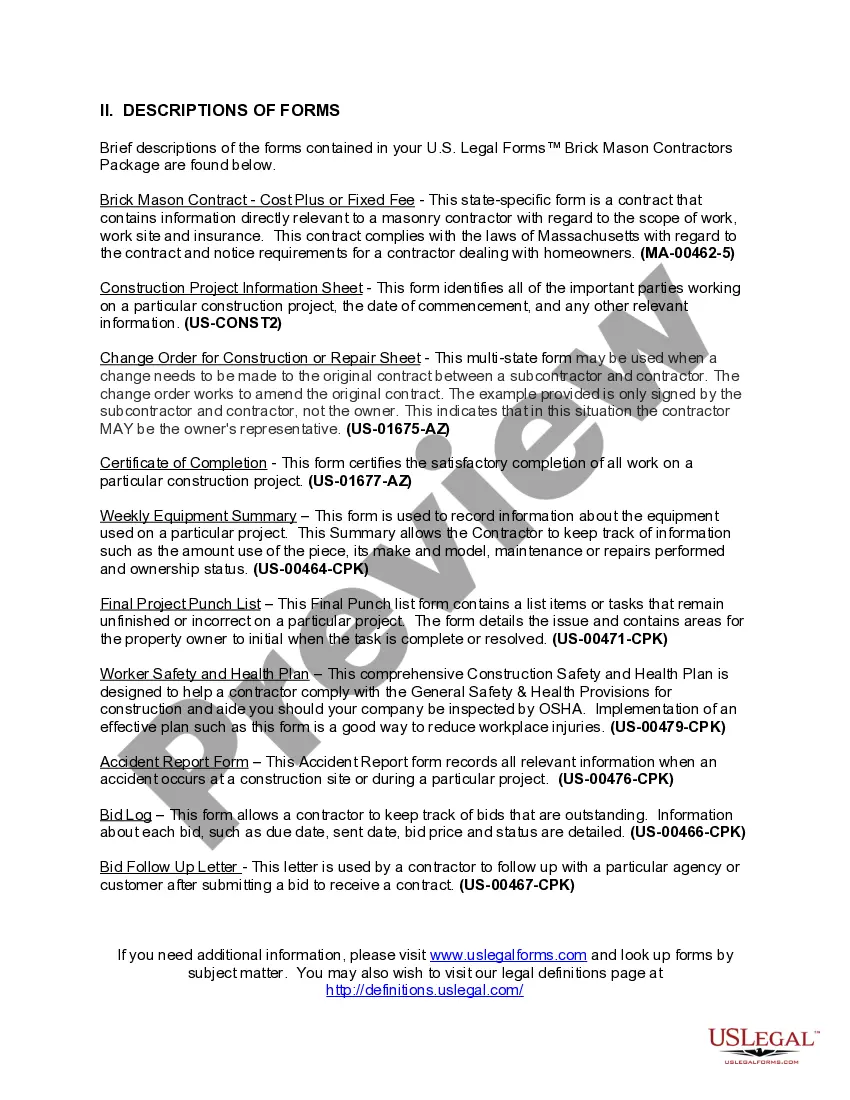
How to fill out Massachusetts Brick Mason Contractor Package?
Creating legal documents from the ground up can occasionally feel a bit daunting.
Certain situations may require extensive research and substantial financial investment.
If you seek a more straightforward and economical method of drafting Brick Masonry With Dry Joints or any other documents without unnecessary complications, US Legal Forms is always accessible.
Our online repository of over 85,000 current legal documents covers almost every facet of your financial, legal, and personal concerns.
Review the document preview and descriptions to confirm that you've located the form you need. Verify that the template you select adheres to the laws and regulations of your state and county. Choose the most appropriate subscription plan to obtain the Brick Masonry With Dry Joints. Download the file, then fill it out, certify it, and print it. US Legal Forms has a solid reputation and over 25 years of experience. Join us now and make document processing straightforward and efficient!
- With just a few clicks, you can swiftly obtain state- and county-specific forms meticulously prepared by our legal experts.
- Utilize our website whenever you require a dependable service that enables you to quickly find and download the Brick Masonry With Dry Joints.
- If you’re familiar with our site and have previously registered, simply Log In to your account, find the template and download it, or re-download it anytime in the My documents section.
- Don't have an account? No worries. It takes minimal time to sign up and browse the inventory.
- Before diving into downloading Brick Masonry With Dry Joints, consider these suggestions.
Form popularity
FAQ
In masonry, mortar joints are the spaces between bricks, concrete blocks, or glass blocks, that are filled with mortar or grout. If the surface of the masonry remains unplastered, the joints contribute significantly to the appearance of the masonry.
Concave Joint This is the most common type of mortar joint used in exterior brick walls. Concave joints are, unsurprisingly, shaped with a slightly curved, concave pattern. This allows for maximum water resistance because it prevents rain from accumulating on any flat surfaces.
Dry bonding is the term given to laying the bricks without applying a bed or cross joint. This is done to establish the bond and size of cross joint required for a given dimension. (
Common Defects in Brick Masonry Works Improperly Mixed Mortar. Mortar strength and the strength of the bricks are directly related to one another. ... Bed Joints That Are Too Thick. ... Bed Joints That Are Filled Improperly. ... Exposing Freshly Laid Bricks to Bad Weather. ... Not Adjusting the Suction of the Bricks.