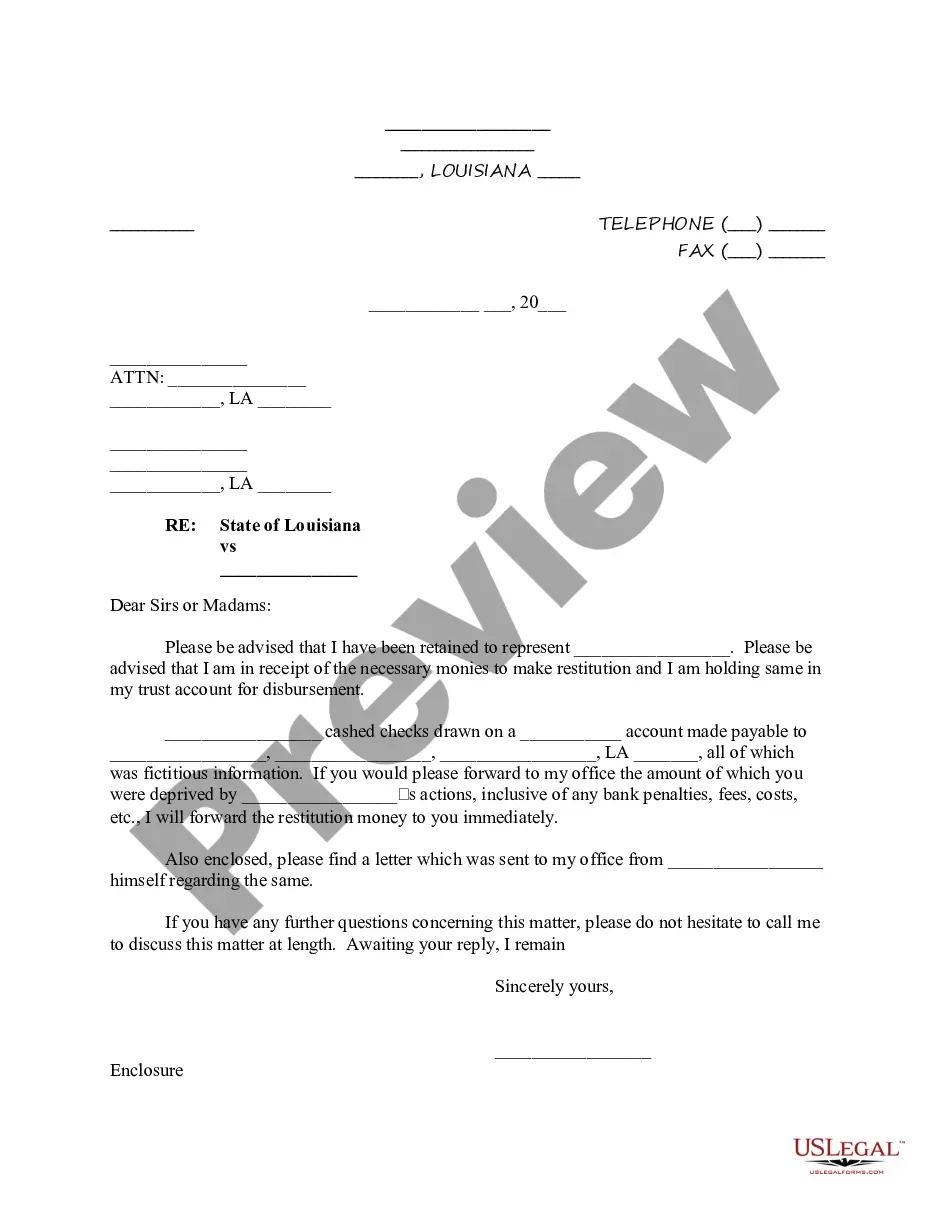
Restitution Letter To Victim
Description
Get your form ready online
Our built-in tools help you complete, sign, share, and store your documents in one place.
Make edits, fill in missing information, and update formatting in US Legal Forms—just like you would in MS Word.
Download a copy, print it, send it by email, or mail it via USPS—whatever works best for your next step.
Sign and collect signatures with our SignNow integration. Send to multiple recipients, set reminders, and more. Go Premium to unlock E-Sign.
If this form requires notarization, complete it online through a secure video call—no need to meet a notary in person or wait for an appointment.
We protect your documents and personal data by following strict security and privacy standards.

Make edits, fill in missing information, and update formatting in US Legal Forms—just like you would in MS Word.

Download a copy, print it, send it by email, or mail it via USPS—whatever works best for your next step.

Sign and collect signatures with our SignNow integration. Send to multiple recipients, set reminders, and more. Go Premium to unlock E-Sign.

If this form requires notarization, complete it online through a secure video call—no need to meet a notary in person or wait for an appointment.

We protect your documents and personal data by following strict security and privacy standards.
Looking for another form?
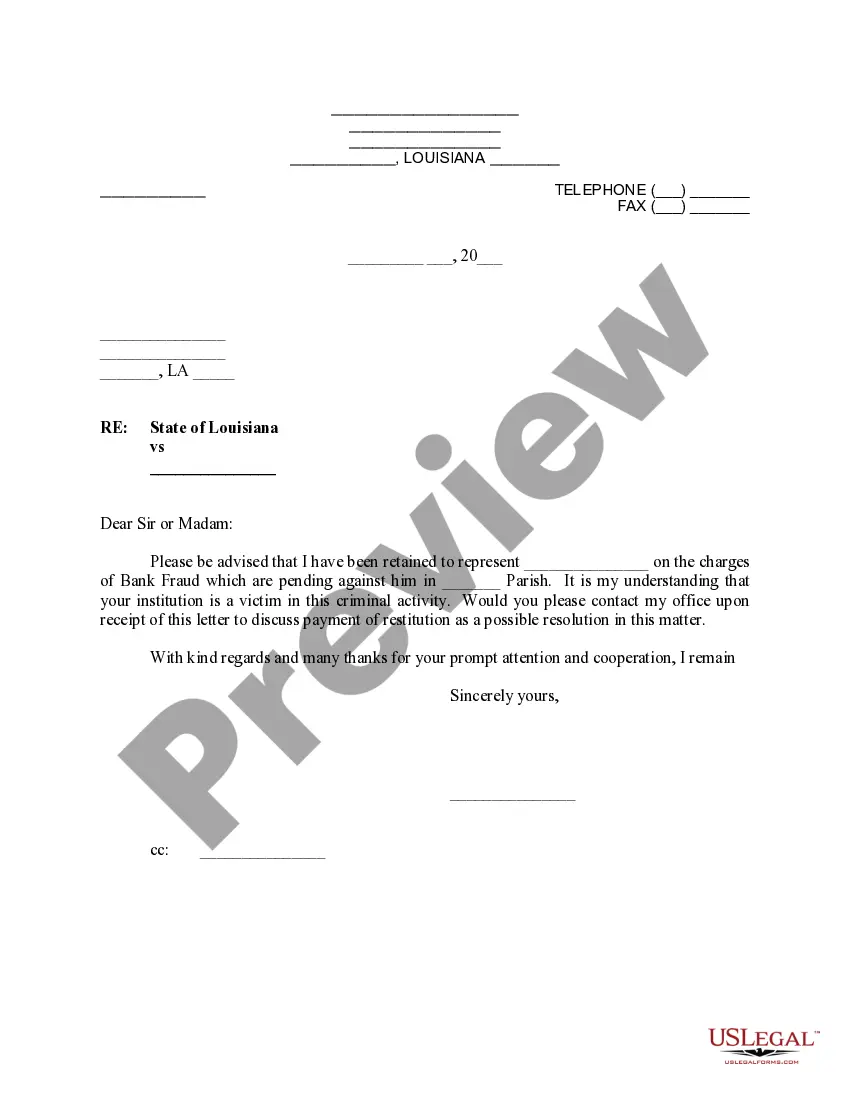
How to fill out Louisiana Follow-up Letter To Bank Regarding Restitution Offer In Bank Fraud Case?
Individuals frequently link legal documentation with something complicated that solely an expert can manage.
In some sense, this holds true, as composing a Restitution Letter To Victim requires considerable knowledge in relevant areas, including state and local statutes.
However, with US Legal Forms, the process has become simpler: pre-made legal templates for any personal or business circumstance tailored to state laws are gathered in one online directory and are now accessible to all.
All templates available in our collection are reusable: once obtained, they remain stored in your profile. You can access them anytime needed via the My documents tab. Discover all the benefits of utilizing the US Legal Forms platform. Subscribe today!
- US Legal Forms offers more than 85,000 current documents organized by state and category of use, making the search for a Restitution Letter To Victim or any specific template quick and easy.
- Previously registered users with an active membership should Log In to their account and click Download to access the form.
- New users will first need to establish an account and subscribe before they can retrieve any documents.
- Follow this step-by-step guide to obtain the Restitution Letter To Victim.
- Carefully review the page content to ensure it meets your requirements.
- Examine the form description or view it using the Preview feature.
- If the initial sample does not meet your needs, find another template using the Search field above.
- Once you locate the correct Restitution Letter To Victim, click Buy Now.
- Select a pricing plan that aligns with your requirements and budget.
- Create an account or Log In to advance to the payment page.
- Complete your subscription payment via PayPal or a credit card.
- Pick your file format and click Download.
- Print your document or upload it to an online editor for a quicker completion.
Form popularity
FAQ
To effectively fill out a restitution form, start with your personal details and a clear description of the damages incurred. Attach supporting documents, such as invoices or receipts, to validate your claims. It's essential to be thorough and precise in your descriptions. You can utilize uslegalforms’ resources to find a restitution letter to victim template that guides you through the necessary steps.
Conditions for restitution may vary based on the jurisdiction and the specifics of the case. Generally, the offender must have the financial means to compensate the victim, and the crime must have resulted in measurable harm. Courts often evaluate the circumstances before issuing an order for restitution. Understanding these conditions can help you prepare a restitution letter to victim that meets legal standards.
Filling out a restitution form requires careful attention to detail. Start by including the victim's information, the nature of the losses, and the amount being requested. Be sure to provide any necessary documentation to substantiate your claims. Using a restitution letter to victim template can simplify this process, ensuring you include all required information accurately.
A restitution letter is a formal request that seeks compensation for losses incurred due to wrongful actions. It outlines the details of the incident and specifies the amount expected. Knowing how to write an effective restitution letter to victim can significantly impact your likelihood of receiving the compensation you deserve.
Writing a restitution letter requires you to present your case in a straightforward manner. State the facts of the case, include the amount of restitution you are claiming, and any supporting materials. You can utilize platforms like US Legal Forms to access templates and guides, making your restitution letter to victim effective and professional.
When you write a letter asking for restitution, start by clearly mentioning what happened and the impact it had on you. Specify the restitution amount you seek and attach any documentation that reinforces your claim. This approach can make your restitution letter to victim more compelling and relevant.
Drafting a letter to request a settlement involves stating your situation, the losses you have incurred, and the compensation you believe is fair. Incorporate factual evidence and be concise in your demands. A strong restitution letter to victim will help convey your need for resolution and encourage the other party to respond positively.
To write a letter of demand for compensation, you need to clearly outline the reasons for your request. Include details about the incident, the compensation amount you seek, and any relevant documents that support your case. A well-crafted restitution letter to victim can improve your chances of receiving a timely and fair response.
Creating a restitution letter involves outlining your intentions, acknowledging wrongdoing, and expressing a willingness to compensate for harm done. Start with a heartfelt apology, then describe the specific actions you intend to take to rectify the situation. Consider using resources like US Legal Forms to find a restitution letter to victim template that ensures all necessary components are included for clarity and effectiveness.
Writing an emotional restitution letter involves several key steps. Begin by acknowledging the pain you caused and expressing genuine remorse for your actions. Follow this by detailing the impact of those actions on the victim and, if possible, suggest ways you can make amends. Utilizing a restitution letter to victim template from US Legal Forms can streamline this process and ensure your message is clear.