Petition Custody Of Child
Description

Get your form ready online
Our built-in tools help you complete, sign, share, and store your documents in one place.
Make edits, fill in missing information, and update formatting in US Legal Forms—just like you would in MS Word.
Download a copy, print it, send it by email, or mail it via USPS—whatever works best for your next step.
Sign and collect signatures with our SignNow integration. Send to multiple recipients, set reminders, and more. Go Premium to unlock E-Sign.
If this form requires notarization, complete it online through a secure video call—no need to meet a notary in person or wait for an appointment.
We protect your documents and personal data by following strict security and privacy standards.

Make edits, fill in missing information, and update formatting in US Legal Forms—just like you would in MS Word.

Download a copy, print it, send it by email, or mail it via USPS—whatever works best for your next step.

Sign and collect signatures with our SignNow integration. Send to multiple recipients, set reminders, and more. Go Premium to unlock E-Sign.

If this form requires notarization, complete it online through a secure video call—no need to meet a notary in person or wait for an appointment.

We protect your documents and personal data by following strict security and privacy standards.
Looking for another form?








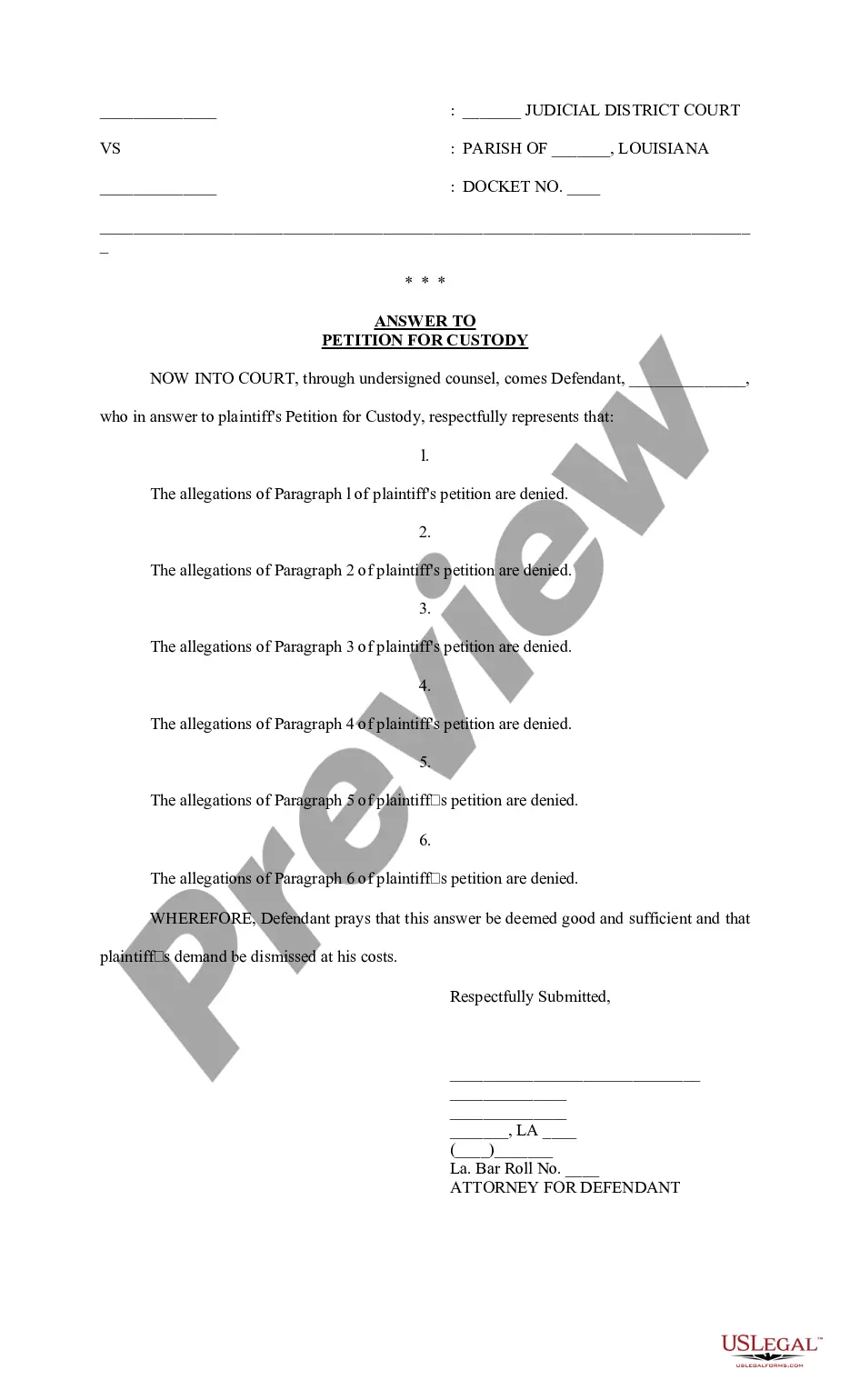
How to fill out Louisiana Answer To Petition For Custody?
Whether for commercial purposes or personal affairs, everyone eventually has to handle legal issues at some point in their lives.
Completing legal forms requires meticulous attention, beginning with choosing the correct form template.
With a vast US Legal Forms catalog available, you do not need to waste time searching for the correct template online. Use the library’s straightforward navigation to find the suitable form for any circumstance.
- Locate the template you need using the search box or catalog browsing.
- Review the form’s description to verify it suits your circumstances, state, and county.
- Click on the form’s preview to view it.
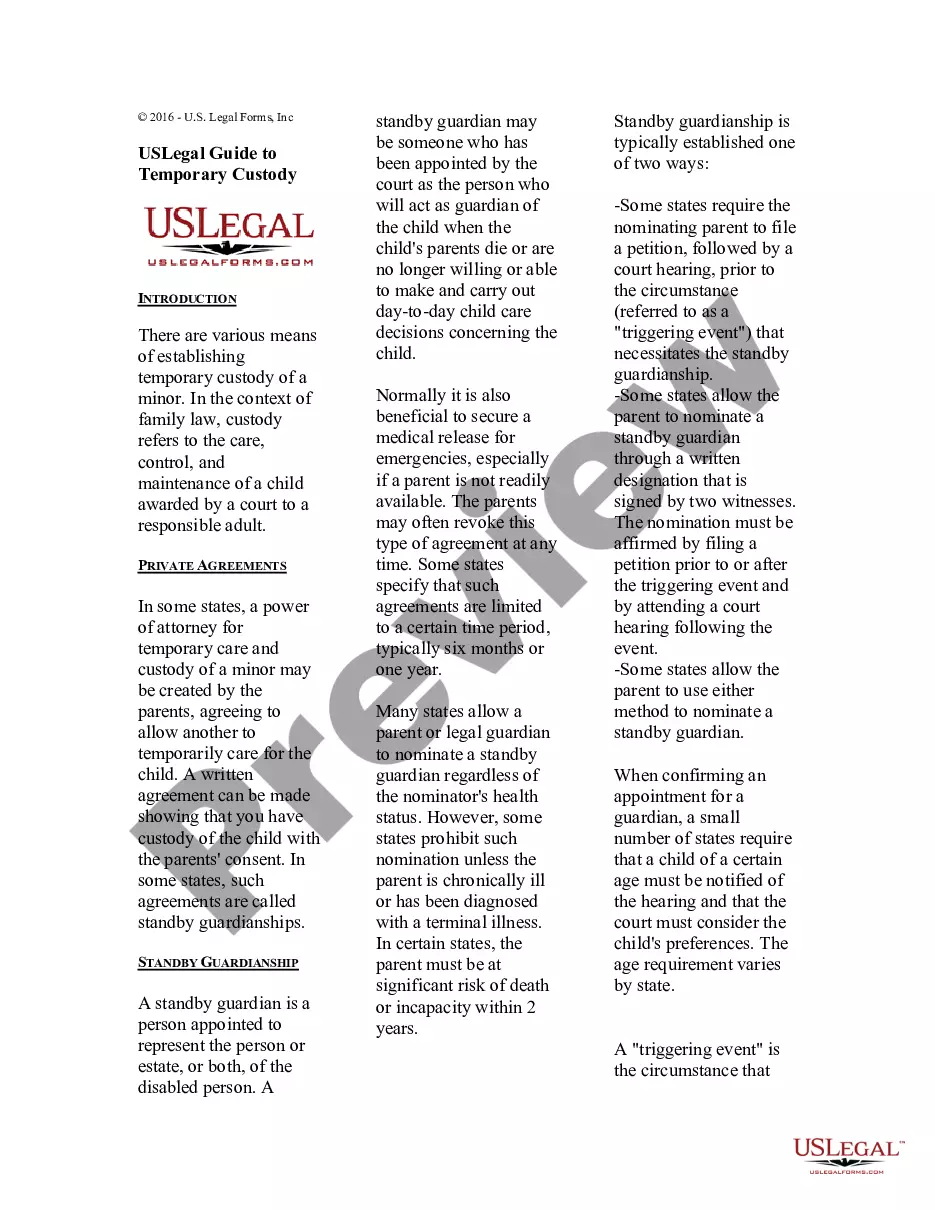
- If it is not the correct document, return to the search function to find the Petition Custody Of Child sample you require.
- Download the template if it fulfills your requirements.
- If you already have a US Legal Forms account, click Log in to access previously saved documents in My documents.
- If you do not yet have an account, you can download the form by clicking Buy now.
- Choose the appropriate pricing option.
- Complete the account registration form.
- Select your payment method: use a credit card or PayPal account.
- Pick the document format you prefer and download the Petition Custody Of Child.
- Once it is saved, you can either fill out the form using editing software or print it and fill it out by hand.
Form popularity
FAQ
One of the biggest mistakes parents make in a custody battle is failing to document everything related to their parenting and the child's needs. Keeping records of interactions, expenses, and parenting time can provide essential evidence in your case. When preparing to petition custody of child, organization and documentation can significantly enhance your position in court.
How do you start an application for decision-making responsibility (formerly custody) for a child? Step 1: Prepare your court application form. ... Step 2: Get your application issued. ... Step 3: Serve your application. ... Step 4: Complete proof of service. ... Step 5: File your court documents.
Close to 80 percent of children under the age of 12 were placed in their mothers' custody in cases where a court order existed. Almost 7 percent were placed in their fathers' custody, and for 13 percent of children, a shared custody arrangement was established.
Women Historically, women have always had the upper hand in being awarded child custody. Statistics show that women win child custody rights a staggering 90% of the time , even though fathers play an important role in their children's lives pre and post-divorce. Divorce For Men: Why Do Women Get Child Custody More Often? familylawattorneymesaaz.net ? divorce-for-men-w... familylawattorneymesaaz.net ? divorce-for-men-w...
To start a new court case, you always have to fill out Form 8: Application (general) in addition to the form that your case is about. For example, if you have to go to court to start a case about child custody and access, you would fill out Form 8 and Form 35.1 Affidavit in Support of Claim for Custody or Access.
Mothers and fathers get equal consideration This means the Court will consider multiple factors, such as who was providing daily care; the degree of attachment (does the child have a stronger attachment with the mother or father) and how can the existing lifestyle of the child be maintained with the least disruption.