Successor Agent For Attorney
Description
Get your form ready online
Our built-in tools help you complete, sign, share, and store your documents in one place.
Make edits, fill in missing information, and update formatting in US Legal Forms—just like you would in MS Word.
Download a copy, print it, send it by email, or mail it via USPS—whatever works best for your next step.
Sign and collect signatures with our SignNow integration. Send to multiple recipients, set reminders, and more. Go Premium to unlock E-Sign.
If this form requires notarization, complete it online through a secure video call—no need to meet a notary in person or wait for an appointment.
We protect your documents and personal data by following strict security and privacy standards.

Make edits, fill in missing information, and update formatting in US Legal Forms—just like you would in MS Word.

Download a copy, print it, send it by email, or mail it via USPS—whatever works best for your next step.

Sign and collect signatures with our SignNow integration. Send to multiple recipients, set reminders, and more. Go Premium to unlock E-Sign.

If this form requires notarization, complete it online through a secure video call—no need to meet a notary in person or wait for an appointment.

We protect your documents and personal data by following strict security and privacy standards.
Looking for another form?

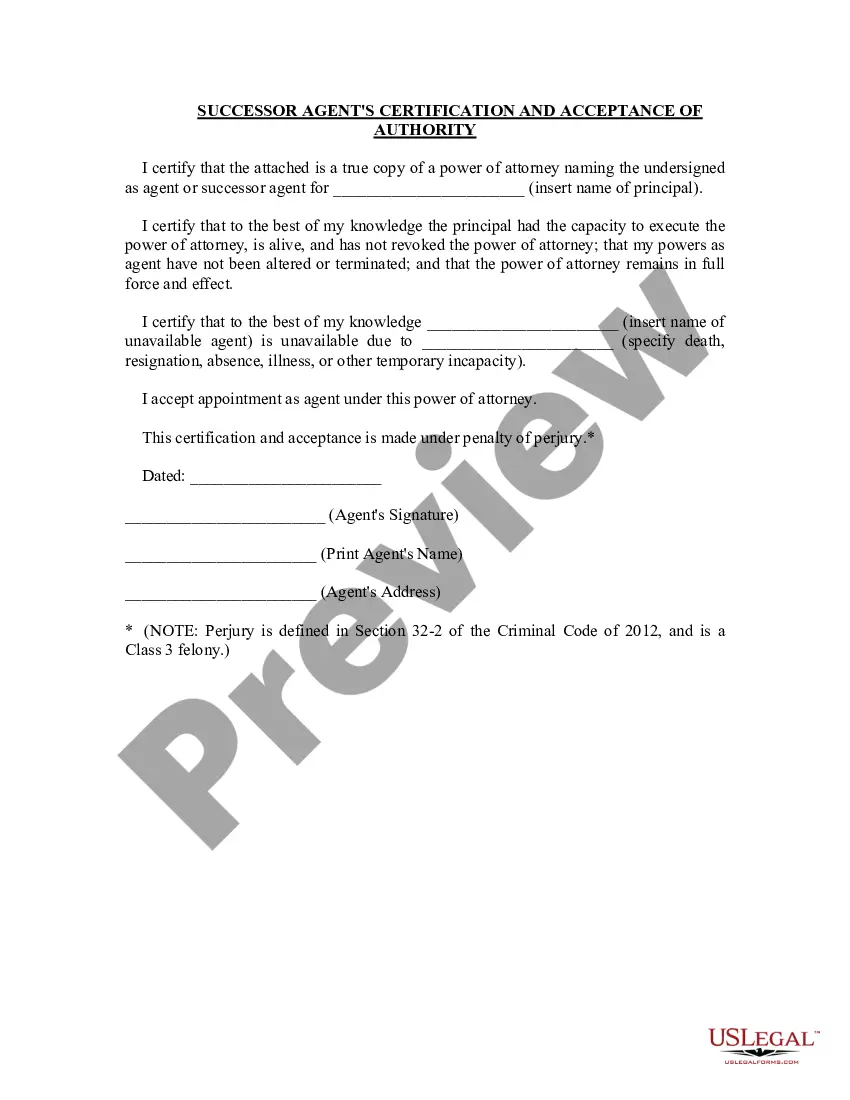
How to fill out Illinois Successor Agent's Certification And Acceptance Of Authority?
Utilizing legal document examples that adhere to federal and state regulations is essential, and the web provides numerous choices to select from.
However, what’s the purpose of spending time searching for the properly composed Successor Agent For Attorney sample online if the US Legal Forms digital library already consolidates such templates in one location.
US Legal Forms is the largest online legal repository featuring over 85,000 editable templates prepared by attorneys for various professional and personal situations.
Review the template using the Preview feature or through the text outline to ensure it meets your needs.
- They are easy to navigate with all documents organized by state and specific use.
- Our experts keep current with legal modifications, ensuring that your documents remain updated and compliant when you acquire a Successor Agent For Attorney from our site.
- Obtaining a Successor Agent For Attorney is straightforward and swift for both existing and new users.
- If you already possess an account with an active subscription, sign in and download the document sample you need in your desired format.
- If you are new to our platform, follow the steps outlined below.
Form popularity
FAQ
A successor in power of attorney refers to the individual who assumes the duties and authority when the original agent is unable to perform their tasks. This successor agent for attorney acts on behalf of the principal in financial, medical, or legal matters as defined in the power of attorney document. Having a clearly defined successor helps ensure that decisions can be made smoothly without interruption when the original agent can no longer act.
The process to transfer power of attorney involves revoking the existing authority and establishing a new one for the successor agent for attorney. This requires documenting the revocation properly and preparing a new power of attorney agreement that complies with relevant state laws. Consider using resources like USLegalForms to ensure everything is correctly managed and legally binding.
To transfer power of attorney from one person to another, the original agent must revoke their authority and a new power of attorney must be created for the new agent. It’s essential to abide by state laws when drafting the new document, ensuring it clearly identifies the new successor agent for attorney. Always consult with a legal expert or use a trusted platform like USLegalForms to properly handle this transfer.
A successor POA takes over by executing the authority granted in the original power of attorney document. This process often requires a written statement affirming their acceptance of the role as the successor agent for attorney. Additionally, the successor may need to notify relevant parties, such as banks and healthcare providers, to ensure a smooth transition of responsibilities.
To take over power of attorney, the individual must be designated as the successor agent for attorney in the original document. This role typically occurs when the primary agent can no longer fulfill their duties due to absence, incapacity, or resignation. It's important to follow the procedures outlined in the power of attorney document and to ensure that the transition is properly documented to maintain legal validity.
Power of attorney (POA) refers to the authorization allowing someone to act on your behalf. A successor, however, is the designated individual meant to take over these responsibilities if the primary agent is unable to serve. Understanding this difference helps you make informed decisions about your legal representation.
A successor agent letter is a formal document that notifies relevant parties about the appointment of a successor agent. This letter can clarify the powers granted to the successor and the conditions under which they may act. It serves as a helpful tool to ensure a smooth transition in representation.
Generally, a successor trustee does not strictly require legal representation, but consulting with an attorney can be beneficial. An attorney can help clarify responsibilities and ensure compliance with state laws. With the guidance of a legal professional, a successor trustee can effectively manage trust-related matters.
A successor agent for a power of attorney is an individual designated to step in for the primary agent when necessary. This role is vital as it provides a backup to ensure that matters are handled according to your preferences. Including a successor agent in your POA documentation can bring peace of mind.
An agent is the primary person authorized to make decisions on your behalf in a power of attorney. In contrast, a successor agent only assumes this role when the primary agent is unavailable. This distinction helps maintain clear pathways for decision-making and ensures your needs are always prioritized.