Hawaii Special Estate Forfeiture
Description
Get your form ready online
Our built-in tools help you complete, sign, share, and store your documents in one place.
Make edits, fill in missing information, and update formatting in US Legal Forms—just like you would in MS Word.
Download a copy, print it, send it by email, or mail it via USPS—whatever works best for your next step.
Sign and collect signatures with our SignNow integration. Send to multiple recipients, set reminders, and more. Go Premium to unlock E-Sign.
If this form requires notarization, complete it online through a secure video call—no need to meet a notary in person or wait for an appointment.
We protect your documents and personal data by following strict security and privacy standards.

Make edits, fill in missing information, and update formatting in US Legal Forms—just like you would in MS Word.

Download a copy, print it, send it by email, or mail it via USPS—whatever works best for your next step.

Sign and collect signatures with our SignNow integration. Send to multiple recipients, set reminders, and more. Go Premium to unlock E-Sign.

If this form requires notarization, complete it online through a secure video call—no need to meet a notary in person or wait for an appointment.

We protect your documents and personal data by following strict security and privacy standards.
Looking for another form?








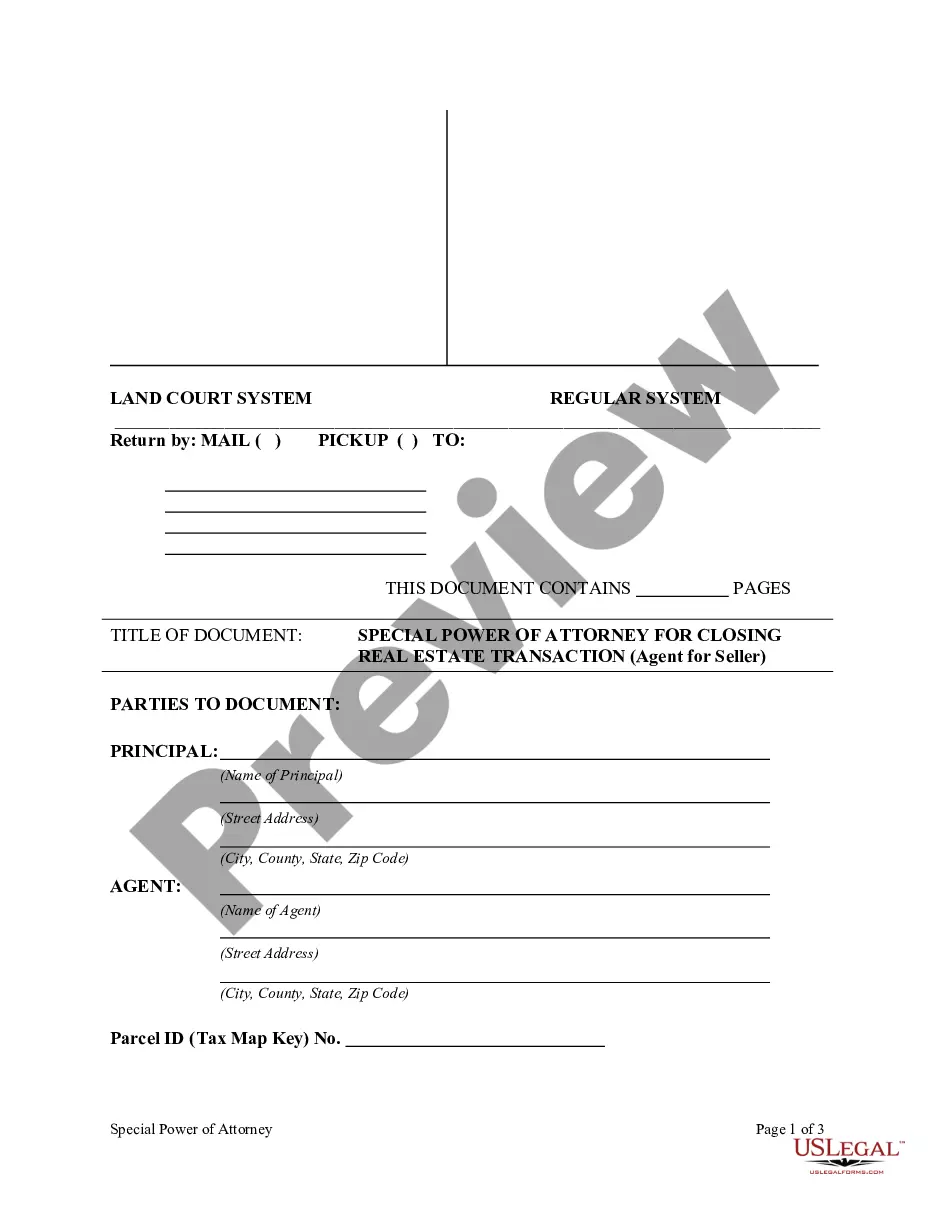
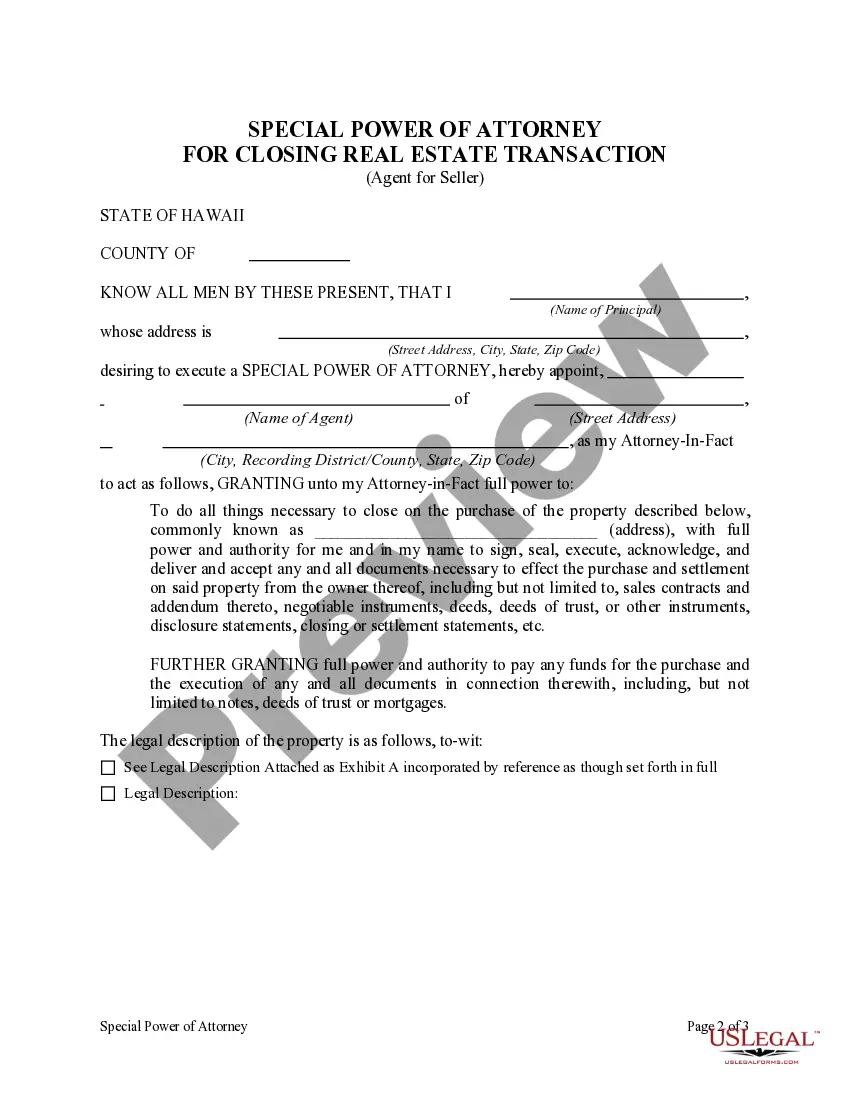
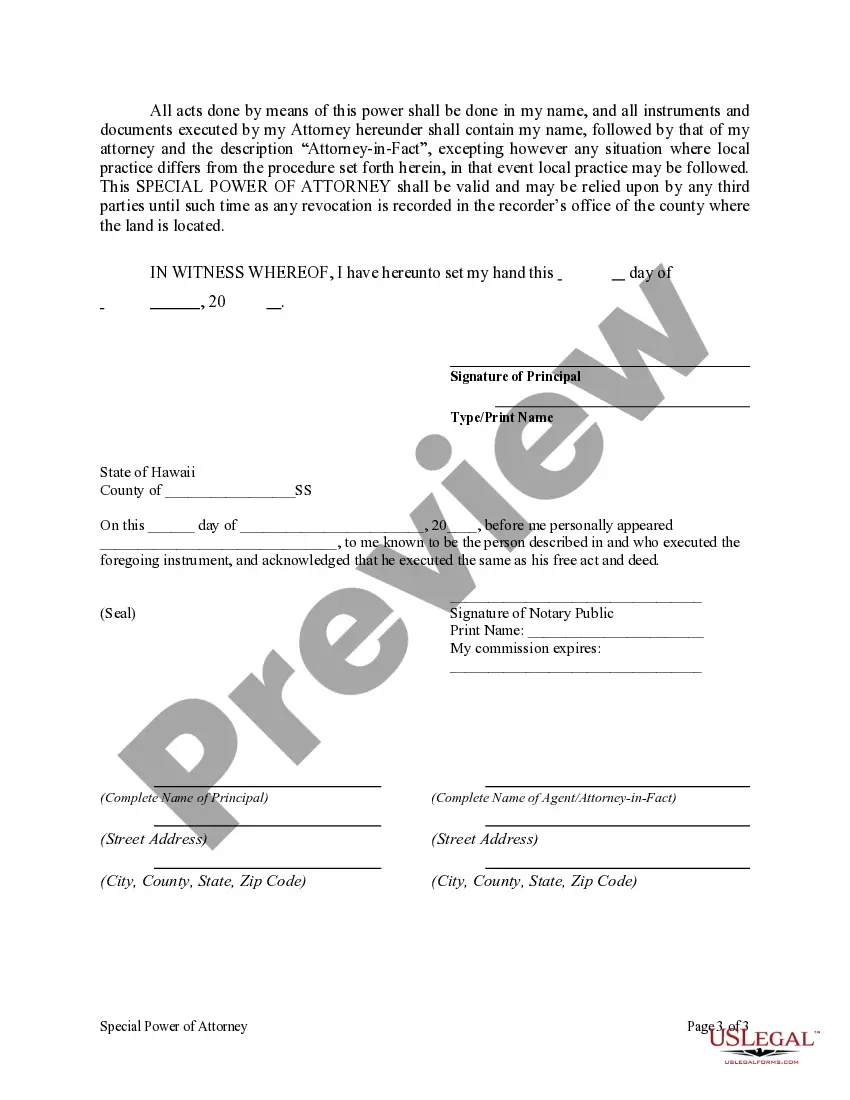
How to fill out Hawaii Special Or Limited Power Of Attorney For Real Estate Sales Transaction By Seller?
- If you're an existing user, log in to your account to access your form templates. Ensure your subscription is active; renew if necessary.
- For first-time users, start by reviewing the form descriptions and preview modes to ensure you select the correct document for your needs.
- If you need a different template, utilize the Search feature to locate the right form corresponding to local jurisdiction requirements.
- Purchase the document by clicking the Buy Now button and selecting a suitable subscription plan. Register for an account to unlock the library's full resources.
- Complete your purchase by entering your payment details via credit card or PayPal.
- Finally, download your form to your device and access it anytime from the My Forms section in your profile.
By using US Legal Forms, you gain access to a vast library of over 85,000 fillable and editable legal forms, which is more than what most competitors offer.
In conclusion, US Legal Forms equips you with all the resources necessary for effective legal documentation, ensuring accuracy and compliance. Start your journey today and simplify your legal processes!
Form popularity
FAQ
Fighting an asset forfeiture requires legal expertise and a solid understanding of the laws involved. You can contest the forfeiture by demonstrating that the assets are not connected to any crime. Utilizing resources from platforms like uslegalforms can help you navigate the complexities of Hawaii special estate forfeiture and build a strong defense.
The rule for forfeiture typically requires the government to prove connection between the property and unlawful activities. In Hawaii, special estate forfeiture follows similar legal frameworks, where it is crucial to demonstrate that the assets are involved in crime. This ensures a fair assessment of what qualifies for forfeiture.
Asset forfeiture law in Illinois permits law enforcement to confiscate property used or acquired in connection with a crime. This law aims to deter further criminal activity while allowing the state to reclaim financial gains from illegal acts. It's important to recognize how this contrasts with Hawaii special estate forfeiture processes.
In Illinois, forfeiture laws allow the state to seize assets linked to criminal activities. Unlike other states, Illinois has specific criteria that outline when forfeiture can apply. Understanding these laws is vital, as they can differ significantly from those governing Hawaii special estate forfeiture.
Hawaii special estate forfeiture occurs under specific legal conditions, such as a conviction for certain crimes. Forfeiture can take place when property is involved in illegal activities or acquired through unlawful means. It's essential to ensure that the appropriate legal standards are met, and understanding these can help protect your rights.
An example of a forfeiture could involve a property seized by the state after it is determined that the owner was involved in illegal activities, such as operating a drug manufacturing lab on the premises. In cases of Hawaii special estate forfeiture, law enforcement may target real estate used as a base for criminal operations and legally claim it as forfeited. This denotes the gravity of following the law, as ownership can be lost without compensation. For assistance with such legal matters, USLegalForms offers helpful resources.
Forfeiture of estate refers to the legal process where an individual loses their property rights due to specific violations or misconduct. In the context of Hawaii special estate forfeiture, this can happen when the property is used for illegal activities, such as drug trafficking or other crimes. It's essential to understand the implications of forfeiture, as it can significantly impact ownership and rights. To navigate these complex issues, you might consider using resources like USLegalForms.
The two primary types of asset forfeiture are criminal and civil forfeiture. Criminal forfeiture occurs as part of a criminal case, while civil forfeiture happens independently of any criminal charges. Each type has its specific legal procedures and implications. For those dealing with Hawaii special estate forfeiture, understanding these distinctions is vital. Utilizing platforms like uslegalforms can streamline your approach and provide access to necessary legal resources.
The defense of asset forfeiture involves arguing that the seized property is not connected to criminal activity. Individuals can present evidence showing legitimate ownership and use of the property. In cases of Hawaii special estate forfeiture, it's essential to have skilled legal representation to navigate the complexities and uphold your rights. Legal professionals can guide you through this challenging process, ensuring a fair assessment.
Yes, asset forfeiture can be constitutional. Under U.S. law, authorities can seize property linked to illegal activities, which falls under certain legal guidelines. However, the process must adhere to due process and can be challenged in court. If you're facing issues related to Hawaii special estate forfeiture, consulting legal experts can help clarify your rights.