Transfer On Death Deed For Vehicles
Description

Get your form ready online
Our built-in tools help you complete, sign, share, and store your documents in one place.
Make edits, fill in missing information, and update formatting in US Legal Forms—just like you would in MS Word.
Download a copy, print it, send it by email, or mail it via USPS—whatever works best for your next step.
Sign and collect signatures with our SignNow integration. Send to multiple recipients, set reminders, and more. Go Premium to unlock E-Sign.
If this form requires notarization, complete it online through a secure video call—no need to meet a notary in person or wait for an appointment.
We protect your documents and personal data by following strict security and privacy standards.

Make edits, fill in missing information, and update formatting in US Legal Forms—just like you would in MS Word.

Download a copy, print it, send it by email, or mail it via USPS—whatever works best for your next step.

Sign and collect signatures with our SignNow integration. Send to multiple recipients, set reminders, and more. Go Premium to unlock E-Sign.

If this form requires notarization, complete it online through a secure video call—no need to meet a notary in person or wait for an appointment.

We protect your documents and personal data by following strict security and privacy standards.
Looking for another form?


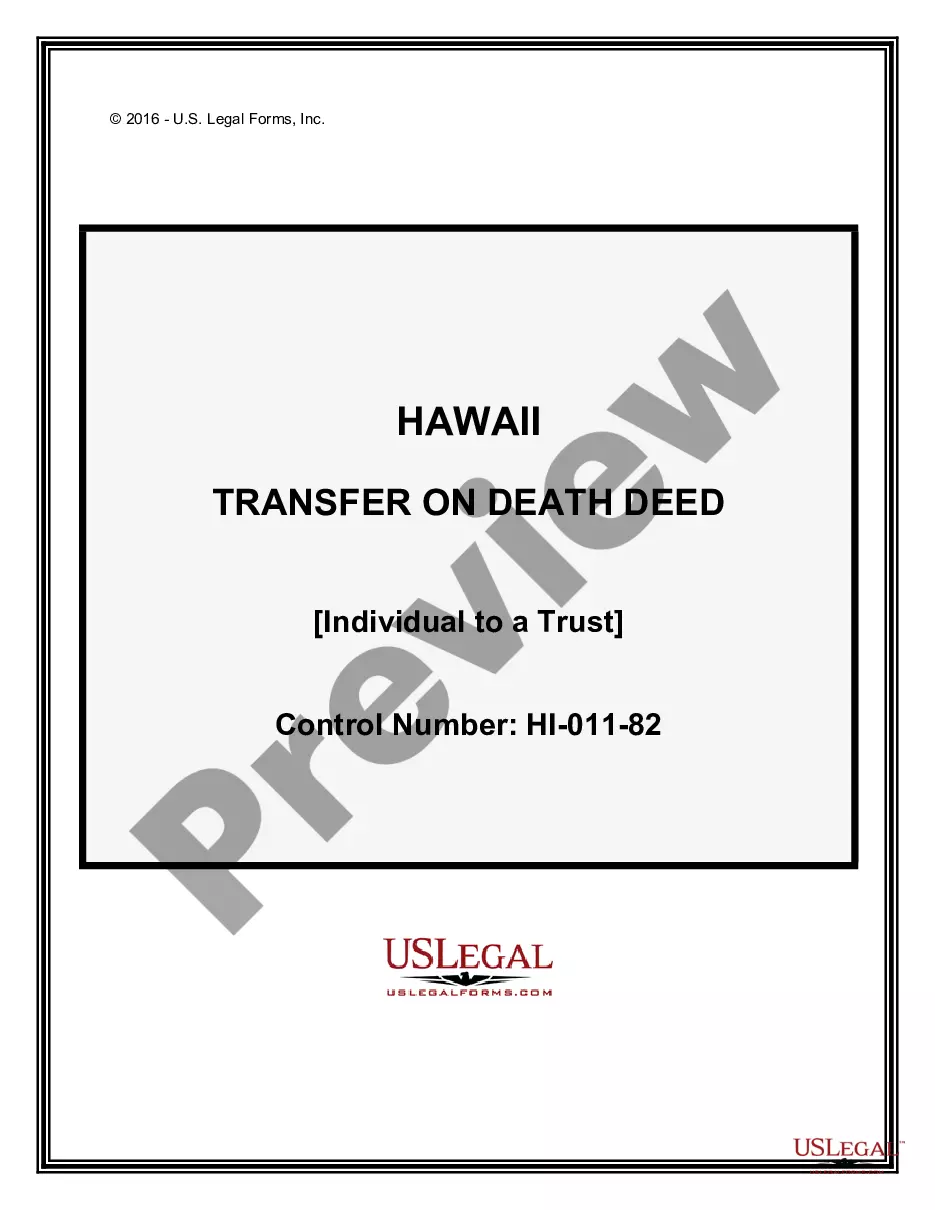
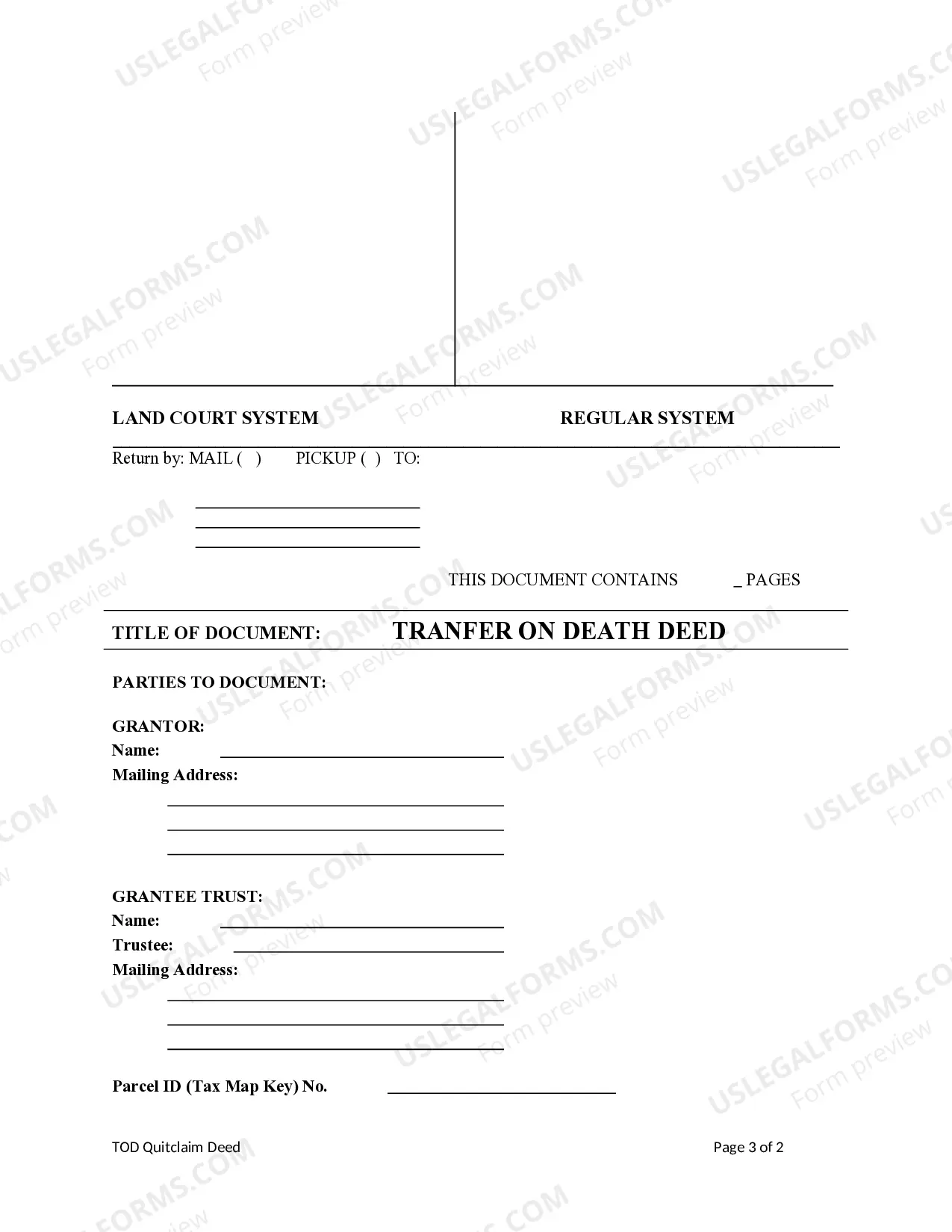
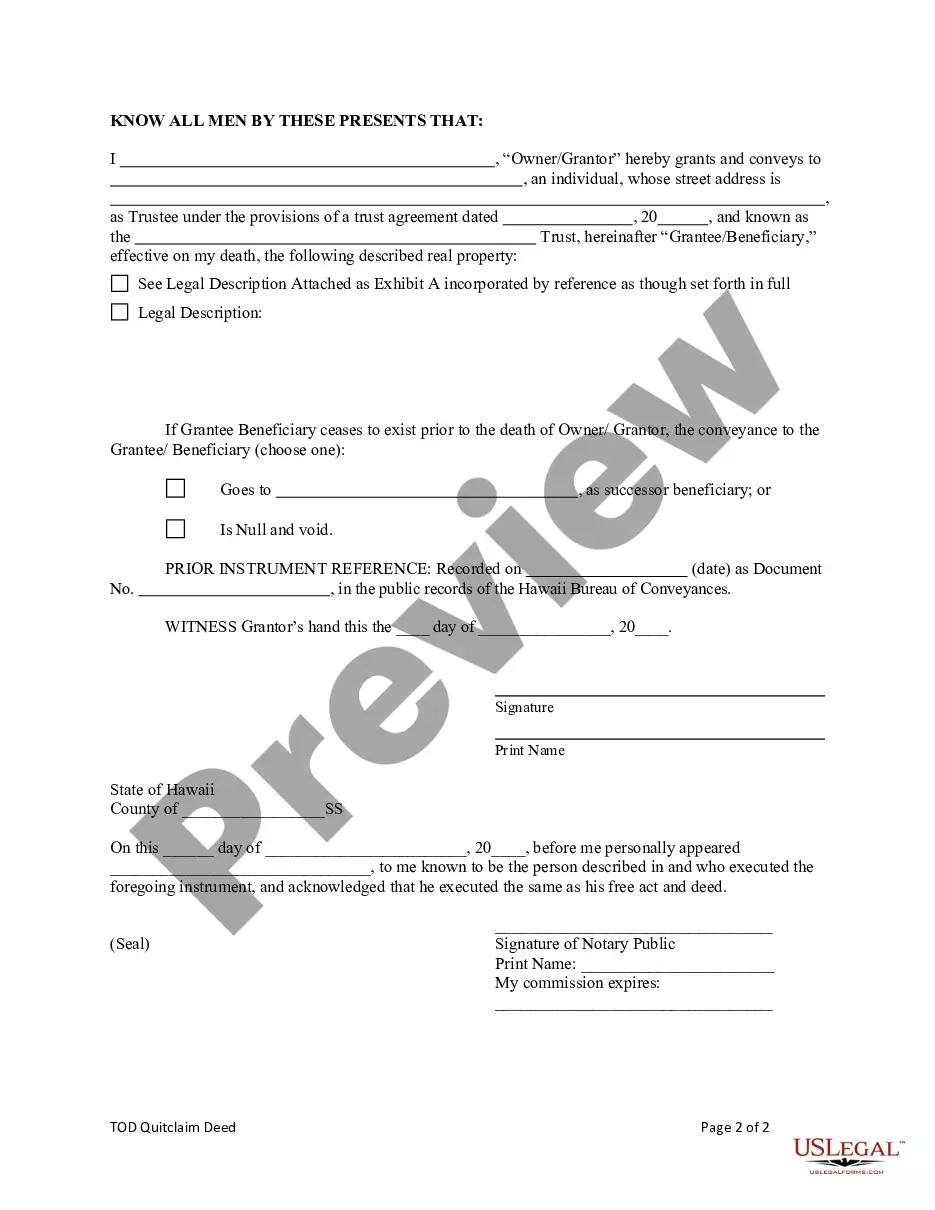
How to fill out Hawaii Transfer On Death Quitclaim Deed From Individual To A Trust?
- For returning users, log in to your account and locate the necessary form. Ensure that your subscription is active or renew it under your payment plan.
- If you’re new, start by previewing the form description to confirm that it aligns with your local jurisdiction’s requirements. Choose the correct form that fits your needs.
- Use the search feature to find alternative templates if there are discrepancies. Once satisfied, proceed to the next step.
- Select your document by clicking the Buy Now button, then choose your preferred subscription plan and create an account to access the library.
- Complete your purchase by entering your payment details or utilizing a PayPal account, then finalize your transaction.
- Download the completed form to your device. You can access it anytime from the My Forms menu of your profile.
By leveraging US Legal Forms, users gain access to an extensive library of over 85,000 customizable legal documents. This platform empowers both individuals and attorneys to efficiently handle legal matters without the hassle.
Take control of your vehicle's future with a transfer on death deed today. Sign up for US Legal Forms and simplify your legal documentation process!
Form popularity
FAQ
In Texas, the rules for a transfer on death deed for vehicles include proper execution and recording with the appropriate county clerk's office. The owner must clearly identify the vehicle and the beneficiaries in the deed. Additionally, the owner retains full control of the vehicle and may revoke the deed at any time before passing. Understanding these rules can help ensure a smooth transition of ownership.
In Texas, a transfer on death deed for vehicles allows an owner to designate one or more beneficiaries to inherit the vehicle upon their death. This deed must be properly executed and recorded with the county's clerk to be valid. Importantly, the vehicle remains under the owner’s control during their lifetime, eliminating any loss of use. Once the owner passes away, the designated beneficiaries can claim ownership without going through probate.
One disadvantage of a transfer on death deed for vehicles is that it does not provide any immediate benefits during the owner's lifetime. Additionally, if the vehicle owner has debts, creditors may still seek payment from the vehicle's value after death. Furthermore, this type of deed does not allow for control over how the vehicle is managed until the owner's passing. Therefore, it is essential to consider individual circumstances before deciding on this option.
In Missouri, a car does not necessarily have to go through probate if a transfer on death deed for vehicles is in place. This deed allows for a direct transfer of ownership to a designated beneficiary, bypassing the probate process. It's essential to have the TOD deed properly executed to avoid any legal hurdles later on.
Yes, transfer on death (TOD) deeds are permitted in Florida for vehicles. This legal option provides an efficient way to transfer ownership without going through probate. By taking advantage of a TOD deed, you can ensure your vehicle goes to the chosen beneficiary seamlessly after your passing.
Yes, Florida allows a transfer on death deed for vehicles. This deed enables vehicle owners to pass on their title directly to a designated beneficiary after their death. By utilizing this option, individuals can simplify the transfer process and minimize any potential legal complications.
To avoid probate on a car in Florida, consider using a transfer on death deed for vehicles. This deed allows you to designate someone to receive the vehicle automatically upon your death. By doing so, the car bypasses the probate process, ensuring a smoother transfer of ownership and reducing related legal fees.
To transfer ownership of a car after death in Florida, the beneficiaries listed on the transfer on death deed for vehicles should gather necessary documents. These include the original title, a death certificate, and any applicable forms from the DMV. The beneficiaries can then visit their local DMV office to complete the transfer, streamlining the process.
To transfer on death title in Florida, you need to complete a transfer on death deed for vehicles form. This legal document should be signed by the vehicle owner and a notary public. Once completed, it must be submitted to the Florida Department of Highway Safety and Motor Vehicles. This process simplifies the transfer of ownership upon the owner's death, avoiding complicated procedures.
Yes, you can transfer the title of a car in Florida if the owner has died, but it requires specific documentation. The next of kin must provide the death certificate, title application, and possibly a transfer on death deed for vehicles, if applicable. For guidance, uslegalforms provides valuable resources to help navigate this process smoothly.