Interspousal Transfer Deed In Divorce
Description
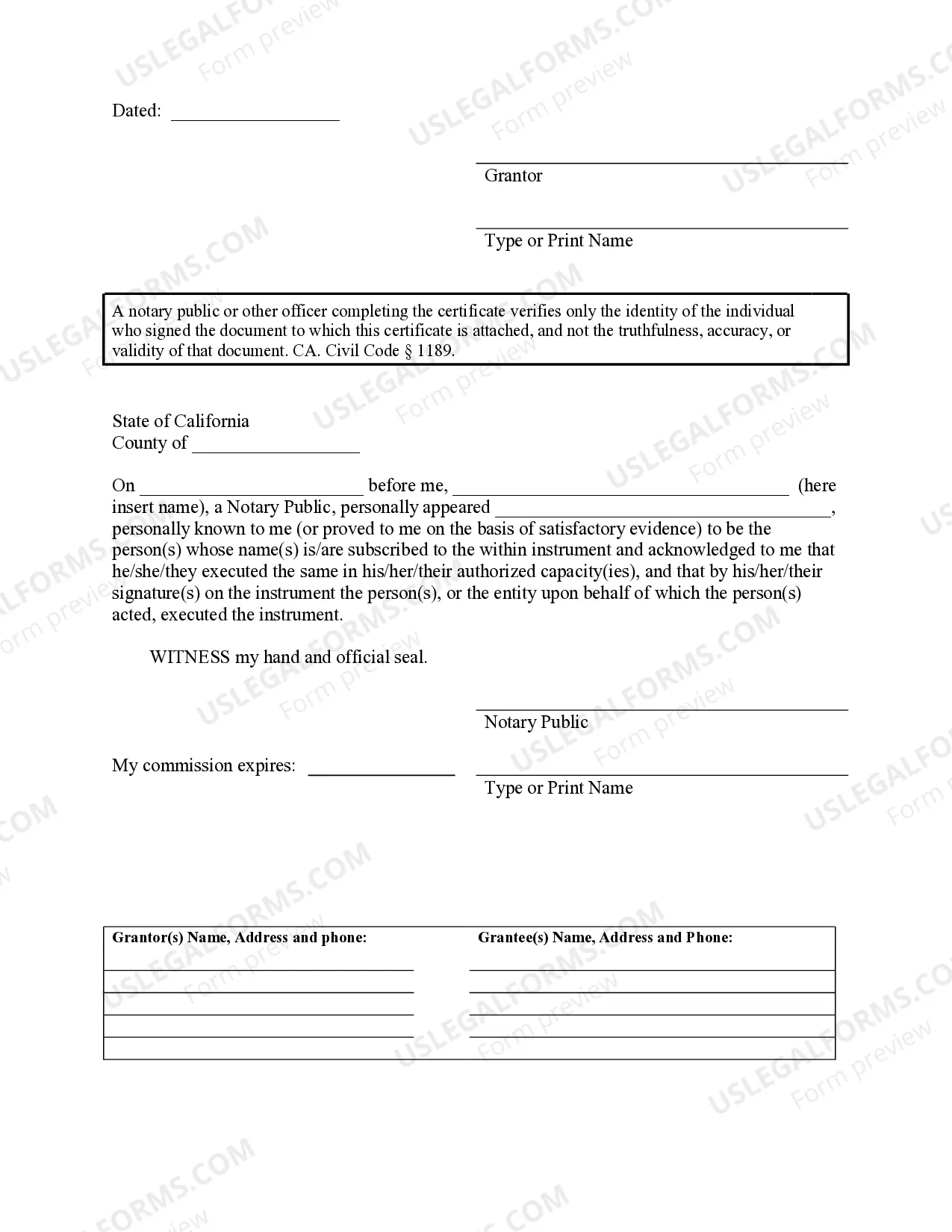
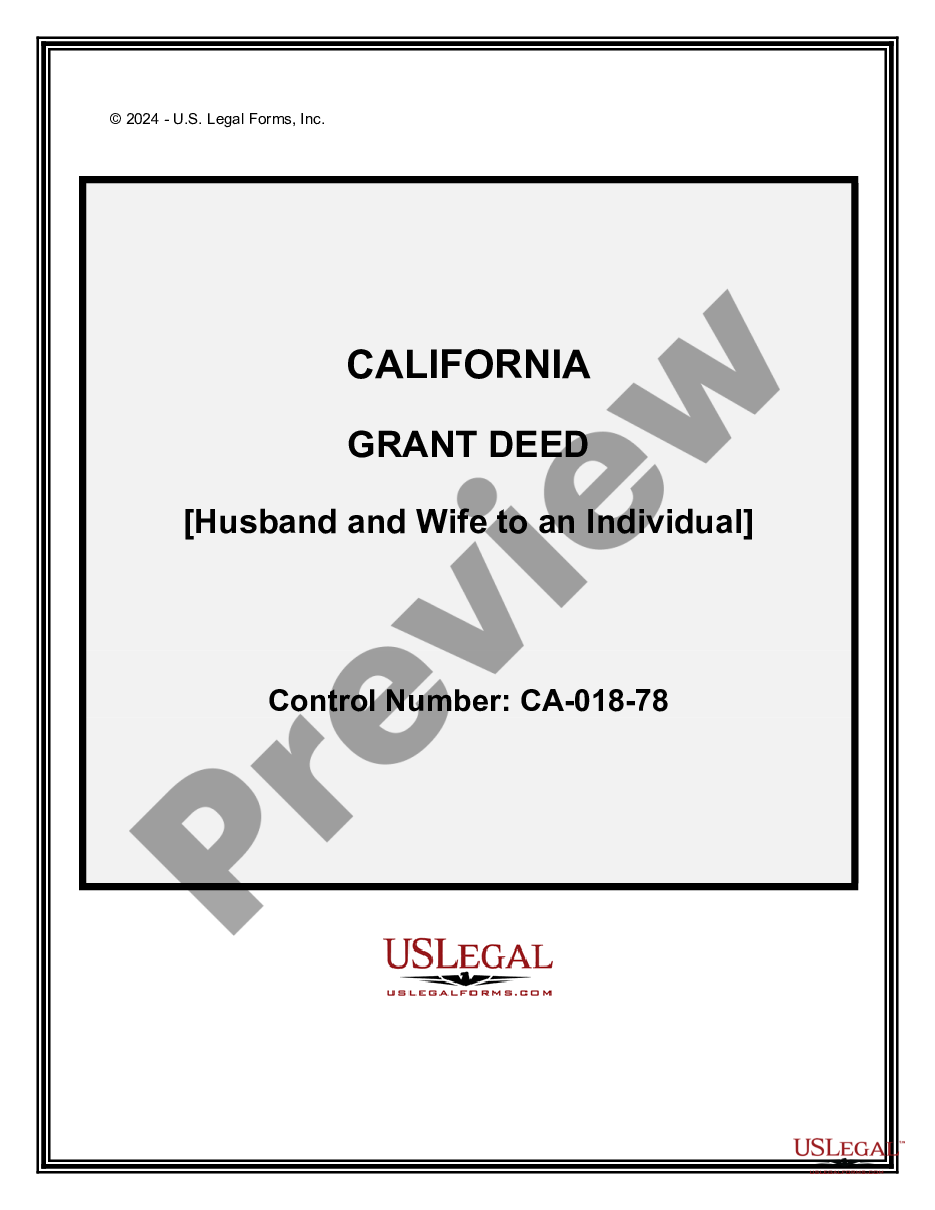
Get your form ready online
Our built-in tools help you complete, sign, share, and store your documents in one place.
Make edits, fill in missing information, and update formatting in US Legal Forms—just like you would in MS Word.
Download a copy, print it, send it by email, or mail it via USPS—whatever works best for your next step.
Sign and collect signatures with our SignNow integration. Send to multiple recipients, set reminders, and more. Go Premium to unlock E-Sign.
If this form requires notarization, complete it online through a secure video call—no need to meet a notary in person or wait for an appointment.
We protect your documents and personal data by following strict security and privacy standards.

Make edits, fill in missing information, and update formatting in US Legal Forms—just like you would in MS Word.

Download a copy, print it, send it by email, or mail it via USPS—whatever works best for your next step.

Sign and collect signatures with our SignNow integration. Send to multiple recipients, set reminders, and more. Go Premium to unlock E-Sign.

If this form requires notarization, complete it online through a secure video call—no need to meet a notary in person or wait for an appointment.

We protect your documents and personal data by following strict security and privacy standards.
Looking for another form?
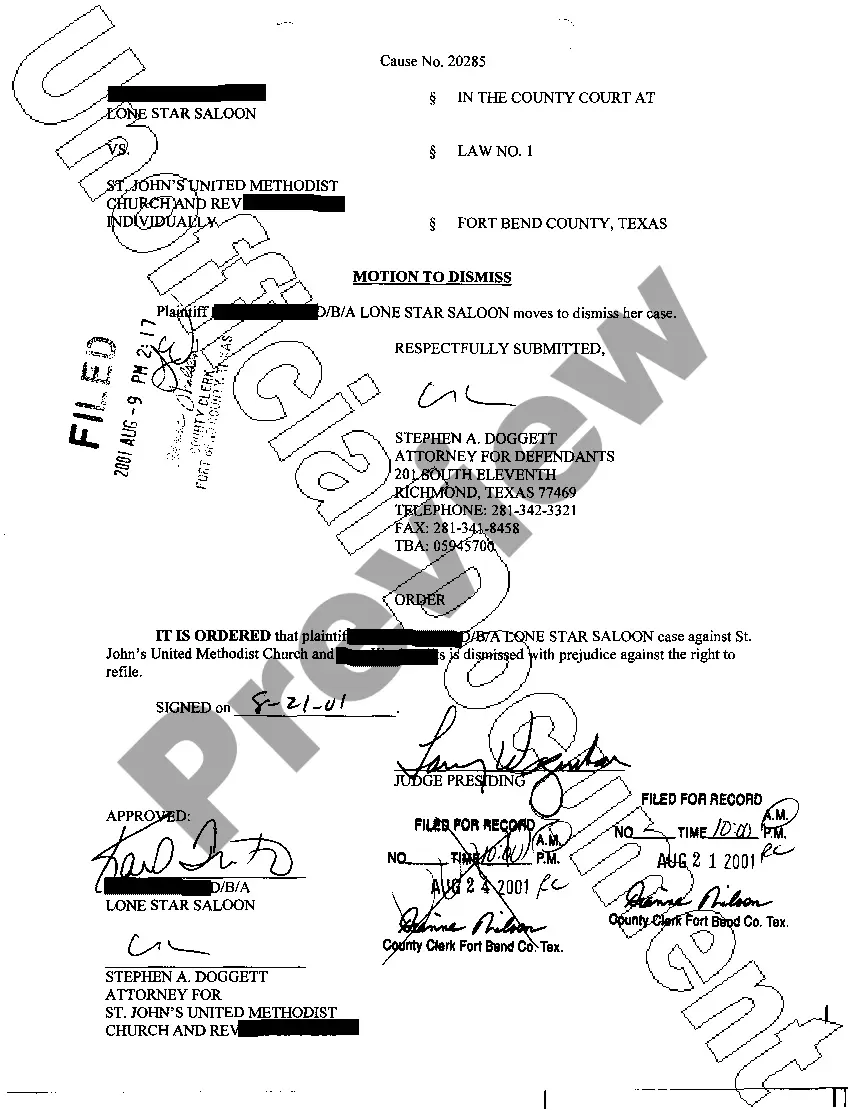






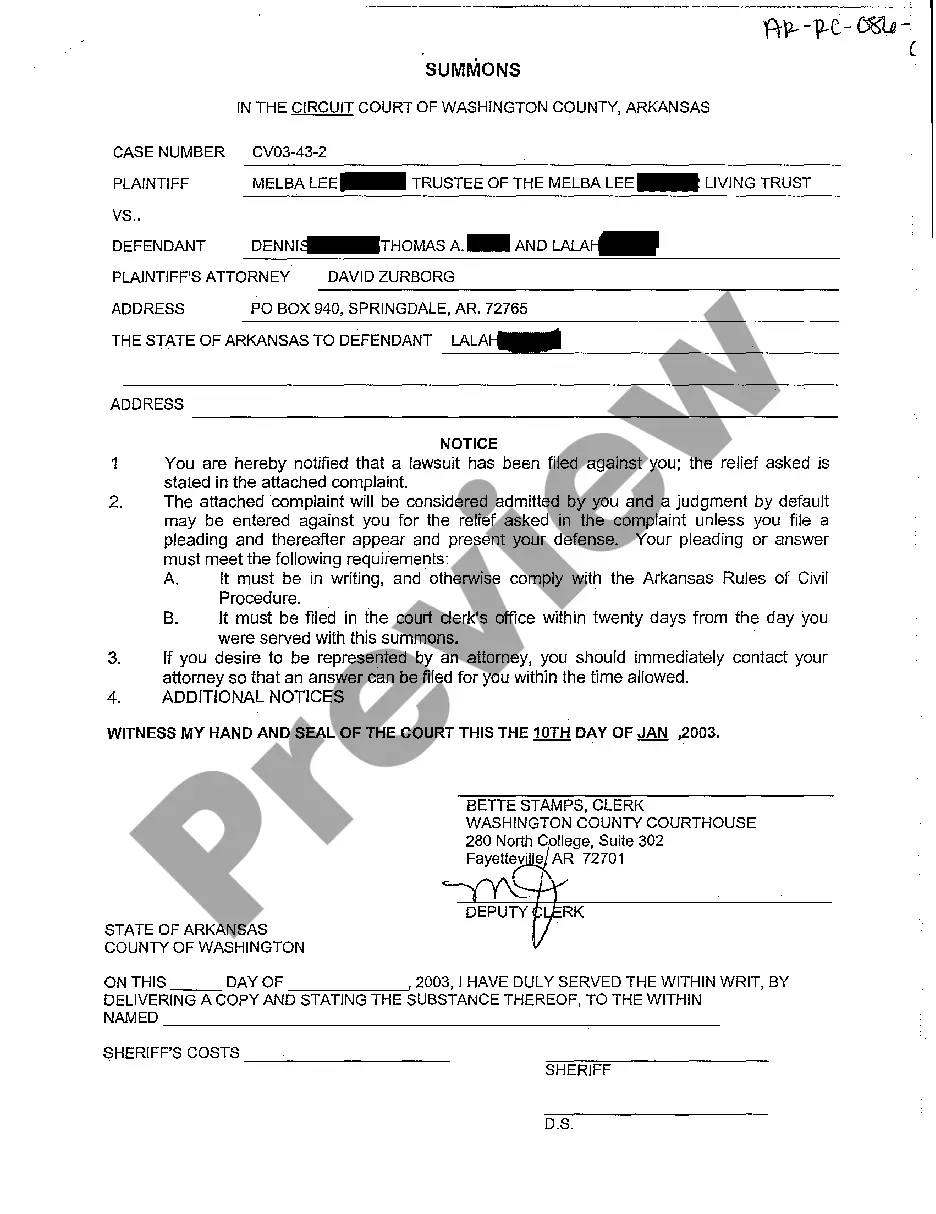
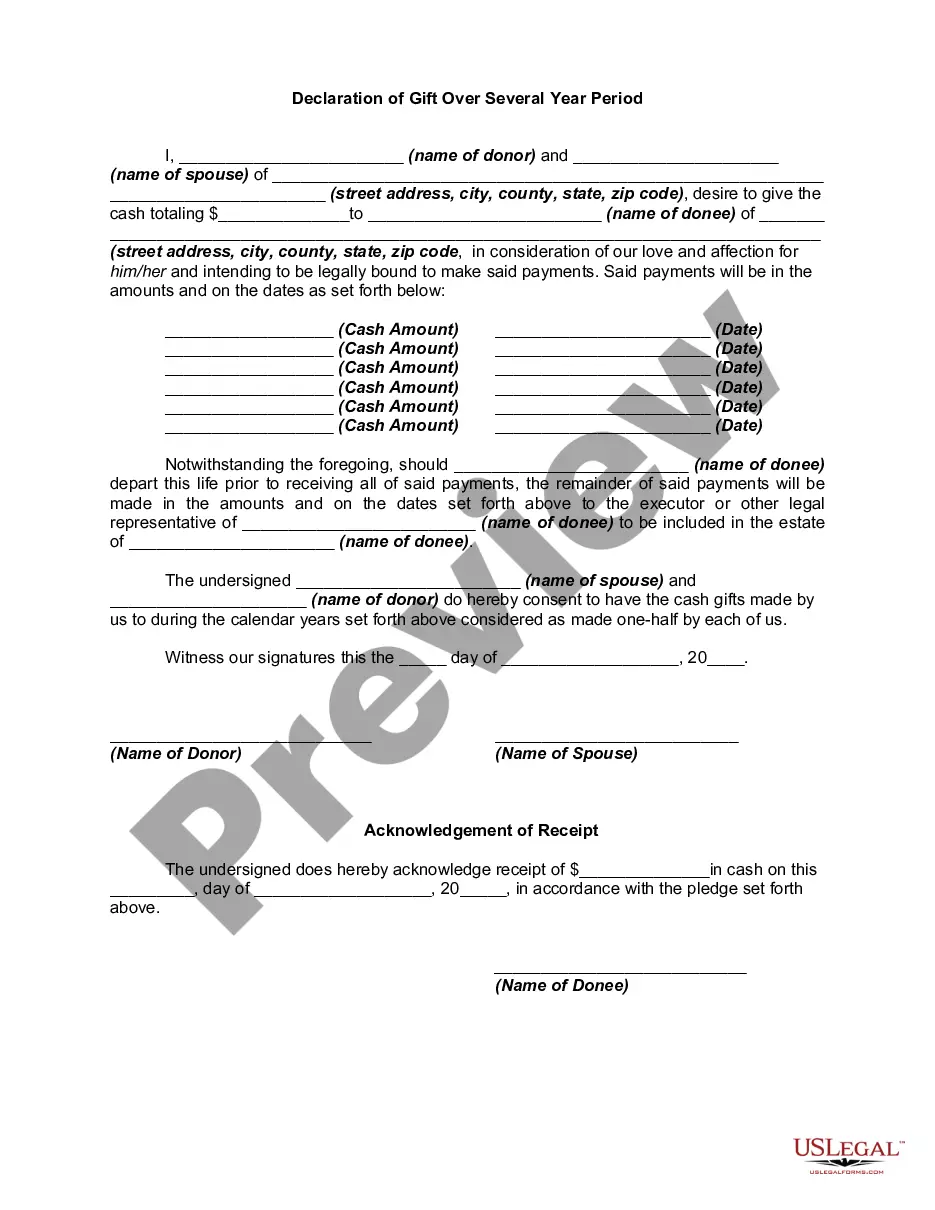
How to fill out California Interspousal Grant Deed From Individual?
Identifying a reliable source to obtain the most updated and pertinent legal templates is a significant part of navigating bureaucracy.
Locating the precise legal documents necessitates precision and meticulousness, which is why it is essential to source Interspousal Transfer Deed In Divorce exclusively from trustworthy providers, such as US Legal Forms. An incorrect template can squander your time and delay your current situation.
Relieve the stress associated with your legal paperwork. Discover the vast US Legal Forms library to locate legal templates, assess their applicability to your situation, and download them promptly.
- Utilize the catalog navigation or search function to find your template.
- Examine the form’s outline to determine if it meets the stipulations of your state and county.
- Inspect the form preview, if available, to confirm that the form aligns with your requirements.
- Return to the search to locate the correct document if the Interspousal Transfer Deed In Divorce does not meet your expectations.
- Once you are certain about the form’s pertinence, download it.
- If you are a registered user, click Log in to verify your identity and access your chosen templates in My documents.
- If you do not possess an account yet, click Buy now to acquire the template.
- Select the pricing option that best fits your requirements.
- Proceed to the registration to complete your order.
- Finalize your transaction by selecting a payment method (credit card or PayPal).
- Choose the document format for downloading Interspousal Transfer Deed In Divorce.
- After you have the form on your device, you may edit it with the editor or print it out and fill it in manually.
Form popularity
FAQ
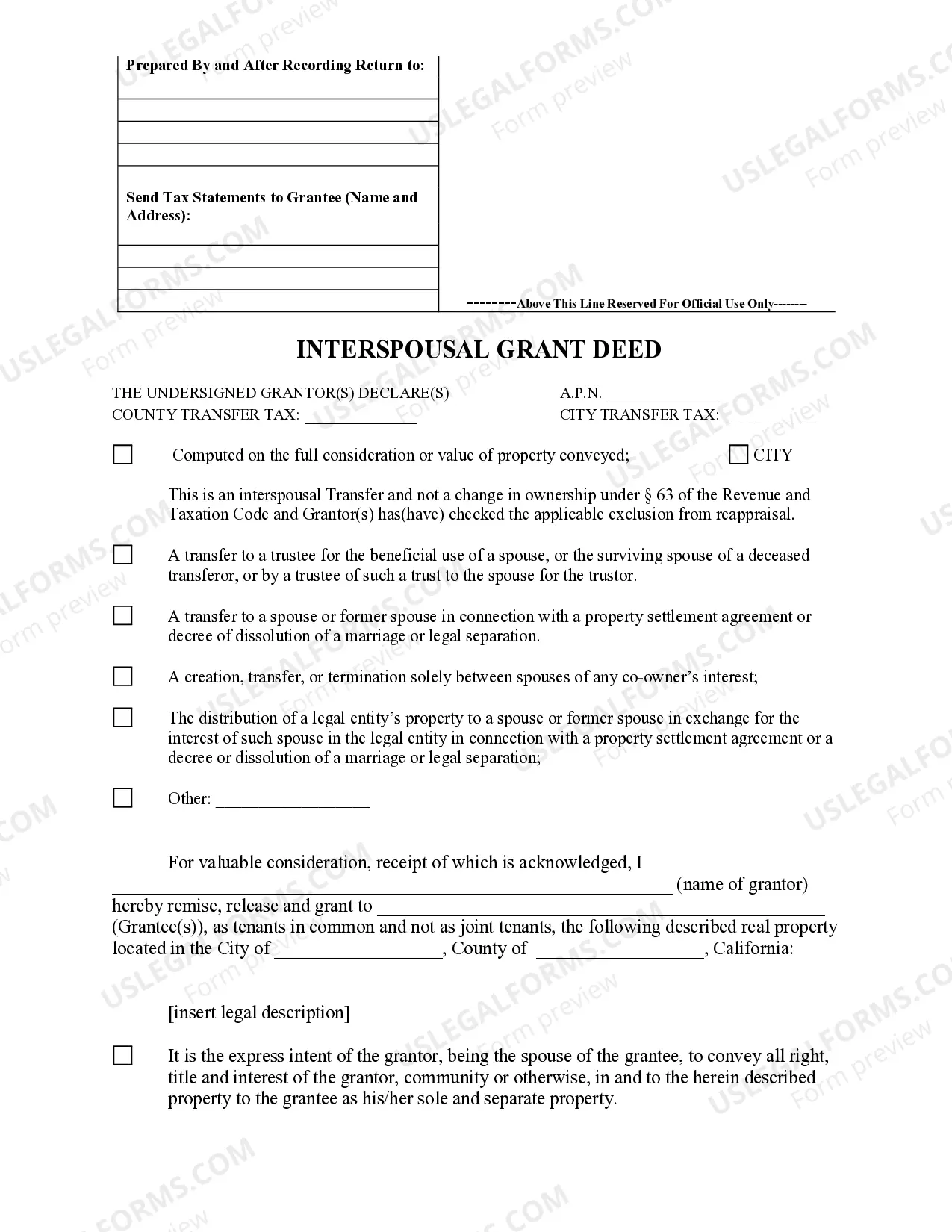
An Interspousal transfer deed in divorce is a legal document that allows spouses to transfer ownership of property between themselves during or after a divorce. This process often helps clarify property rights and ensures that both parties agree on the division of assets. By using this deed, you can simplify the transfer of property titles without the need for lengthy court procedures. If you seek assistance with creating this deed, consider using the US Legal Forms platform to access proper templates and ensure compliance with local laws.
In California, an interspousal transfer deed in divorce allows spouses to transfer property to one another without incurring a property tax reassessment. This deed simplifies the transfer process and may provide tax benefits following a divorce settlement. Utilizing a user-friendly platform like US Legal Forms can help you navigate the requirements and ensure compliance during this transition.
Spouses have two years after the divorce is finalized to transfer property without it being recognized as a gain or loss for tax purposes. This timeline is crucial for completing an interspousal transfer deed in divorce, allowing both parties to restructure asset ownership seamlessly. Always consult with a tax professional to understand any implications specific to your situation.
While you are not required to hire a lawyer to transfer a deed in New Jersey, it is strongly recommended, especially during a divorce. An experienced attorney can help ensure that the interspousal transfer deed in divorce is executed correctly and meets all legal requirements. They can also provide legal advice specific to your situation and help avoid potential pitfalls.
To file an interspousal transfer deed in California, first, complete the document with the necessary details and signatures. After the deed is notarized, take it to your local county recorder's office to file it. Make sure to inquire about any specific forms or fees that may apply in your county.
The purpose of an interspousal transfer deed in divorce is to facilitate the transfer of property ownership between spouses smoothly. This legal document helps clarify property rights and can simplify the distribution of assets, avoiding potential disputes in the future. It serves as a formal way to document the transfer, providing both clarity and security.
Filing an interspousal transfer deed is a straightforward process. First, ensure that both spouses sign the deed and have it notarized. Then, you can submit it to the county recorder's office in your area, along with any required filing fees.
To complete an interspousal transfer deed in divorce, both parties must fill out the deed form accurately. This includes providing property details and the names of both spouses. After signing the deed in front of a notary, you can proceed to file it with your local county recorder’s office.
You do not necessarily need a lawyer to transfer a deed, especially when you use an interspousal transfer deed in divorce. However, having legal assistance can help ensure that the process is completed correctly. A lawyer can provide valuable insights into the specific requirements even though the procedure may seem straightforward.