Beneficiary For Death Benefits
Description
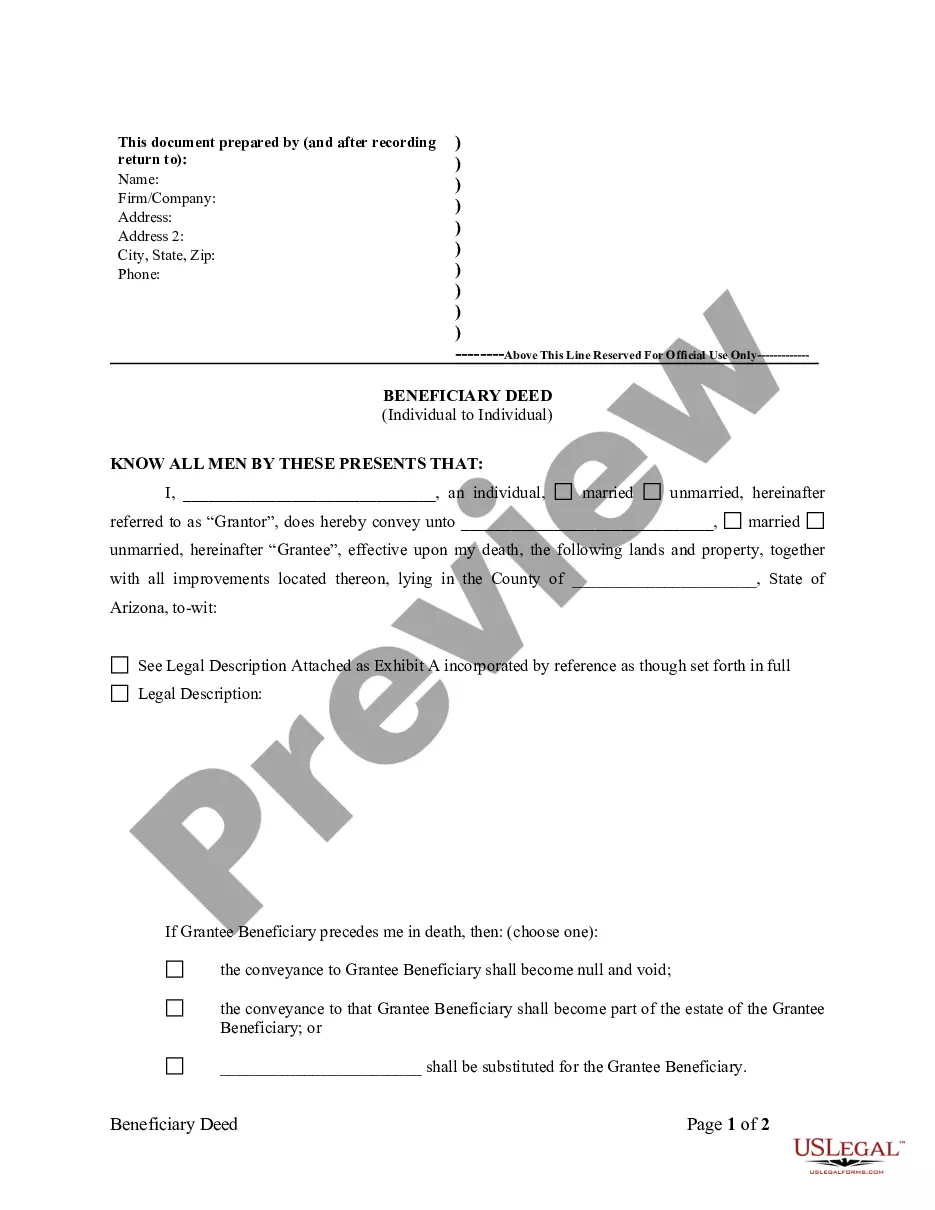



Get your form ready online
Our built-in tools help you complete, sign, share, and store your documents in one place.
Make edits, fill in missing information, and update formatting in US Legal Forms—just like you would in MS Word.
Download a copy, print it, send it by email, or mail it via USPS—whatever works best for your next step.
Sign and collect signatures with our SignNow integration. Send to multiple recipients, set reminders, and more. Go Premium to unlock E-Sign.
If this form requires notarization, complete it online through a secure video call—no need to meet a notary in person or wait for an appointment.
We protect your documents and personal data by following strict security and privacy standards.

Make edits, fill in missing information, and update formatting in US Legal Forms—just like you would in MS Word.

Download a copy, print it, send it by email, or mail it via USPS—whatever works best for your next step.

Sign and collect signatures with our SignNow integration. Send to multiple recipients, set reminders, and more. Go Premium to unlock E-Sign.

If this form requires notarization, complete it online through a secure video call—no need to meet a notary in person or wait for an appointment.

We protect your documents and personal data by following strict security and privacy standards.
Looking for another form?









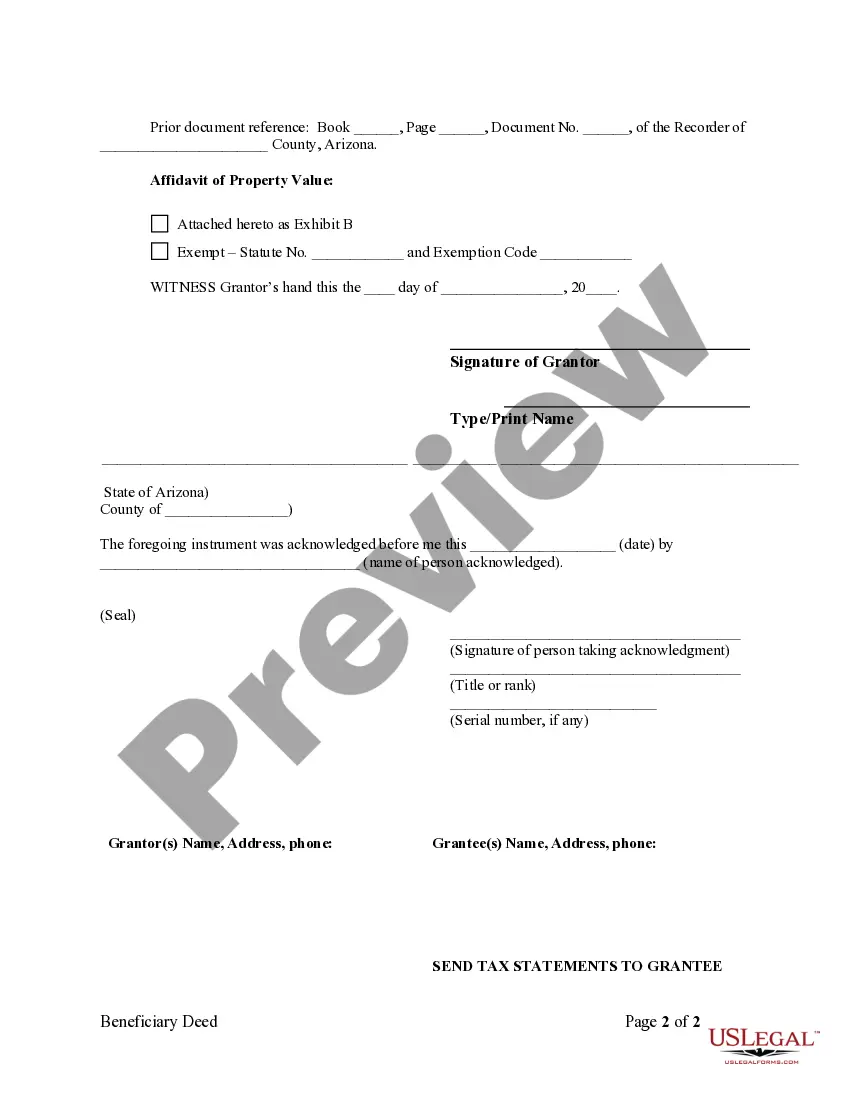
How to fill out Arizona Beneficiary Deed For Individual To Individual?
The Recipient For Death Benefits you view on this site is a reusable official template crafted by experienced attorneys in accordance with federal and state regulations.
For over 25 years, US Legal Forms has offered individuals, businesses, and legal practitioners more than 85,000 validated, state-specific documents for any commercial and personal circumstance. It’s the quickest, most direct, and most dependable method to acquire the documentation you require, as the service guarantees the utmost level of data security and anti-malware safeguards.
Subscribe to US Legal Forms to have validated legal templates for all of life's situations available at your fingertips.
- Search for the document you require and examine it.
- Browse through the template you looked up and preview it or assess the form description to verify it meets your criteria. If it doesn’t, utilize the search function to find the correct one. Click Buy Now when you have located the template you want.
- Choose and sign in.
- Pick the pricing package that works for you and create an account. Use PayPal or a credit card to make an immediate payment. If you already possess an account, Log In and verify your subscription to continue.
- Acquire the editable template.
- Select the format you desire for your Recipient For Death Benefits (PDF, DOCX, RTF) and save the template on your device.
- Fill out and sign the documents.
- Print the template to complete it by hand. Alternatively, employ an online multifunctional PDF editor to swiftly and accurately fill out and sign your form with an electronic signature.
- Download your documents again.
- Use the same document again whenever necessary. Access the My documents tab in your account to re-download any previously acquired templates.
Form popularity
FAQ
To name a primary beneficiary: Check the box that indicates the beneficiary's relationship to you. For each individual you designate, enter the full name, share, address, and date of birth or Social Security number (SSN) or other tax ID (such as an Employer Identification Number (EIN)).
A death benefit is the primary reason someone purchases a life insurance policy; it's the amount of money your insurer will pay out to your beneficiaries if you die during the policy's term.
Spouse, partner, children, parents, brothers and sisters, business partner, key employee, trust and charitable organization.
The death benefit of a life insurance policy represents the face amount that will be paid out on a tax-free basis to the policy beneficiary when the insured person dies. Therefore, if you were to buy a policy with a $1 million dollar death benefit, your beneficiary will receive $1 million upon your death.
Write only one beneficiary on each line. Make sure that you write the full names of all beneficiaries. For example, if you name you children as beneficiaries, DO NOT merely write ?children? on one of the lines; instead write the full names of each of your children on separate lines.