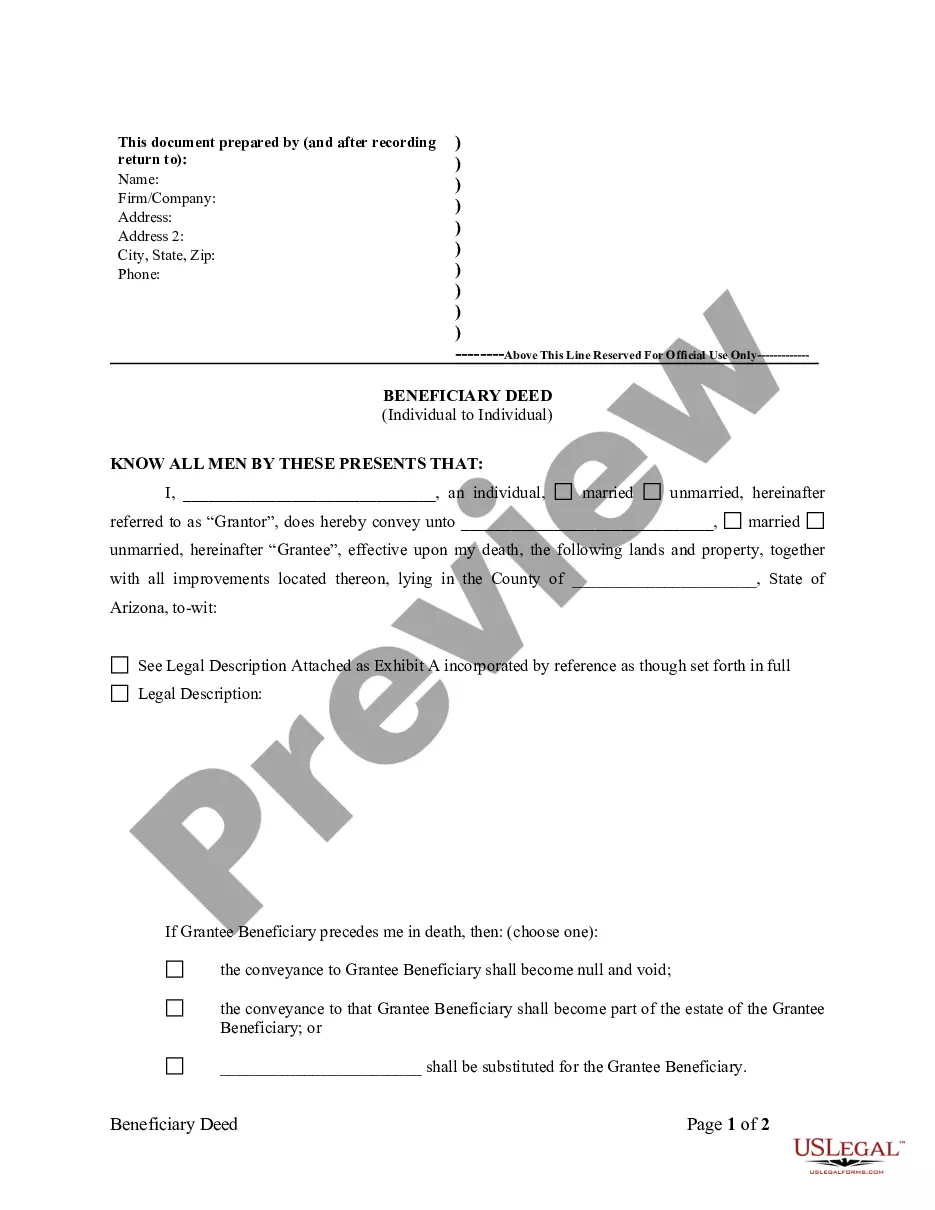
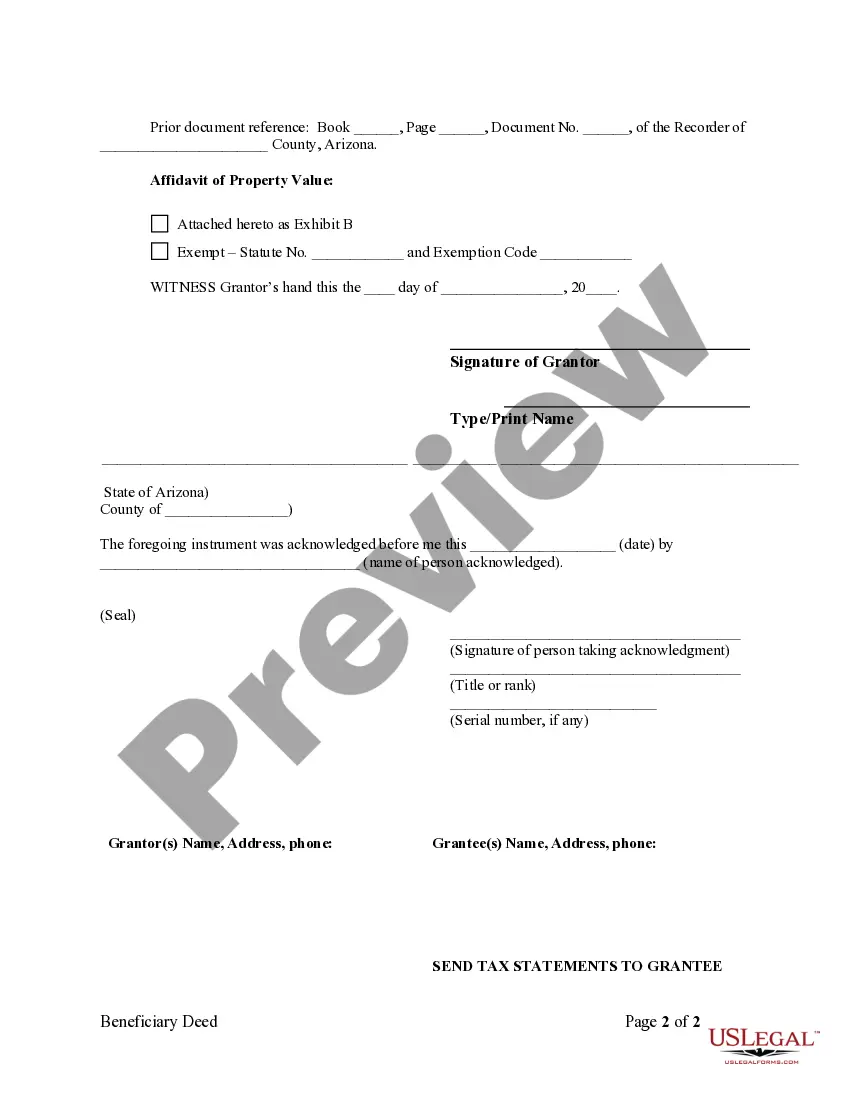
Arizona Beneficiary Deed With Life Estate
Description

Get your form ready online
Our built-in tools help you complete, sign, share, and store your documents in one place.
Make edits, fill in missing information, and update formatting in US Legal Forms—just like you would in MS Word.
Download a copy, print it, send it by email, or mail it via USPS—whatever works best for your next step.
Sign and collect signatures with our SignNow integration. Send to multiple recipients, set reminders, and more. Go Premium to unlock E-Sign.
If this form requires notarization, complete it online through a secure video call—no need to meet a notary in person or wait for an appointment.
We protect your documents and personal data by following strict security and privacy standards.

Make edits, fill in missing information, and update formatting in US Legal Forms—just like you would in MS Word.

Download a copy, print it, send it by email, or mail it via USPS—whatever works best for your next step.

Sign and collect signatures with our SignNow integration. Send to multiple recipients, set reminders, and more. Go Premium to unlock E-Sign.

If this form requires notarization, complete it online through a secure video call—no need to meet a notary in person or wait for an appointment.

We protect your documents and personal data by following strict security and privacy standards.
Looking for another form?

How to fill out Arizona Beneficiary Deed For Individual To Individual?
Managing legal documents and processes can be a lengthy enhancement to your overall day.
Arizona Beneficiary Deed With Life Estate and similar forms generally necessitate you to search for them and figure out how to fill them out accurately.
Consequently, if you are handling financial, legal, or personal matters, having a comprehensive and user-friendly online library of forms at your disposal will be incredibly beneficial.
US Legal Forms is the leading online platform for legal templates, providing over 85,000 state-specific forms along with various resources to help you complete your documents swiftly.
Is it your first time using US Legal Forms? Register and create a free account within a few minutes and you’ll get access to the form library and Arizona Beneficiary Deed With Life Estate. Then, follow the steps below to fill out your form: Be sure to confirm you have found the correct form by using the Preview option and reviewing the form details. Choose Buy Now when ready, and select the monthly subscription plan that works for you. Click Download then complete, sign, and print the document. US Legal Forms has twenty-five years of experience helping clients manage their legal documents. Find the form you need today and streamline any process without stress.
- Explore the collection of relevant documents available to you with just one click.
- US Legal Forms offers state- and county-specific forms accessible anytime for download.
- Safeguard your document management tasks with exceptional support that enables you to create any form within minutes without extra or concealed costs.
- Just Log In to your account, locate Arizona Beneficiary Deed With Life Estate and download it immediately from the My documents section.
- You can also access previously downloaded documents.
Form popularity
FAQ
A life estate is not transferable by will in the traditional sense. Instead, once a person passes away, the life estate automatically terminates, allowing the remainderman to gain full ownership. Therefore, if you want to pass on property using an Arizona beneficiary deed with life estate, it is advisable to designate beneficiaries while you are still alive.
While a beneficiary deed with life estate offers many advantages, it also has some disadvantages to consider. One potential drawback is that it does not avoid creditors, meaning your estate may still be subject to claims after your death. Additionally, once the deed is executed, you cannot change your mind, so it's vital to make this decision carefully.
Yes, a non-attorney can prepare a deed in Arizona, including the Arizona beneficiary deed with life estate. However, it is crucial to follow the state's legal requirements to ensure the deed is valid and enforceable. Consider using USLegalForms, which provides user-friendly templates and instructions to help non-attorneys create legally sound documents.
One effective way to leave property upon death is by using a beneficiary deed with life estate. This method allows you to transfer property directly to your chosen beneficiaries while retaining control during your lifetime. It's essential to ensure the deed is properly executed and recorded to guarantee a smooth transition after your passing.
To obtain a beneficiary deed in Arizona, begin by visiting the local county recorder's office. You will need to fill out the proper forms, which are often available online, and provide identifying information about the property and the beneficiaries. Utilizing USLegalForms can simplify this process, as they offer templates specifically designed for the Arizona beneficiary deed with life estate.
A life estate deed in Arizona allows an individual to retain the right to live in a property for their lifetime while transferring ownership to other beneficiaries after their death. This legal tool is particularly useful for estate planning, as it can help avoid probate and ensure smooth property transfer. By utilizing an Arizona beneficiary deed with life estate, you can maintain control during your lifetime while providing for your heirs.
Yes, an Arizona beneficiary deed with life estate typically takes precedence over a will. If a property is included in both a beneficiary deed and a will, the beneficiary deed controls the transfer of the property upon the owner’s death. It's essential to ensure that all estate planning documents are consistent to avoid confusion.
No, bank accounts with designated beneficiaries do not typically have to go through probate in Arizona. When the account holder passes away, the funds automatically transfer to the named beneficiaries, provided that they are correctly designated. This simplifies the transfer process and ensures quick access to funds without probate delays.
The best way to avoid probate in Arizona includes using an Arizona beneficiary deed with life estate, setting up a living trust, or naming beneficiaries on accounts like bank or retirement accounts. Each of these strategies can effectively transfer assets directly to your chosen individuals without going through the probate process. Choosing the right method depends on your specific circumstances and estates.
One disadvantage of an Arizona beneficiary deed with life estate is that the original owner cannot sell or mortgage the property without the consent of the beneficiaries. Additionally, if the beneficiaries face financial issues in the future, creditors may have claims against the property. This limitation can complicate financial planning and estate management.