Arkansas Deed Of Trust
Description
Get your form ready online
Our built-in tools help you complete, sign, share, and store your documents in one place.
Make edits, fill in missing information, and update formatting in US Legal Forms—just like you would in MS Word.
Download a copy, print it, send it by email, or mail it via USPS—whatever works best for your next step.
Sign and collect signatures with our SignNow integration. Send to multiple recipients, set reminders, and more. Go Premium to unlock E-Sign.
If this form requires notarization, complete it online through a secure video call—no need to meet a notary in person or wait for an appointment.
We protect your documents and personal data by following strict security and privacy standards.

Make edits, fill in missing information, and update formatting in US Legal Forms—just like you would in MS Word.

Download a copy, print it, send it by email, or mail it via USPS—whatever works best for your next step.

Sign and collect signatures with our SignNow integration. Send to multiple recipients, set reminders, and more. Go Premium to unlock E-Sign.

If this form requires notarization, complete it online through a secure video call—no need to meet a notary in person or wait for an appointment.

We protect your documents and personal data by following strict security and privacy standards.
Looking for another form?
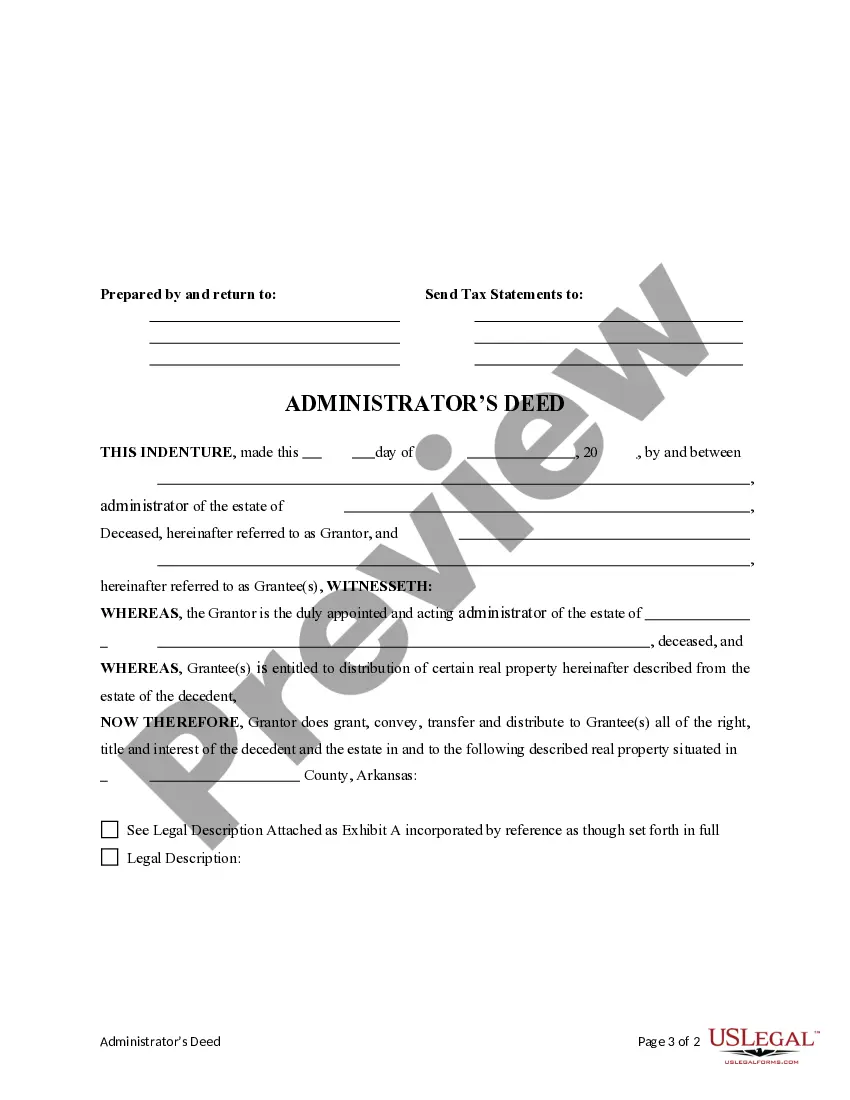
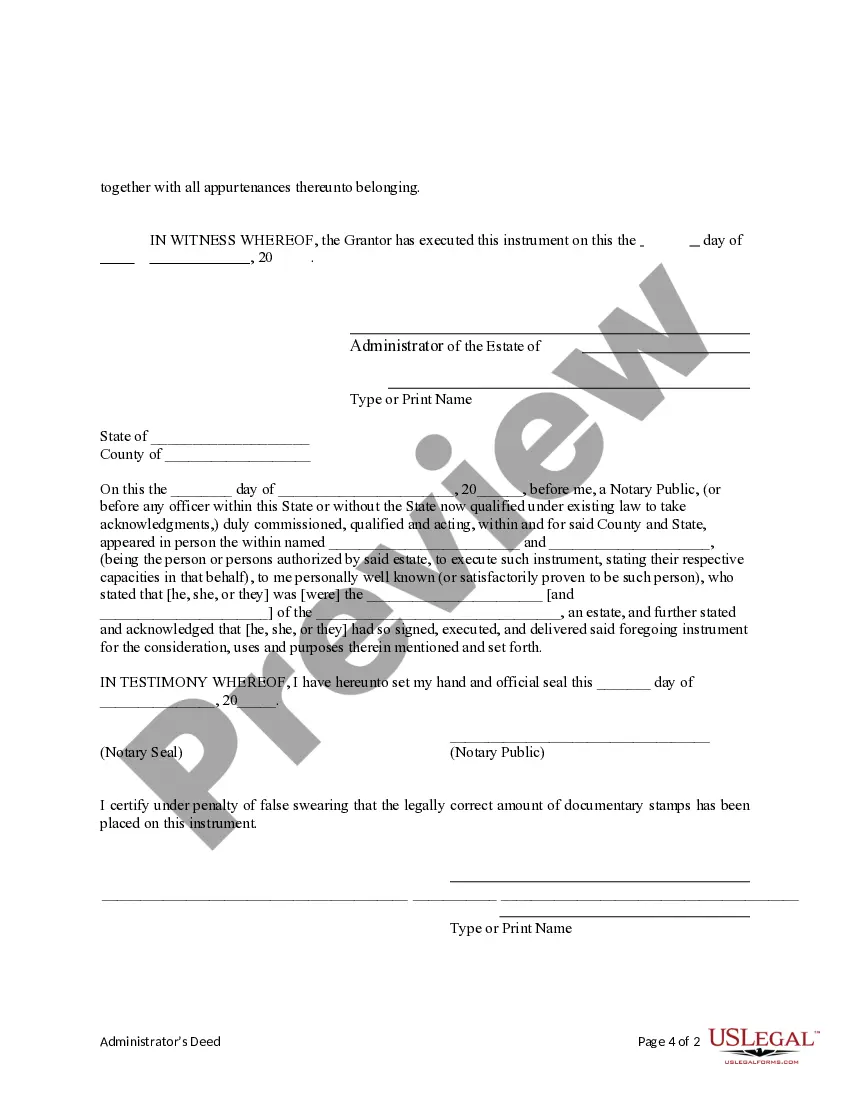
How to fill out Arkansas Administrator's Deed Distributing Real Property To Beneficiaries Of Estate?
When you need to complete the Arkansas Deed of Trust that adheres to your local state's laws and regulations, there can be several choices to select from.
You don't have to review every form to ensure it meets all the legal requirements if you are a US Legal Forms subscriber.
It is a trustworthy source that can assist you in obtaining a reusable and current template on any topic.
Acquiring well-crafted formal documents is made effortless with US Legal Forms. Moreover, Premium users can also take advantage of the strong integrated tools for online PDF editing and signing. Give it a try today!
- US Legal Forms is the most extensive online directory with a collection of over 85k ready-to-use documents for business and personal legal needs.
- All templates are verified to comply with each state's laws and regulations.
- Consequently, when downloading the Arkansas Deed of Trust from our site, you can be assured that you hold a valid and recent document.
- Obtaining the necessary sample from our platform is quite simple.
- If you already possess an account, just Log In to the system, ensure your subscription is active, and save the selected file.
- Subsequently, you can access the My documents tab in your profile and retrieve the Arkansas Deed of Trust at any time.
- If this is your first interaction with our library, please follow the instructions below.
- Review the suggested page and check it for alignment with your standards.
Form popularity
FAQ
An example of a declaration of trust could involve a parent setting up a trust for their child's education. The parent would name themselves as the trustee, specify the child as the beneficiary, and outline how funds from the trust will be distributed for education-related expenses. When drafting such a document, incorporating an Arkansas deed of trust may provide additional legal protection for the assets involved.
To create a declaration of trust, you should start by determining your goals for the trust and identifying the assets to be included. Following this, draft the document specifying the trustee, beneficiaries, and distribution instructions. For those unfamiliar with legal language, using platforms like US Legal Forms can simplify this process and ensure compliance, especially when detailing the Arkansas deed of trust.
A valid declaration of a trust typically includes essential components such as the intent to create the trust, the identification of the trustee, the description of the trust assets, and the beneficiaries. In Arkansas, an Arkansas deed of trust also needs to conform to state-specific requirements, ensuring that the document is legally enforceable. Always ensure your declaration is clear and unambiguous to avoid future disputes.
A trust declaration is a legal document that creates a trust, outlining how the trust assets will be managed and distributed. In the context of an Arkansas deed of trust, this document serves to clarify the intentions of the parties involved. It typically names the trustee, the beneficiaries, and describes the property or assets held in trust.
The time it takes to obtain a land deed in Arkansas can vary, but typically it is processed within a few weeks. Once the necessary paperwork is complete and filed, it will be recorded by the county office. However, if you need a copy, you may need to allow additional time for processing and delivery.
Arkansas is primarily a deed of trust state, meaning that most real estate transactions utilize a deed of trust instead of a traditional mortgage. This method allows for a streamlined foreclosure process in case of default. Understanding this distinction is important for borrowers when navigating financing options.
If you need to obtain the deed to your property in Arkansas, you can start by visiting the county assessor's or clerk's office where the property is located. You can request a copy of your property deed through their records. Additionally, online platforms like USLegalForms can help simplify the process by providing templates and resources for your convenience.
To obtain a deed of trust in Arkansas, first, you should contact a local lender or mortgage company. They will provide the necessary paperwork and guidance throughout the process. Once completed, the deed of trust will be recorded by the county clerk to officially document the transaction.
A trust is a legal arrangement where one party holds property for the benefit of another, while a trust deed specifically refers to a document used in real estate transactions in Arkansas. The Arkansas deed of trust secures the lender's interest in the property, whereas a general trust manages various assets. Understanding this distinction is crucial for proper asset management.
The choice between a deed of trust and a mortgage often depends on individual circumstances and preferences. A deed of trust can offer faster foreclosure processes and clearer terms, which some may find advantageous. However, it's crucial to evaluate your specific situation before deciding, and consulting resources like USLegalForms can provide you with the right information on the Arkansas deed of trust to aid in your decision.