Transfer On Death Deed With Mortgage Example
Description

Get your form ready online
Our built-in tools help you complete, sign, share, and store your documents in one place.
Make edits, fill in missing information, and update formatting in US Legal Forms—just like you would in MS Word.
Download a copy, print it, send it by email, or mail it via USPS—whatever works best for your next step.
Sign and collect signatures with our SignNow integration. Send to multiple recipients, set reminders, and more. Go Premium to unlock E-Sign.
If this form requires notarization, complete it online through a secure video call—no need to meet a notary in person or wait for an appointment.
We protect your documents and personal data by following strict security and privacy standards.

Make edits, fill in missing information, and update formatting in US Legal Forms—just like you would in MS Word.

Download a copy, print it, send it by email, or mail it via USPS—whatever works best for your next step.

Sign and collect signatures with our SignNow integration. Send to multiple recipients, set reminders, and more. Go Premium to unlock E-Sign.

If this form requires notarization, complete it online through a secure video call—no need to meet a notary in person or wait for an appointment.

We protect your documents and personal data by following strict security and privacy standards.
Looking for another form?








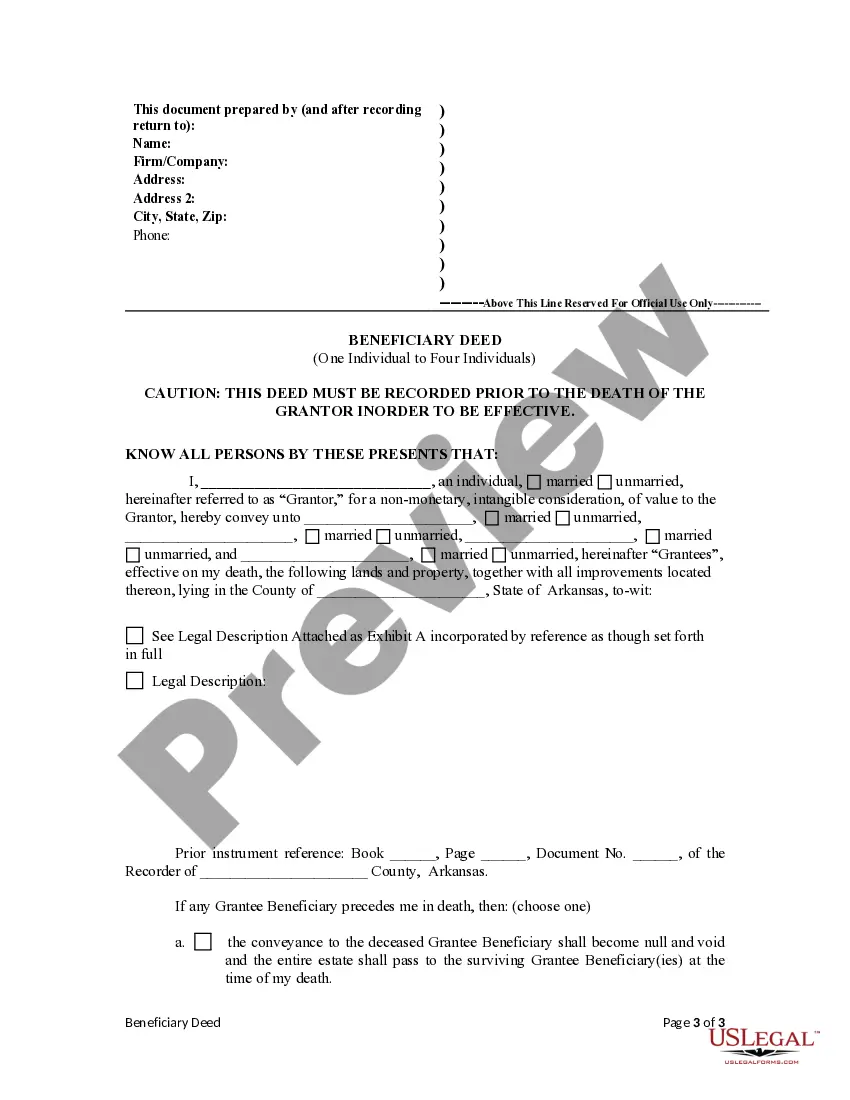
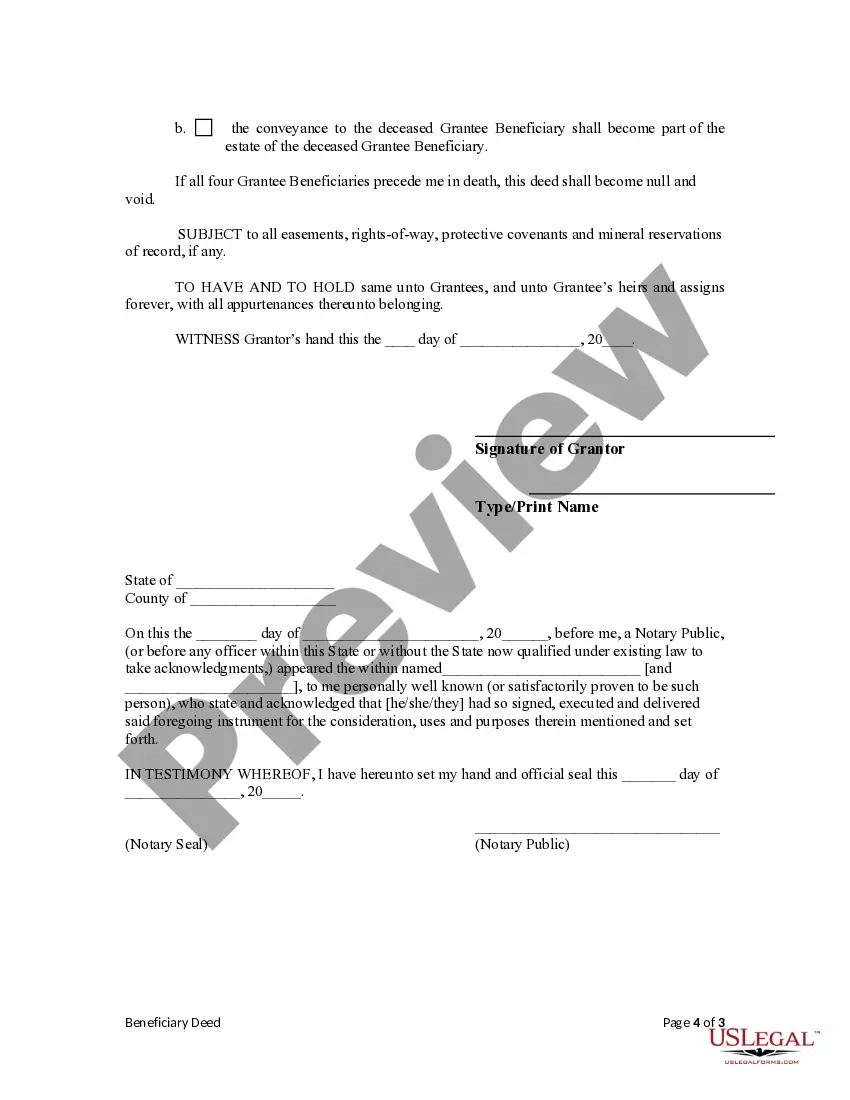
How to fill out Arkansas Transfer On Death Deed Or TOD - Beneficiary Deed For One Individual To Four Individuals?
- If you are a returning user, log in to your US Legal Forms account to download the desired template. Confirm that your subscription is valid; if not, renew it according to your preferred payment plan.
- For first-time users, begin by exploring the preview mode and reading the form's description to ensure it meets your specific needs and local jurisdiction requirements.
- If you need to, utilize the search feature at the top to find the correct template and check for any inconsistencies.
- To purchase the document, click on the 'Buy Now' button, select the subscription plan that best suits you, and register an account for access to additional resources.
- Complete your purchase by entering your payment details, using either a credit card or PayPal for your subscription.
- Download your form and save it on your device. You can access it later through the 'My Forms' section in your profile.
By following these straightforward steps, you can effectively prepare your transfer on death deed while benefiting from US Legal Forms' extensive resources.
Take the first step today; access US Legal Forms to streamline your legal documentation process!
Form popularity
FAQ
A Transfer on Death deed can sometimes be viewed unfavorably due to potential complications. For instance, if beneficiaries have differing interests in the property, disputes may arise after your passing. Furthermore, while it avoids probate, it does not necessarily shield the property from creditors or lawsuits. Always weigh these considerations thoughtfully, and explore how a US Legal Forms platform can provide answers tailored to a TOD deed with mortgage example.
Leaving property upon death can be accomplished through various means, but a Transfer on Death deed is often considered a simple and effective option. By using a TOD deed with mortgage example, you can ensure that your property transfers directly to your chosen beneficiary without the hassle of probate. This method can also make the process smoother for your loved ones at a difficult time. Consider consulting with an expert to determine the most beneficial approach for your unique situation.
Yes, mortgages can be transferable upon death, but it normally depends on the terms of the mortgage agreement. When you use a Transfer on Death deed, the mortgage usually continues under the new owner, requiring them to keep up with the payments. Therefore, it’s essential to discuss your options and obligations with a legal expert. A Transfer on death deed with mortgage example can clarify how this works in your situation.
The major disadvantages of a Transfer on Death deed include the potential transfer of mortgage debt to the beneficiary and lack of control over future property management. If the beneficiary cannot manage the mortgage or related costs, it can lead to financial strain. Understanding these factors through a Transfer on death deed with mortgage example can help you make informed decisions.
A Transfer on Death (TOD) deed can create complications if the property has a mortgage. The mortgage liability typically transfers to the beneficiary upon your death. This means that heirs may face financial burdens with existing loans. Therefore, it's crucial to consider your options and consult with a professional to understand how a Transfer on death deed with mortgage example may affect you.
A transfer on death deed does not automatically exempt heirs from inheritance tax. The assets passed through a TOD may still be subject to state inheritance taxes, depending on local laws. It is wise to review your state’s regulations regarding inheritance tax to ensure you understand your obligations. Platforms like US Legal Forms can provide clarity on how a transfer on death deed with mortgage example affects your estate planning strategy.
While a transfer on death deed is convenient, it has potential downsides. One primary concern is that it may not supersede certain debts secured by the property, such as mortgages or liens. Additionally, if the property owner becomes incapacitated, the TOD does not offer the same benefits as a living trust, which allows someone to manage your affairs. Exploring your options, including a TOD with mortgage implications, is essential.
A transfer on death deed (TOD) does not inherently avoid capital gains tax when the property is sold after the owner's death. The basis of the property usually carries over to the heirs, meaning they may owe capital gains tax if the property appreciates in value. Understanding how a TOD works can help you plan for these tax implications effectively. Consider consulting legal resources, such as US Legal Forms, for more detailed insights.
A Transfer on Death deed and a will serve different purposes in estate planning, each with its strengths. A TOD deed allows for a quick transfer of property outside of probate, which can save time and costs associated with a will. However, a will encompasses all aspects of an individual's estate and can address additional concerns, such as guardianship or debts. Using US Legal Forms can help compare these options and guide you in making the best choice for your needs.
When a Transfer on Death deed is in place, the existing mortgage continues to be the responsibility of the estate or beneficiary. The beneficiary typically inherits the property subject to the mortgage, which means they may need to continue making payments. It is essential to communicate with the mortgage lender to understand their policies. US Legal Forms provides resources that can help navigate these situations and ensure a smooth transfer.