Transfer On Death Deed For Vehicles
Description

Get your form ready online
Our built-in tools help you complete, sign, share, and store your documents in one place.
Make edits, fill in missing information, and update formatting in US Legal Forms—just like you would in MS Word.
Download a copy, print it, send it by email, or mail it via USPS—whatever works best for your next step.
Sign and collect signatures with our SignNow integration. Send to multiple recipients, set reminders, and more. Go Premium to unlock E-Sign.
If this form requires notarization, complete it online through a secure video call—no need to meet a notary in person or wait for an appointment.
We protect your documents and personal data by following strict security and privacy standards.

Make edits, fill in missing information, and update formatting in US Legal Forms—just like you would in MS Word.

Download a copy, print it, send it by email, or mail it via USPS—whatever works best for your next step.

Sign and collect signatures with our SignNow integration. Send to multiple recipients, set reminders, and more. Go Premium to unlock E-Sign.

If this form requires notarization, complete it online through a secure video call—no need to meet a notary in person or wait for an appointment.

We protect your documents and personal data by following strict security and privacy standards.
Looking for another form?








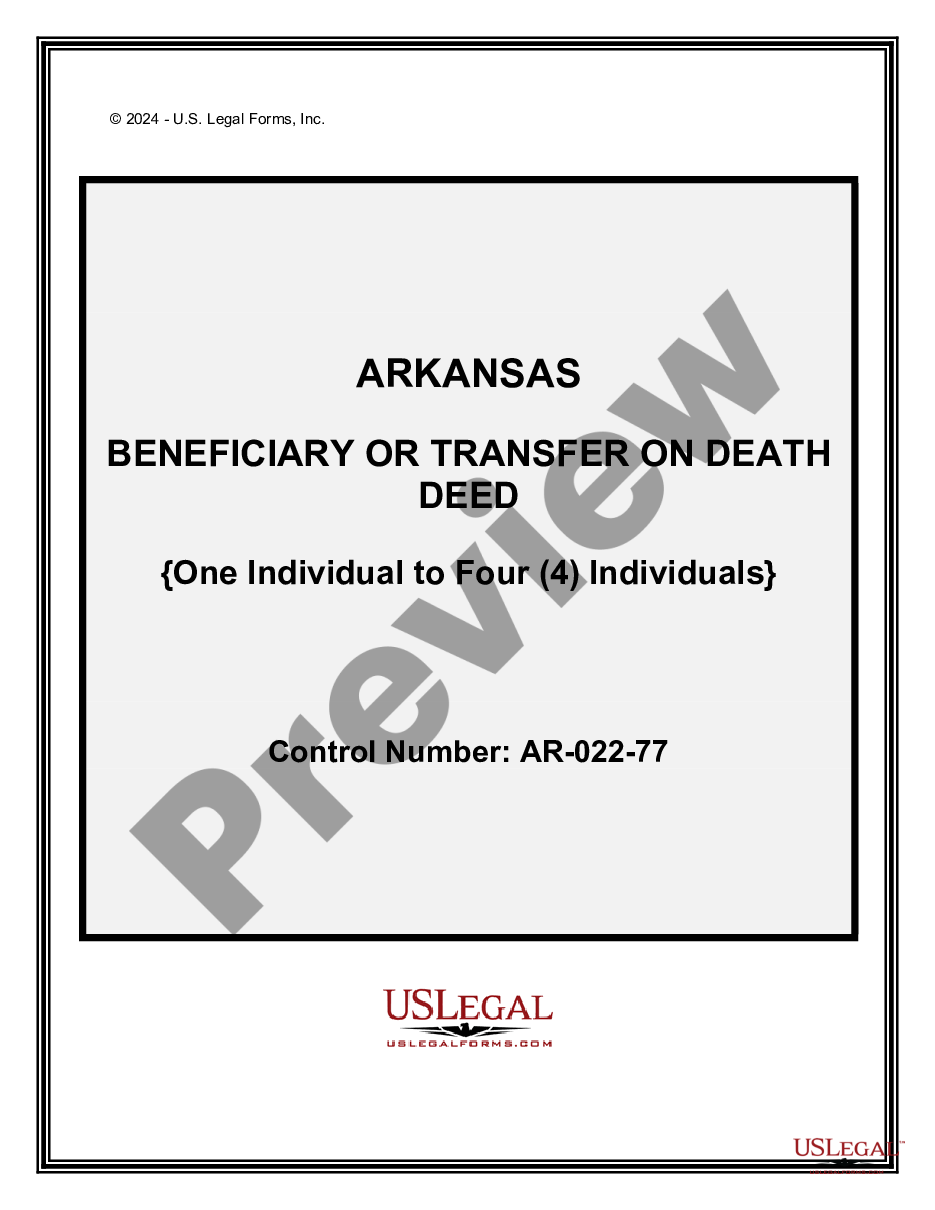
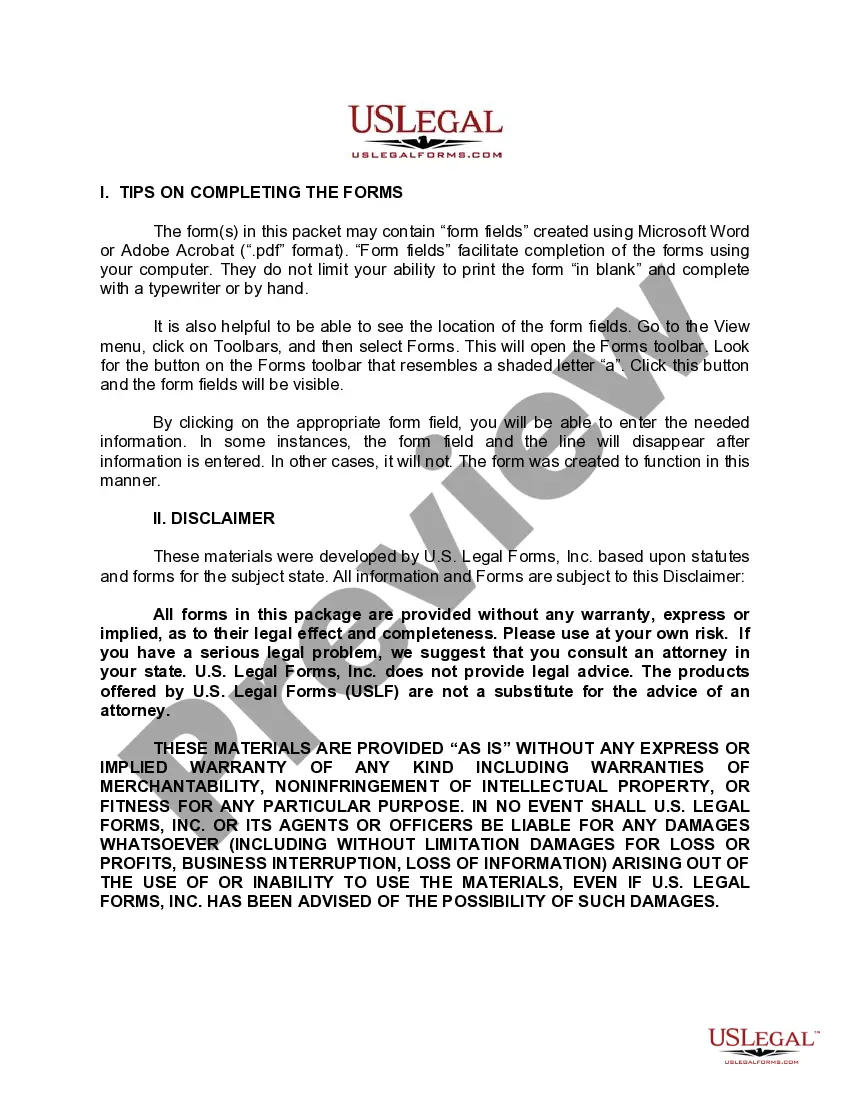
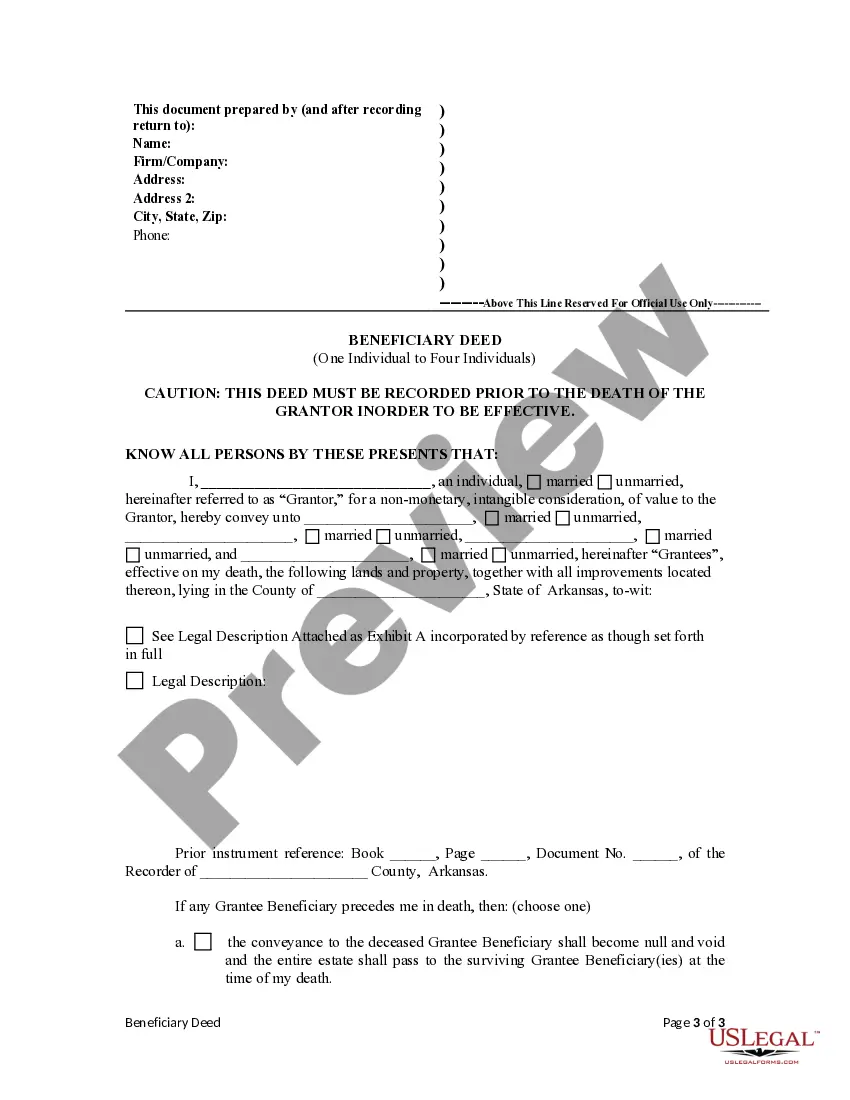
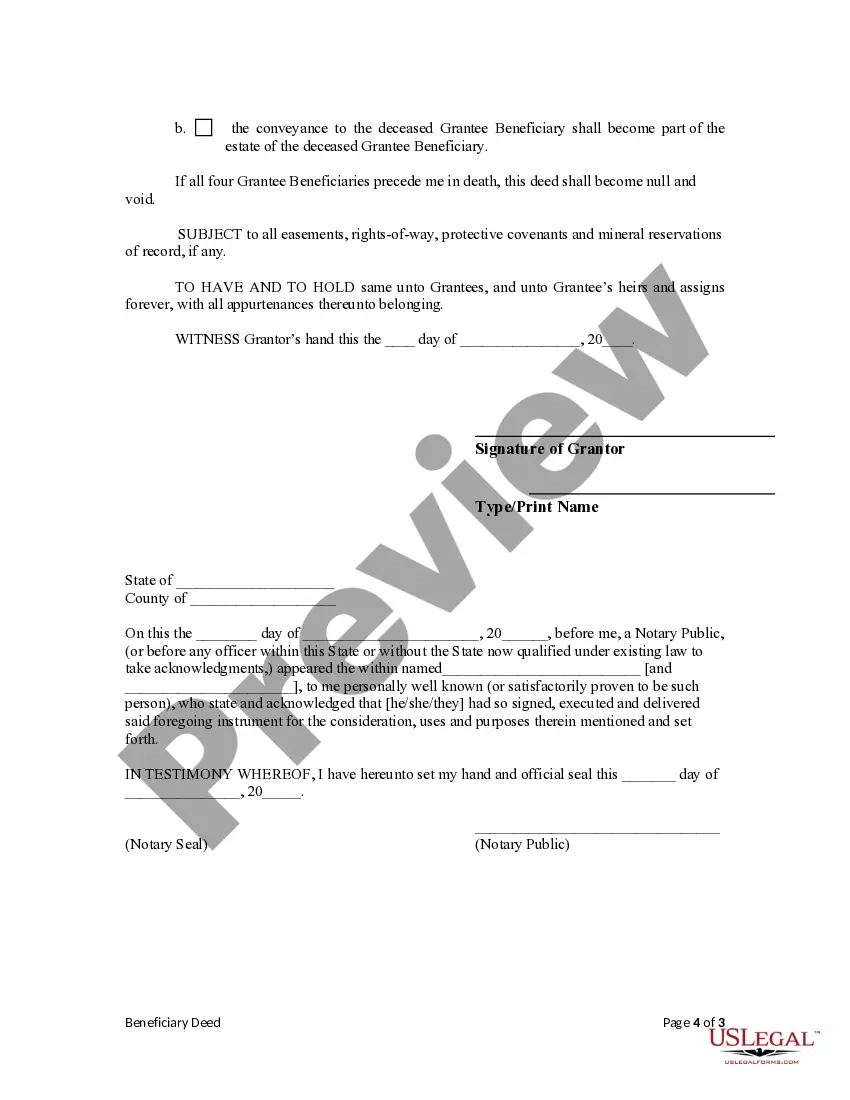
How to fill out Arkansas Transfer On Death Deed Or TOD - Beneficiary Deed For One Individual To Four Individuals?
- If you're a returning user, log in to your account and access the form template you need by clicking on the Download button. Ensure your subscription is current; renew if necessary.
- For first-time users, explore the Preview mode and form description to confirm you have selected the form that best suits your needs based on your local regulations.
- If the form doesn’t meet your requirements, use the Search tab at the top to find another suitable template.
- Once you locate the right document, click the Buy Now button and select the subscription plan that fits your needs, making sure to register an account for full access.
- Complete your purchase by entering your credit card information or using your PayPal account.
- Finally, download your form to your device for completion, which you can access later through the My Forms section.
US Legal Forms offers a vast collection of over 85,000 legal documents, more than many competitors, providing the necessary resources to execute legal matters efficiently.
With access to premium experts, you can ensure your TOD deed for vehicles is accurately completed, offering you and your beneficiaries legal security. Start your journey of securing your assets today!
Form popularity
FAQ
A transfer on death deed for vehicles in Texas allows the owner to designate a beneficiary who will inherit the vehicle upon the owner's death. The owner retains full control of the vehicle during their lifetime, including the right to sell or change the beneficiary. Upon death, the beneficiary must present a death certificate and the recorded deed to transfer ownership. It's a convenient way to ensure the smooth passage of your vehicle to your chosen person.
Yes, a transfer on death deed for vehicles helps avoid probate in Texas. When the vehicle owner passes, the vehicle transfers directly to the named beneficiary without going through the lengthy probate process. This means that your loved ones can gain ownership quickly and easily, reducing the burden during an already challenging time. Utilizing this option can provide significant peace of mind.
In Texas, the transfer on death deed for vehicles must be executed while the owner is alive and competent. The owner must clearly name the beneficiary and provide necessary vehicle identification details. Importantly, this deed must be recorded with the local county clerk to be effective. Be sure to follow all legal requirements to ensure your transfer is valid and smooth.
While a transfer on death deed for vehicles offers a straightforward way to transfer ownership, it has some disadvantages. One major drawback is that it does not remove the vehicle from the deceased's estate, which may still subject it to estate taxes and claims. Additionally, if the beneficiary has financial issues, creditors might claim the vehicle, affecting the transfer. Therefore, it's important to consider these risks when using this method.
Transfers on death deeds are indeed legal in Florida. They allow for the seamless transfer of property, including vehicles, after the owner's death. For a streamlined process, you can use platforms like US Legal Forms to draft and file the necessary documents, ensuring compliance with Florida law.
Yes, a next of kin can usually sell a car belonging to a deceased individual, but certain conditions must be met. If there is no transfer on death deed for vehicles in place, the next of kin may need to go through the probate process to establish their right to sell the vehicle. This often requires documentation proving their relationship to the deceased.
One disadvantage of a transfer on death deed for vehicles is that it does not avoid probate for any debts associated with the vehicle. Moreover, if the beneficiary is not able to accept the vehicle, ownership will revert to the estate. Therefore, careful planning is essential to fully understand implications for your estate during this process.
When a mother dies, the car ownership typically transfers to the heirs. If the vehicle is not part of a trust or estate, a transfer on death deed for vehicles can facilitate the direct transfer of the title. This process helps avoid lengthy probate proceedings, making it easier for family members to claim the vehicle.
Yes, you can transfer the title of a car after the owner dies in Florida. Typically, heirs must provide a death certificate and proof of their relationship to the deceased. Utilizing a transfer on death deed for vehicles simplifies this process, ensuring a smooth transition of ownership.
Assets that typically do not go through probate include those held in joint ownership, assets with a transfer on death deed for vehicles, and assets held in trust. These designations allow for the direct transfer of ownership upon death, simplifying the process for your loved ones. By planning ahead, you can help your beneficiaries avoid the hassles associated with probate.